
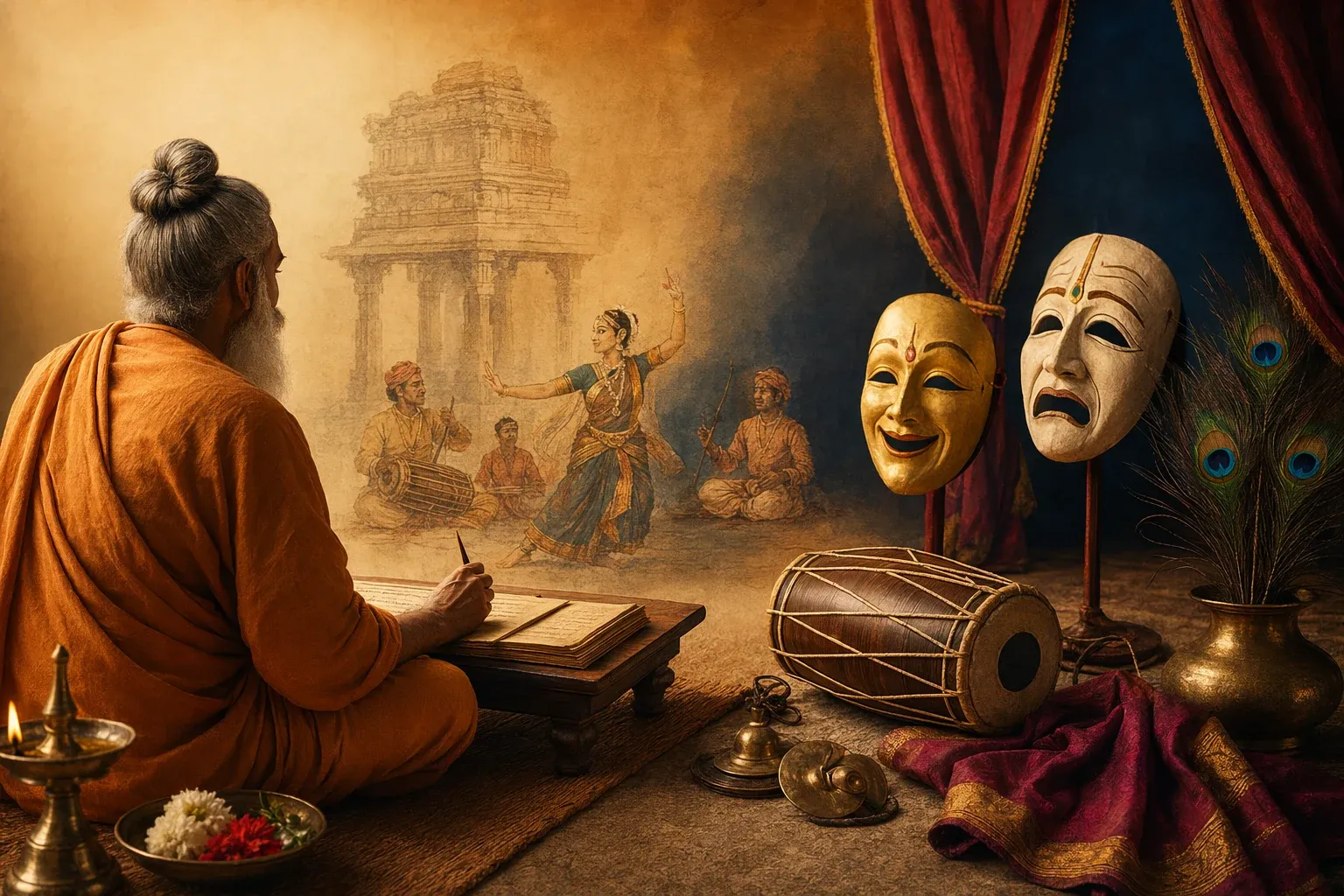
When people ask “Who is the father of Indian theatre?”, the honest answer is not a single, flat name. It depends on what the question means. If we are speaking about the classical theory of Indian drama, the name most strongly connected with the foundation is Bharata Muni, the sage traditionally associated with the Nāṭya Śāstra. If we are speaking about modern Indian theatre training and stage practice, many readers also meet the name Ebrahim Alkazi, the legendary director and teacher linked with the National School of Drama.
So the better answer is this: Bharata Muni is usually remembered as the foundational figure of Indian dramatic theory, while Ebrahim Alkazi is one of the most important makers of modern Indian theatre. Both matter, but they belong to different periods and different meanings of “father”. Mixing them up makes Indian theatre look simpler than it really is.
Bharata Muni and the foundation of dramatic thought
Bharata Muni’s importance comes from the Nāṭya Śāstra, a Sanskrit treatise on performance. The text is traditionally attributed to him and is usually placed by scholars somewhere in the broad ancient period, with estimates varying across centuries. It is not a small handbook about acting. It is a large work on drama, dance, music, stagecraft, emotion, costume, gesture, and the experience of the audience.
For a young reader, the easiest way to understand its importance is to imagine an ancient performing-arts manual that does not treat theatre as only entertainment. It asks: How should a stage be made? How does an actor move? What is the role of music? How does a performance create rasa, the felt flavour or emotional experience in the audience? That is why Bharata Muni is not just a name from a textbook. He represents an early Indian attempt to think seriously about art, emotion, training, discipline, and society.
Drama, dance, music, and rasa belonged together
In many modern minds, theatre, dance, and music sit in separate boxes. The Indian classical imagination was often more connected. A dramatic performance could include speech, movement, rhythm, song, costume, make-up, and symbolic gesture. The Nāṭya Śāstra discusses these as parts of one performance world.
The idea of rasa is especially famous. A play does not simply show anger, love, courage, fear, or wonder. It shapes those emotions artistically so the audience can experience them at a deeper level. That is why Indian dramatic theory became influential beyond theatre alone. It touched poetics, dance traditions, music, and later commentaries on aesthetics.
Why “father of Indian theatre” can be confusing
The phrase “father of Indian theatre” is popular because it is short and easy to remember. But Indian theatre is not a single straight road. It includes Sanskrit drama, regional theatre, folk performance, temple-linked forms, storytelling traditions, colonial-era proscenium theatre, political street theatre, and modern experimental performance. A Sanskrit scholar, a folk performer, a Parsi theatre entrepreneur, and an NSD-trained director may all be part of the same larger story, but they are not doing the same work.
That is why Bharata Muni should be understood as the foundational figure of Indian dramaturgy rather than as the only person who “created” Indian theatre. Indian performance traditions grew through many communities and languages. Kerala’s Kutiyattam, Marathi Sangeet Natak, Bengali theatre, Hindi theatre, Parsi theatre, Yakshagana, Tamasha, Jatra, Nautanki, and many other forms have their own histories and heroes.
Where Ebrahim Alkazi fits in
Ebrahim Alkazi belongs to the modern chapter. Born in 1925, he became one of India’s most respected theatre directors and teachers. He directed major productions, taught generations of actors and theatre workers, and served as director of the National School of Drama from 1962 to 1977. The NSD itself was set up in 1959 by the Sangeet Natak Akademi and later became an autonomous institution supported by India’s Ministry of Culture.
Alkazi is remembered for discipline, design, scale, and professional training. Productions associated with him include plays such as Dharamvir Bharati’s Andha Yug, Mohan Rakesh’s Ashadh Ka Ek Din, and Girish Karnad’s Tughlaq. He also used historic and open-air spaces in powerful ways, showing that modern Indian theatre could be visually bold without losing intellectual seriousness.
Ancient theory and modern practice are not rivals
It is tempting to turn Bharata Muni and Alkazi into competing answers. That is not necessary. Bharata Muni stands at the level of classical theory: the language of performance, emotion, and dramatic structure. Alkazi stands at the level of modern institution-building, directing, pedagogy, and stage professionalism. One helps us understand how Indian performance was thought about in the ancient world. The other helps us understand how theatre was trained and staged in modern India.
This distinction is useful because it respects both tradition and history. Tradition remembers Bharata Muni as the sage of nāṭya. Historical study asks when texts were compiled, how they circulated, and how performance communities used or transformed ideas. Modern theatre history studies institutions, directors, actors, playwrights, audiences, and spaces. A good answer should hold all three levels together.
A simple way to remember the answer
If an exam or general knowledge question asks for the father of Indian drama or Indian theatre in the classical sense, Bharata Muni is the safest answer, because of the Nāṭya Śāstra. If the discussion is about modern Indian theatre education, the National School of Drama, or twentieth-century stage direction, Ebrahim Alkazi is a major name to know.
The deeper lesson is even better: Indian theatre has never been just one person’s achievement. It is a living ecosystem of writers, performers, singers, musicians, craftspeople, teachers, communities, and audiences. Bharata Muni gives us one of the oldest theoretical windows into that ecosystem. Alkazi shows how modern India rebuilt theatre training with seriousness and ambition. Together, they help us see Indian theatre as both ancient and alive.
Who is called the father of Indian theatre?
Bharata Muni is commonly linked with the title in the classical sense because the Nāṭya Śāstra, attributed to him, is one of the foundational texts of Indian dramatic theory.
Why is Ebrahim Alkazi important in Indian theatre?
Ebrahim Alkazi is important because he shaped modern theatre training and direction in India, especially through his long association with the National School of Drama and his influential productions.