
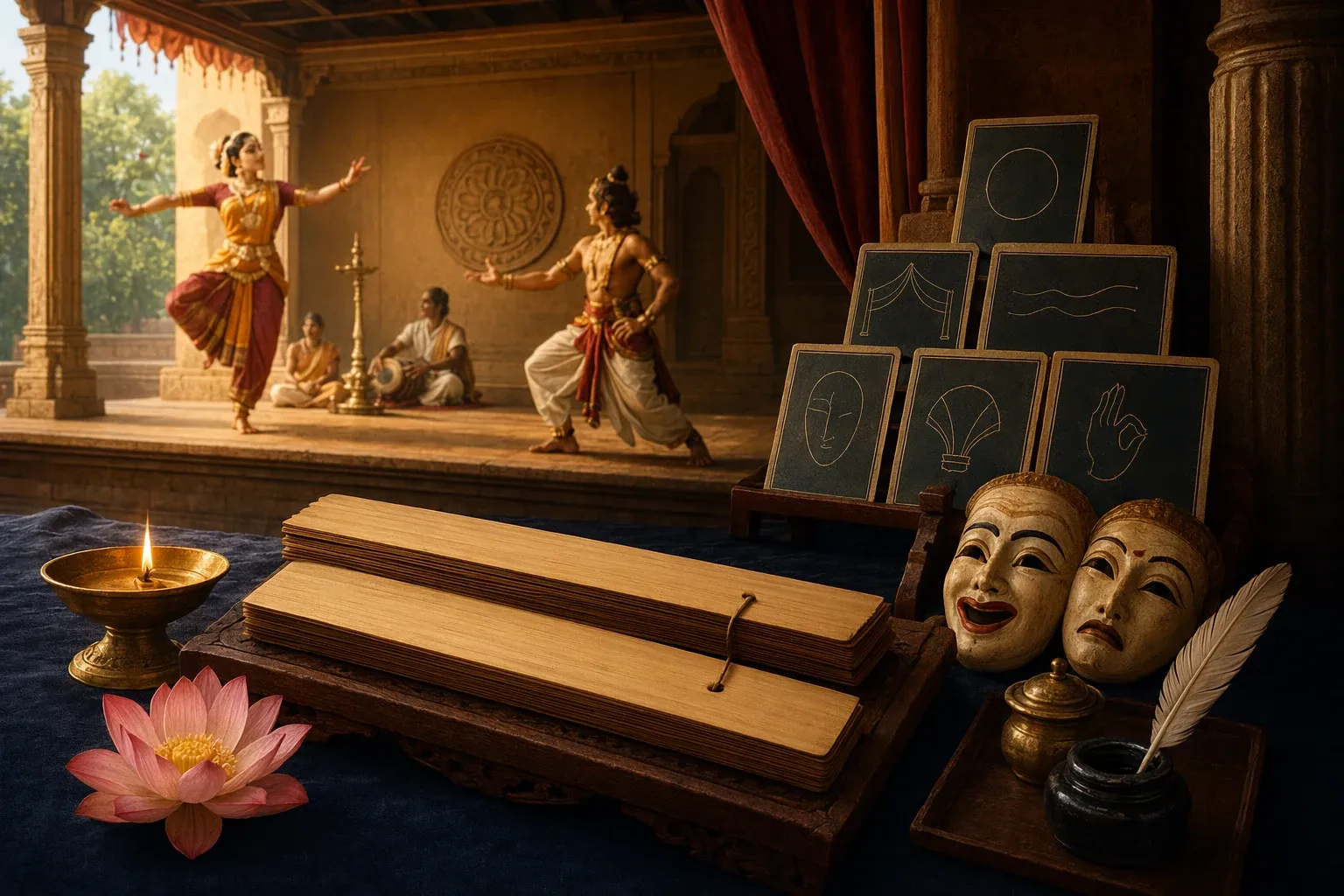
Sanskrit theatre is the classical drama tradition connected with the Sanskrit language and the wider world of ancient Indian performance. It includes plays, acting theory, music, gesture, poetry, stage conventions, and ideas about emotion. For many beginners, it is easiest to remember Sanskrit theatre as the refined dramatic world behind names such as Bharata Muni, the Natya Shastra, Kalidasa, Bhasa, Shudraka, Bhavabhuti, and the living Kerala tradition of Kutiyattam.
For context around performance theory and related traditions, pair this guide with Natya Shastra and Indian performing arts, Indian theatre basics, history of Indian theatre, Indian classical dance, and Kuchipudi dance-drama so the ideas of rasa, abhinaya, drama, dance-drama and Indian performance history sit together naturally.
This does not mean every Indian performance in the past was in Sanskrit. India has always been multilingual. But Sanskrit drama became one of the most influential classical models for thinking about theatre, just as Sanskrit shaped many fields of poetry, ritual, grammar, philosophy, and aesthetics.
The ancient language clue
When people ask which Indian theatre is named after an ancient Indian language, the answer is Sanskrit theatre. The name points to language, but the tradition is larger than language alone. A Sanskrit play may include different registers, poetic verse, prose dialogue, stage directions, song-like passages, and characters who speak Sanskrit or Prakrit depending on convention, class, gender, and dramatic role.
So a beginner should not imagine Sanskrit theatre as a dry recitation of difficult words. Its purpose was performance. The audience was meant to experience love, humour, courage, wonder, compassion, fear, anger, disgust, peace, and other emotional moods through acting, music, poetry, gesture, costume, and dramatic situation.
Bharata Muni and the Natya Shastra
Bharata Muni is often called the father of Indian drama because the Natya Shastra, traditionally associated with him, is one of the foundational texts for Indian performing arts. It discusses drama, acting, stage space, gesture, music, dance, character types, emotional experience, and performance discipline. Scholars debate dates and layers of the text, so it is better to say it belongs to the broad ancient classical world rather than force one simple year.
The most famous idea connected with the Natya Shastra is rasa, the aesthetic flavour or emotional relish experienced by the audience. A good performance is not only about plot. It helps the viewer feel a refined emotional state. Abhinaya, or expression, is also central: the performer communicates through body, speech, costume, and inner feeling.
Famous playwrights and plays
Several Sanskrit playwrights became part of India’s literary memory. Kalidasa is celebrated for Abhijnanashakuntalam, often called Shakuntala in English discussions, along with plays such as Vikramorvashiyam and Malavikagnimitram. Bhasa is associated with plays such as Svapnavasavadattam and Urubhangam, though questions of date and authorship are discussed by scholars. Shudraka’s Mricchakatika, known as The Little Clay Cart, is famous for its lively urban world and memorable characters. Bhavabhuti is remembered for works such as Uttararamacharita and Malatimadhava.
These plays do not all feel the same. Some are romantic, some heroic, some political, some devotional, some full of courtly elegance, and some surprisingly human in their treatment of longing, danger, duty, and weakness. That range is important because “ancient drama” can sound distant, but many themes remain recognisable.
Kutiyattam shows the tradition still breathes
The strongest living example connected with Sanskrit theatre is Kutiyattam in Kerala. UNESCO describes Kutiyattam as one of India’s oldest living theatrical traditions, practised in Kerala and representing a synthesis of Sanskrit classicism with local Kerala traditions. It is traditionally performed in Kuttampalams, temple theatres, and gives great importance to eye expression and hand gestures.
Kutiyattam also teaches patience. A single act may be elaborated for days, and a complete performance may last far longer than a modern theatre audience expects. Actors undergo long training in breathing, facial control, subtle movement, and interpretation. This reminds us that Sanskrit theatre is not just printed literature; it is embodied knowledge.
The stage was symbolic, not cinematic
Ancient Indian drama did not try to copy reality exactly the way a camera does. A forest, palace, journey, battle, curse, memory, or divine meeting could be suggested through words, gesture, costume, music, and convention. The audience understood the language of signs. This symbolic style makes the performance imaginative rather than poor or incomplete.
For example, a character’s entrance, costume, gait, and speech can reveal status before the plot explains it. A glance can carry love, shame, doubt, anger, or recognition. A gesture can stand for an action too large or delicate to show literally. The theatre trusts the audience to participate with imagination.
Tradition, interpretation, and history
In tradition, Sanskrit theatre is often linked with divine origin stories of natya and with the idea that performance can teach, delight, and refine people. In interpretation, readers may study rasa, dharma, kingship, gender, love, humour, and power through the plays. In historical context, scholars study manuscripts, inscriptions, commentaries, regional performance lineages, and the long relationship between Sanskrit and other Indian languages.
Keeping these layers separate helps avoid confusion. A traditional story about the origin of theatre is meaningful within culture, but it is not the same as archaeological dating. A modern stage production of Shakuntala may be beautiful, but it is not identical to how a court or temple audience experienced drama centuries ago. Both can be valuable if we are clear about context.
Why Sanskrit theatre matters today
Sanskrit theatre matters because it shaped Indian ideas of performance. Dance, music, acting, literature, aesthetics, temple arts, and modern theatre all carry echoes of its vocabulary. When a Bharatanatyam dancer speaks of abhinaya, when a theatre student studies rasa, or when a director stages Kalidasa or Bhasa in a modern language, the old tradition enters the present.
For a young reader, the best entry point is not to memorise every date. Start with three ideas: Sanskrit theatre is classical Indian drama; the Natya Shastra gives a major theory of performance; Kutiyattam shows that the tradition is not dead. From there, the subject becomes less intimidating and much more alive.
Frequently asked questions
Which Indian theatre is named after an ancient Indian language?
Sanskrit theatre is the theatre tradition named after the ancient Sanskrit language. It refers to classical Indian drama connected with Sanskrit plays, acting theory, rasa, abhinaya, and performance conventions.
Who is called the father of Indian drama?
Bharata Muni is often called the father of Indian drama because the Natya Shastra, associated with him in tradition, became a foundational text for Indian theatre, dance, music, and performance theory.
Is Sanskrit theatre still performed?
Yes, most notably through Kutiyattam in Kerala, a living Sanskrit theatre tradition recognised by UNESCO. Sanskrit plays are also adapted and staged by modern theatre groups in different languages and styles.