
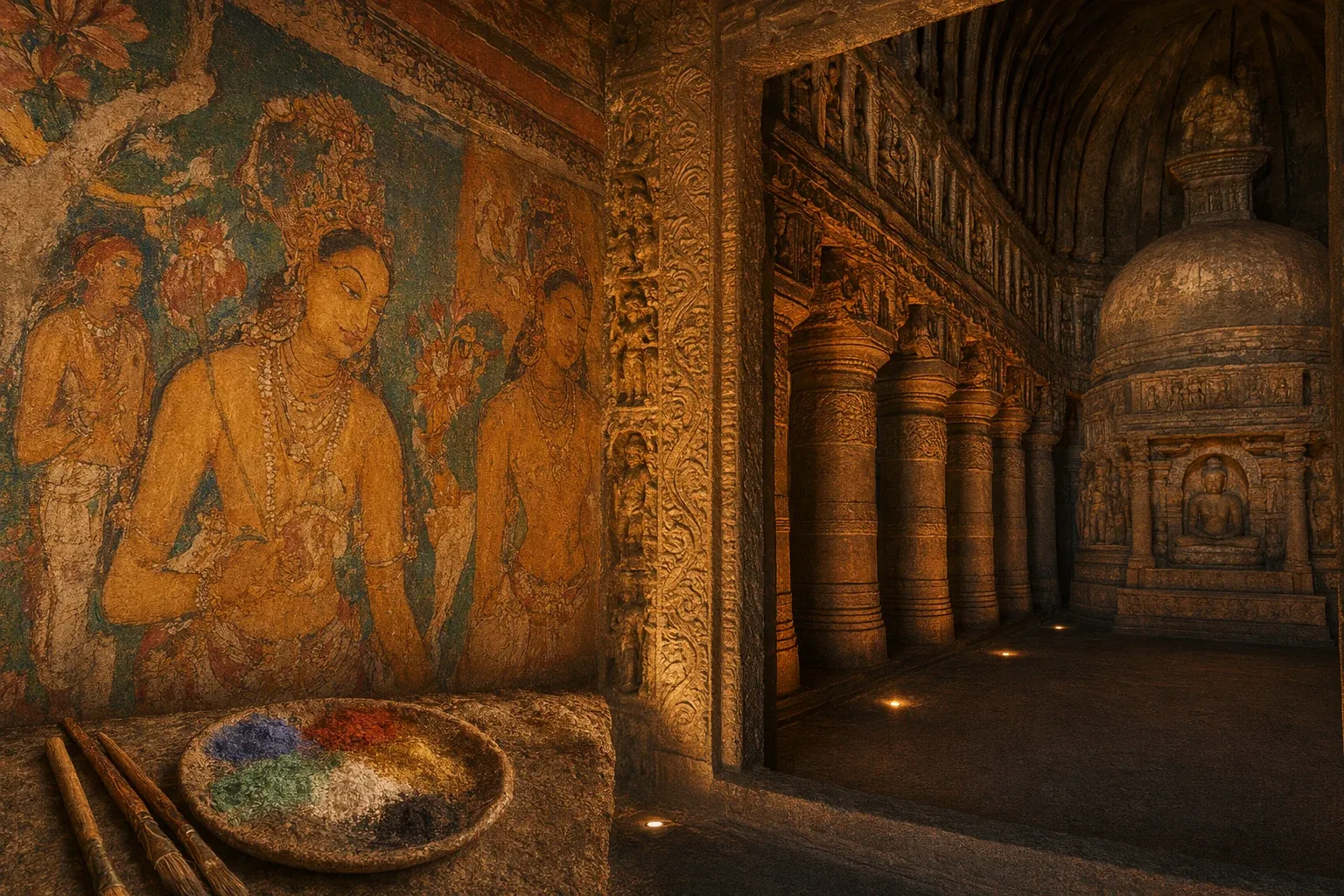
Ajanta is famous because it preserves one of India’s most remarkable combinations of rock-cut architecture, Buddhist devotion, painting, sculpture, and narrative art. Many monuments impress visitors through scale alone. Ajanta does something more delicate. It asks you to enter a horseshoe-shaped ravine and notice how monks, patrons, painters, sculptors, and storytellers turned stone into a place of meditation and memory.
If you are new to the subject, Bhaktilipi’s guide to Indian cave temples gives a broader introduction. This article explains why Ajanta, in particular, has such a special place in Indian cultural history.
Ajanta is famous for Buddhist rock-cut monasteries
The Ajanta Caves are not random caves decorated for beauty. They include chaitya halls used for worship and viharas used as monastic residences. A chaitya hall usually centers the devotional path around a stupa, while a vihara gives monks cells, halls, and spaces for teaching or contemplation. This combination helps a beginner see Ajanta as a lived religious site, not simply an ancient art gallery.
The caves were cut into the rock over different periods, with major activity often associated with early Buddhist communities and later patronage under powerful regional elites. That long span matters. Ajanta is not the work of one ruler, one artist, or one single moment. It is a layered sacred landscape shaped by changing devotional needs, artistic skill, and support from donors.
The paintings make Ajanta extraordinary
Ajanta’s murals are the main reason many art historians speak of the site with such admiration. The paintings are famous for expressive faces, graceful hands, flowing garments, palace scenes, forest settings, musicians, attendants, Bodhisattvas, and narrative detail. They show that ancient Indian painting was capable of emotional subtlety, not just decorative pattern.
The best-known images, such as the compassionate Bodhisattva figures often associated with Cave 1, are powerful because they feel alive. Their eyes, posture, jewellery, and quiet expression create a mood of inward attention. Even when the surface has darkened or suffered damage, the remaining work gives a rare glimpse into early Indian painting traditions that have not survived in many other places.
Ajanta tells stories through walls
A beginner may wonder how to read the paintings. One helpful approach is to see them as visual storytelling. Many scenes connect with Jataka tales, which recount previous births of the Buddha and teach generosity, patience, wisdom, self-sacrifice, and compassion. The paintings do not function like a modern comic strip with one obvious frame after another. They often combine courtly scenes, travel, forest episodes, and symbolic moments in a continuous visual field.
This means Ajanta rewards slow looking. A figure at the edge of a panel, a servant holding an object, an animal in the background, or a gesture between two people may carry meaning. The site is famous because it preserves this sophisticated visual language in a religious setting.
Sculpture and architecture work with the paintings
Ajanta is not only about murals. Carved pillars, shrine images, doorways, ceiling patterns, stupas, and seated Buddha figures all contribute to the experience. The architecture directs movement, the sculpture gives devotional focus, and the painting fills the interior with atmosphere. When these elements work together, the cave feels like a complete sacred environment.
This is different from looking at a painting on a flat museum wall. At Ajanta, the art belongs to the space. Lamps, chants, footsteps, and monastic routines would once have shaped how people encountered the images. The fame of Ajanta comes partly from this unity of place, practice, and art.
Ajanta shows ancient India’s cosmopolitan world
The paintings include royal courts, jewellery, textiles, musical instruments, architecture, travellers, attendants, animals, and scenes of refined life. These details help historians imagine clothing, social settings, and artistic taste from the time. Ajanta therefore matters not only to religious studies, but also to anyone interested in ancient Indian society.
The site also reminds us that Buddhism in India was deeply connected with trade routes, patronage, and wider networks of learning. Monks did not live outside history. They depended on donors, routes, food, shelter, and community support. Ajanta’s fame grows when we see it as part of this larger world.
Why Ajanta should not be reduced to tourism
Many people hear about Ajanta as a tourist destination, but that is only a modern layer. The deeper importance lies in the survival of fragile cultural memory. Paint on cave walls can be damaged by moisture, light, touch, and neglect. The fact that so much remains visible is remarkable. Visitors should therefore treat the caves with patience and restraint.
Avoid flash photography where restricted, do not touch surfaces, and do not rush from cave to cave only to tick off names. The value of Ajanta is not measured by how many photographs you collect. It is measured by how carefully you notice the relationship between stone, silence, image, and story.
Ajanta and other cave sites
Ajanta is often compared with Ellora, Elephanta, Badami, and other rock-cut sites. The comparison is useful, but Ajanta’s identity is distinct. It is especially famous for Buddhist murals and monastic interiors. Ellora is celebrated for its multi-religious range and the Kailasa temple. Elephanta is known for Shaiva sculpture. Badami is remembered for early Chalukya art. For a broader list, see Bhaktilipi’s guide to famous cave temples in India.
Simple takeaway
Ajanta is famous because it brings together Buddhist devotion, rare mural painting, rock-cut architecture, narrative storytelling, and a dramatic natural setting. It is not just old, beautiful, or large. It is a surviving classroom of Indian art, where walls teach stories, pillars shape movement, and painted faces still carry a quiet emotional force after many centuries.