
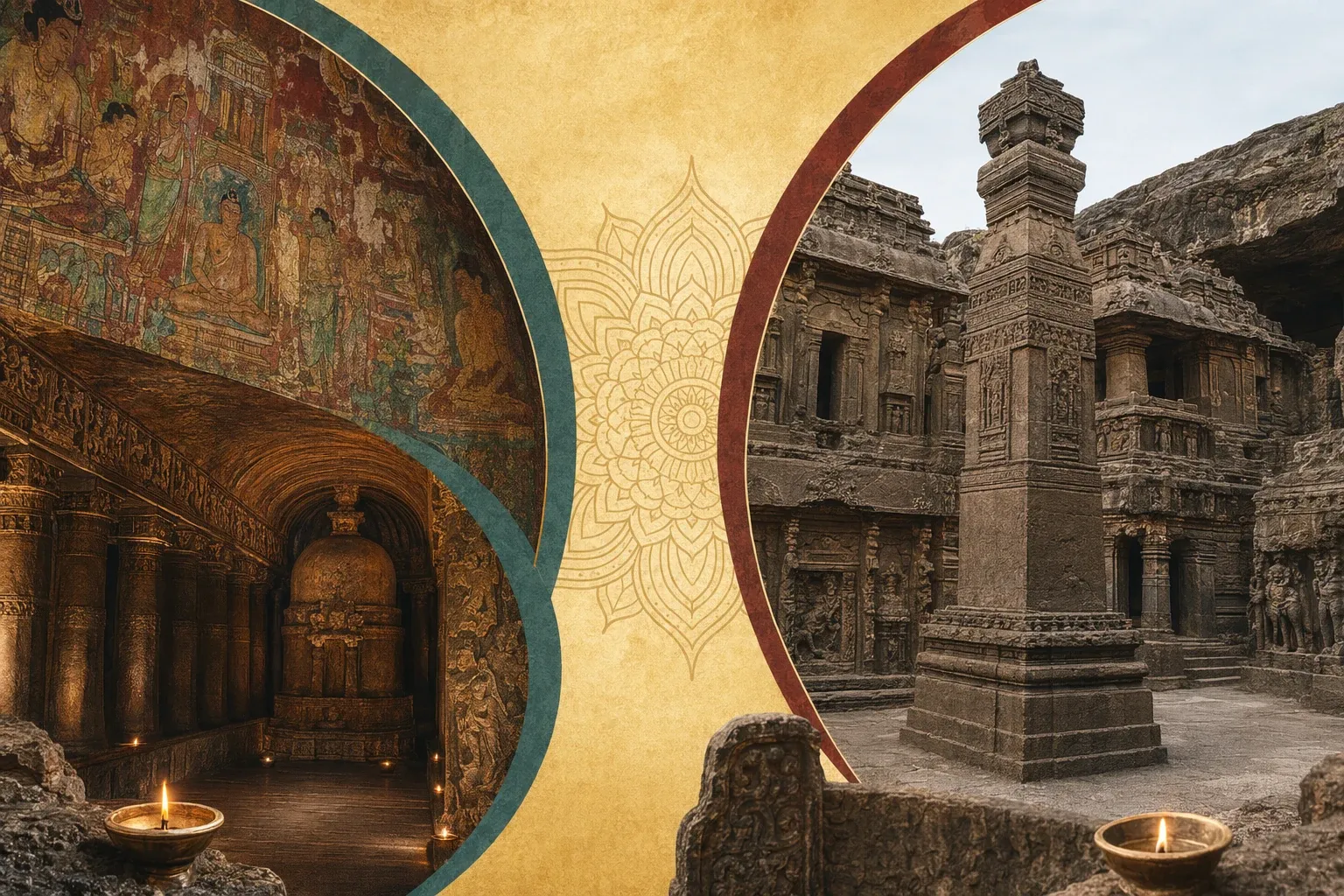
Ajanta and Ellora are often mentioned together because both are famous rock-cut cave sites in Maharashtra. They are close enough to appear in the same travel conversation, but they are not the same kind of monument. Ajanta is older in origin and is especially celebrated for Buddhist paintings and monastic cave spaces. Ellora developed later across a wider religious range and is famous for Buddhist, Hindu, and Jain caves, including the astonishing Kailasa Temple.
For a beginner introduction to the wider subject, see Bhaktilipi’s article on what Indian cave temples are. This comparison focuses on the difference between the two sites.
Which is older: Ajanta or Ellora?
Ajanta is older in its earliest phase. The earliest Ajanta caves are generally placed many centuries before the most famous later work at Ellora. Ajanta’s development includes earlier Buddhist activity and a later flowering of mural-rich caves. Ellora’s major activity belongs to a later period, with work continuing across Buddhist, Hindu, and Jain traditions.
This does not mean every part of Ajanta is older than every part of Ellora in a simple one-line way. Both sites have phases. The safer beginner answer is: Ajanta begins earlier; Ellora becomes prominent later and shows a broader religious range.
The main identity of Ajanta
Ajanta is best remembered as a Buddhist cave complex. Its chaitya halls and viharas preserve the world of monastic worship, residence, teaching, and storytelling. The paintings are central. When people speak of Ajanta’s greatness, they usually mean the murals, the Jataka-related stories, the expressive Bodhisattva images, the carved interiors, and the way art fills the cave atmosphere.
Ajanta’s setting also matters. The caves curve along a ravine, which gives the site a secluded feeling. The landscape supports the sense of retreat. Even a visitor who knows little about Buddhist history can feel that the place was shaped for contemplation, not only spectacle.
The main identity of Ellora
Ellora is different because it is multi-religious and more architecturally varied. The site includes Buddhist caves, Hindu caves, and Jain caves. This makes Ellora a powerful lesson in India’s layered religious history. Instead of representing one tradition in a mostly monastic setting, Ellora shows several traditions sharing a rock-cut landscape over time.
The most famous monument at Ellora is the Kailasa Temple, a vast monolithic Hindu temple associated with Shiva. It was carved downward out of rock rather than assembled stone by stone in the usual way. That achievement makes Ellora famous for engineering imagination and sculptural scale.
Painting versus architectural drama
A simple way to remember the difference is this: Ajanta is especially famous for painting; Ellora is especially famous for architectural range and sculptural ambition. This is not a perfect rule, because Ajanta has architecture and Ellora has important sculpture. But it helps beginners avoid confusion.
At Ajanta, you slow down to see painted faces, ceiling designs, narrative scenes, and the relationship between mural and cave interior. At Ellora, you move through different religious zones and confront the mass of carved rock, especially at Kailasa. The mood changes from intimate painted storytelling to large-scale stone drama.
Religious difference between the sites
Ajanta is primarily Buddhist. Its caves help readers understand Buddhist monastic life, stupa worship, Bodhisattva imagery, and story-based teaching. Ellora includes Buddhist spaces too, but it also includes major Hindu and Jain caves. That makes Ellora a better site for seeing religious diversity in one rock-cut complex.
This difference matters because beginners sometimes ask which site is “better.” That is the wrong question. Ajanta and Ellora answer different cultural questions. Ajanta asks us to notice the interior world of Buddhist art and memory. Ellora asks us to notice how rock-cut skill served several traditions and reached monumental form.
What should a first-time learner look for at Ajanta?
At Ajanta, pay attention to painted expression, storytelling, monastic layout, and the feeling of enclosed sacred space. Look for how figures are arranged, how gestures guide attention, how decorative patterns cover ceilings and pillars, and how the cave plan supports worship or residence. Do not treat the paintings as background decoration. They are the main text of the site.
It is also useful to read a little about Jataka stories before visiting or viewing images. The scenes become richer when you know that they are often teaching moral and spiritual values through narrative.
What should a first-time learner look for at Ellora?
At Ellora, begin by noticing variety. Buddhist halls, Hindu mythological panels, Jain carvings, and the Kailasa Temple do not create one single mood. Walk with the awareness that different communities, patrons, and artists shaped this landscape. The scale of Kailasa can be overwhelming, so pause to imagine the planning required to remove rock and reveal a temple form.
Also notice that Ellora is not only one monument. Kailasa is famous, but the surrounding caves help explain why the whole site matters. For a broader overview, Bhaktilipi’s guide to famous cave temples in India places both Ajanta and Ellora in context.
A practical memory aid
Remember Ajanta through the words painting, monastery, ravine, and Buddhist story. Remember Ellora through the words variety, sculpture, Kailasa, and shared sacred landscape. This simple pair of memory lists keeps the two sites separate without reducing either one to a slogan.
Simple takeaway
Ajanta is older in origin and is most famous for Buddhist murals, monastic caves, and refined visual storytelling. Ellora is later, broader, and famous for Buddhist, Hindu, and Jain caves, especially the Kailasa Temple. If Ajanta teaches the power of painted devotion inside a quiet ravine, Ellora teaches the power of carved rock to hold many religious worlds in one dramatic landscape.