
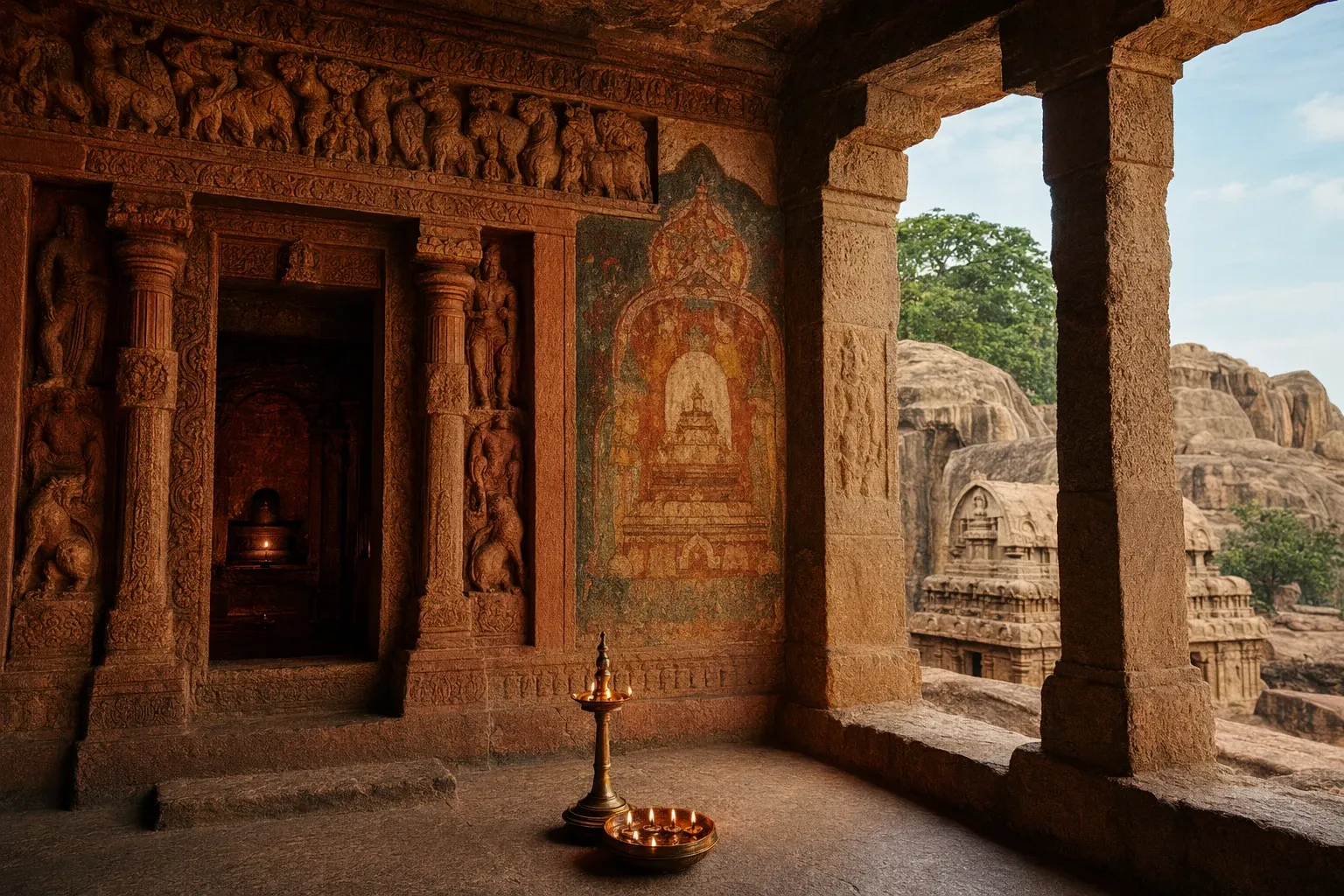
South Indian cave temples are an important bridge between natural rock, early temple architecture, sculpture, and royal patronage. When beginners think of Indian cave temples, they often jump to Ajanta, Ellora, or Elephanta. South India adds another story: the Chalukya caves at Badami, the Pallava rock-cut monuments around Mahabalipuram, and many smaller sites where artisans tested forms that later became central to temple architecture.
For the broader idea, start with Bhaktilipi’s guide to Indian cave temples. This article focuses on the southern examples and why they matter.
Why South Indian cave temples are special
South Indian rock-cut shrines often feel like experiments in turning a cliff or boulder into a temple front, pillared hall, or sacred chamber. They are not only places of worship. They are also architectural laboratories. Artists and patrons explored how pillars should stand, how door guardians should frame a sanctum, how mythological scenes should be carved, and how a sacred space should guide the devotee’s eye.
This makes them different from sites famous mainly for murals or huge monolithic scale. The southern caves often teach through form: column, mandapa, shrine, relief panel, and relationship with the surrounding landscape.
Badami: Chalukya art in red sandstone
Badami in Karnataka is one of the most important names in South Indian cave-temple history. The caves are carved into red sandstone cliffs above a historic tank, creating a striking relationship between water, rock, and sacred space. The Chalukyas used this setting to create Hindu, Jain, and related sacred imagery with strong sculptural confidence.
At Badami, look for the way figures occupy the wall. Vishnu, Shiva, and other sacred forms are not treated as flat decoration. They have movement, weight, and presence. The pillars and ceilings also matter. They show how rock-cut halls could imitate and influence built temple forms.
Badami is valuable because it shows an early Deccan style with its own personality. It is not merely a southern copy of northern caves. Its material, landscape, and dynasty give it a distinct voice.
Mahabalipuram: Pallava imagination by the sea
Mahabalipuram, also called Mamallapuram, is associated with the Pallavas of Tamil Nadu. The site is famous for rock-cut mandapas, reliefs, monolithic rathas, and later structural temple forms. Not everything at Mahabalipuram is a cave in the narrow sense, but the rock-cut spirit is central to the place.
The mandapas show how mythological scenes and sacred space could be carved into living rock. The famous relief often called Arjuna’s Penance or the Descent of the Ganga shows how a rock surface can become a vast story field. The rathas show another experiment: carving monolithic forms that resemble temple models.
Mahabalipuram is especially useful for beginners because it lets you see several architectural ideas side by side. You can observe a mandapa, a relief, a monolithic shrine form, and a shore temple tradition in one cultural landscape.
What these caves teach about early temple design
South Indian cave temples help explain how Indian temple architecture developed through experimentation. Before every form became standard in built stone temples, artisans explored proportions, pillars, sanctum arrangements, and sculptural placement in rock-cut spaces. A cave could become a testing ground for future ideas.
This does not mean cave temples are incomplete or inferior. They are complete sacred works in their own right. But they also preserve the creative movement from carved rock to freestanding architecture. That is why students of Indian art pay close attention to sites like Badami and Mahabalipuram.
Hindu, Jain, and regional layers
South Indian cave temples are not limited to one religious expression. Badami includes important Hindu and Jain material. Other southern rock-cut sites also show local patronage, regional forms, and changing devotional priorities. This variety reminds us that cave temples were not one fixed category. They could serve many communities and artistic goals.
The best way to study them is to ask: who carved this, for which sacred idea, in what landscape, and with what visual language? Those questions reveal more than a simple list of names.
How they differ from Ajanta, Ellora, and Elephanta
Ajanta is famous for Buddhist painting and monastic storytelling. Ellora is famous for its multi-religious range and the Kailasa Temple. Elephanta is known for Shaiva sculpture. South Indian cave temples, especially Badami and Mahabalipuram, are famous for early temple forms, dynastic style, and the transition between rock-cut and structural architecture.
This difference matters because a beginner may otherwise expect every cave site to look the same. In reality, each region solved the problem of carving sacred space in its own way. For a broader comparison, see Bhaktilipi’s guide to famous cave temples in India.
What to notice when visiting or studying images
Look first at the site’s landscape. Is the cave in a cliff, near water, beside a hill, or in a coastal zone? Then notice the entrance, pillars, shrine focus, and major sculptural panels. Ask how a devotee would move through the space. Finally, compare the carved forms with later temples in the same region.
This method makes the art easier to remember. Instead of memorising dates alone, you begin to see the design logic: rock becomes hall, hall becomes shrine, shrine becomes a place where story and devotion meet.
Simple takeaway
South Indian cave temples matter because they show artists shaping rock into early temple worlds. Badami reveals Chalukya strength in red sandstone, while Mahabalipuram reveals Pallava experimentation with mandapas, reliefs, and monolithic forms. Together they show that rock-cut heritage in India was not one northern story. It was a many-region conversation between stone, devotion, landscape, and architectural imagination.