
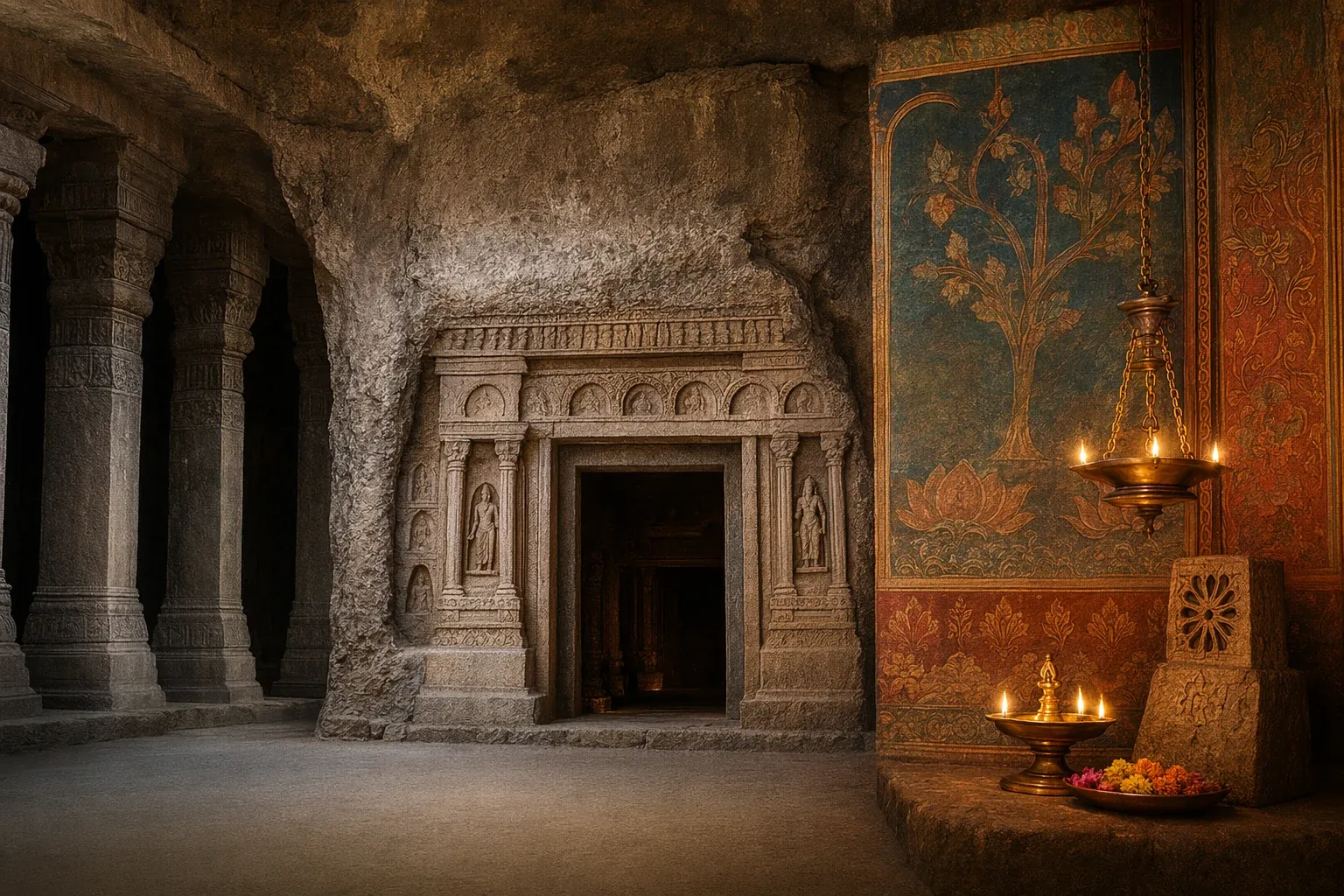
The Elephanta Caves are famous for powerful Shaiva sculpture, especially the great three-faced image often called Maheshmurti or Trimurti. They are also surrounded by a common question: who damaged the Elephanta Caves? The honest answer is that the site shows damage from more than one historical pressure, and popular explanations often simplify a complicated story. What matters most is that the surviving sculpture still speaks with extraordinary force.
For wider context, see Bhaktilipi’s guide to famous cave temples in India. Elephanta belongs to the rock-cut heritage of India, but its mood is distinct from Ajanta’s paintings or Ellora’s Kailasa Temple.
Where Elephanta is and why it matters
Elephanta Island lies near Mumbai, and the caves are carved into the hill. The main cave is a Shaiva sacred space with sculptural panels that present Shiva in several forms and moods. The visitor is not simply looking at stone decoration. The cave is arranged to communicate power, balance, cosmic presence, and devotion.
The great central image is especially important because it presents Shiva with a calm majesty that is difficult to forget. The three faces are often understood as expressing different aspects of Shiva’s nature. Even a beginner who does not know every theological detail can feel the image’s authority: stillness, beauty, severity, and grace held together.
Who damaged the Elephanta Caves?
Many popular accounts blame Portuguese soldiers for shooting at sculptures after the Portuguese came into control of the island. This explanation appears often because visible damage on figures makes the story memorable. It is reasonable to say that colonial-period misuse and iconoclastic damage contributed to the condition of the caves.
At the same time, a careful explanation should not pretend that one sentence explains everything. Stone monuments also suffer from time, weathering, neglect, salt-laden air, human handling, earlier breakage, and changes in patronage. Some damage may have occurred across different periods. The safest beginner answer is: Elephanta’s sculptures were damaged by a mix of historical human harm and long-term deterioration, with Portuguese-era damage commonly remembered as a major cause.
Why the damage should not become the whole story
It is natural to notice broken limbs, worn surfaces, and missing details. But if we focus only on destruction, we miss the main achievement. The Elephanta Caves still preserve one of the great Shaiva sculptural programs of India. The surviving panels continue to teach through composition, scale, gesture, and presence.
Damage can even sharpen our responsibility. It reminds us that heritage is not guaranteed. Temples, caves, paintings, and sculptures survive only when communities, scholars, governments, visitors, and caretakers treat them with seriousness.
Shiva as many-sided presence
Elephanta’s sculptural world presents Shiva not as a single flat idea, but as a many-sided divine presence. Shiva can be ascetic, lord of dance, householder, fierce power, cosmic teacher, and source of grace. The panels invite the viewer to understand divinity through contrast. Stillness and movement, tenderness and force, worldly marriage and yogic withdrawal can all belong to the same sacred imagination.
This is why Elephanta matters for beginners studying Hindu art. It shows how sculpture can express theology without needing a long written explanation. A posture, a face, a hand, or a surrounding figure can carry meaning.
How Elephanta differs from Ajanta and Ellora
Ajanta is especially famous for Buddhist murals and monastic interiors. Ellora is known for its Buddhist, Hindu, and Jain range, especially the Kailasa Temple. Elephanta is more concentrated. Its identity is strongly Shaiva, and its power lies in sculptural panels within a cave setting.
That concentration makes Elephanta memorable. You do not need to understand dozens of monuments to sense its importance. Stand before the central image and the surrounding panels, and the site begins to explain itself through scale and silence.
What a visitor should notice
Look at the arrangement of the main cave, the pillars, the central shrine area, and the large sculptural panels. Notice how the figures are not small ornaments added after construction. They are part of the cave’s body. The architecture and sculpture are one experience.
Also notice the emotional range. Some scenes feel calm, others dramatic. Some figures appear composed, others active. This range helps explain why Shiva devotion has inspired such rich art across India. If you want a simple background to Shiva pilgrimage, Bhaktilipi’s article on Jyotirlinga meaning may be useful.
Respecting a damaged heritage site
Because Elephanta has already suffered, visitors should be extra careful. Do not touch sculptures, scratch surfaces, climb where not allowed, or treat broken images as entertainment. Avoid spreading exaggerated stories without evidence. A respectful visitor can say, “The caves show damage, and Portuguese-era harm is often mentioned,” while also admitting that heritage decay is complex.
This balanced approach protects both truth and reverence. It allows us to mourn damage without turning the site into a simple blame story.
Why the central image stays memorable
The central image stays in memory because it does not depend on ornament alone. Its calm scale, balanced faces, and shadowed setting create a feeling of depth. Even after damage, the sculpture helps a beginner understand why sacred art can be both philosophical and emotional.
Simple takeaway
The Elephanta Caves still matter because their Shaiva sculpture remains powerful despite damage. The common story links much of the harm to Portuguese-era misuse, while time and neglect also played a role. But Elephanta should be remembered first as a sacred artistic achievement: a cave where Shiva’s many-sided presence is carved in stone with gravity, beauty, and lasting force.