
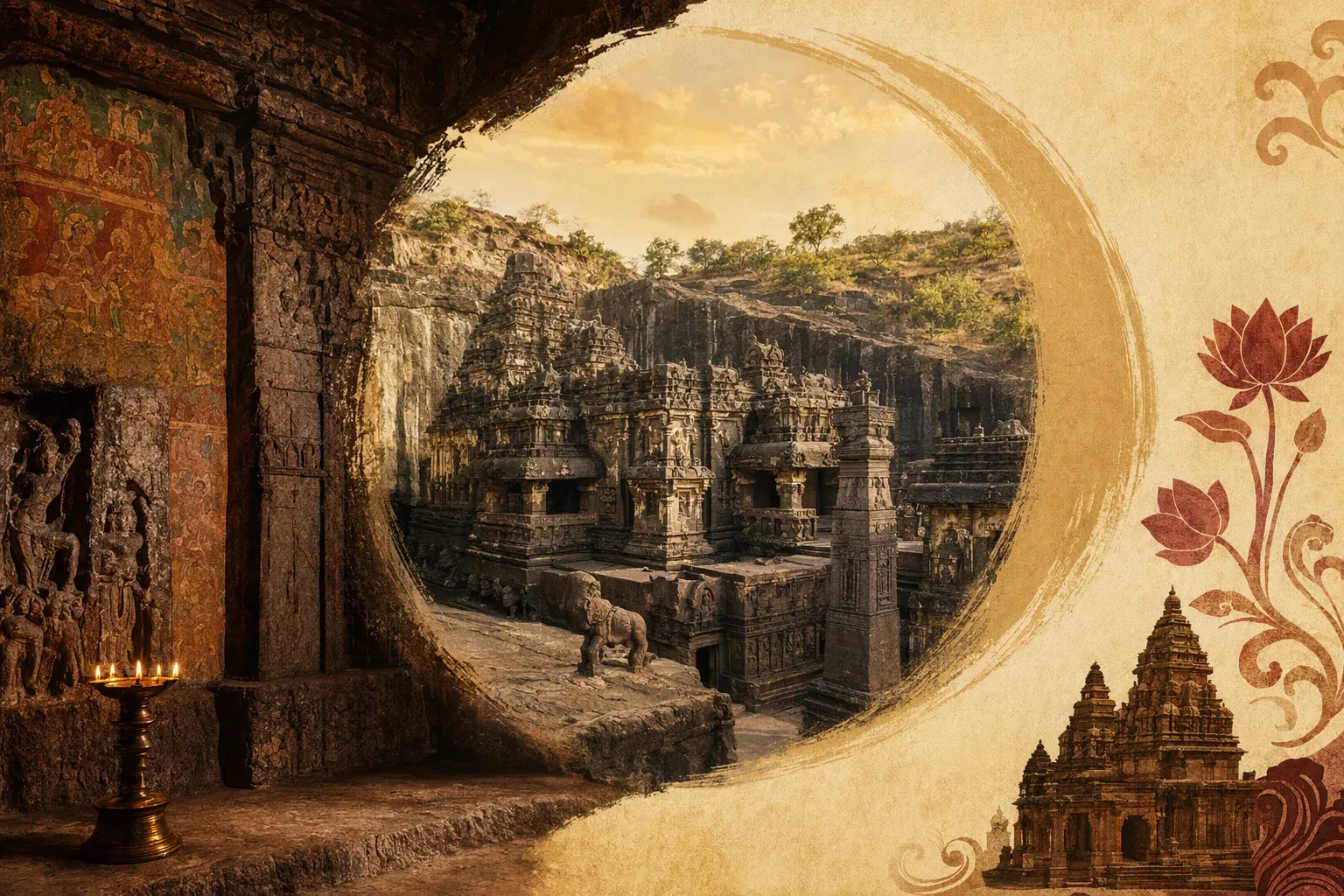
The Kailasa Temple at Ellora is the name most often given when people ask about the biggest cave temple in India. It is not a cave in the simple sense of a hollow chamber. It is a vast monolithic temple carved out of living rock, associated with Lord Shiva and located within the Ellora cave complex in Maharashtra. Its fame comes from scale, imagination, and the astonishing method by which rock was removed to reveal a temple form.
To understand why Kailasa stands apart, it helps to read a general introduction to Indian cave temples. Kailasa is one of the most dramatic examples of what rock-cut architecture can achieve.
Why Kailasa is called a cave temple
A normal built temple is made by bringing stone blocks together. Kailasa reverses that logic. Instead of adding material, artisans removed rock. The temple was carved from a rocky mass, with courts, walls, pillars, sculptural panels, and shrine forms emerging through subtraction. That is why it belongs to the world of rock-cut architecture even though it looks more like a freestanding temple than a dark cave hall.
This distinction is important for beginners. Kailasa is not simply “inside” a cave; it is a temple released from rock. The achievement lies in planning the final form before cutting too much away. Once rock is removed, it cannot be put back. The monument therefore suggests extraordinary coordination, skill, and confidence.
The link with Shiva and Mount Kailasa
The temple’s name evokes Mount Kailasa, the sacred mountain associated with Shiva. This gives the monument a symbolic meaning beyond size. It is not just a large carved structure; it is an attempt to bring a cosmic mountain idea into a temple setting. The devotee encounters stone as sacred landscape.
Shaiva imagery at Ellora includes forms connected with Shiva’s power, stories, and presence. For a reader new to Shiva traditions, Bhaktilipi’s Jyotirlinga guide can help explain why sacred places of Shiva are remembered with such intensity across India.
What makes Kailasa technically impressive
Kailasa is impressive because of the amount of rock removed, the depth of carving, and the complexity of the final layout. It includes a courtyard, sculpted elephants, pillars, shrine spaces, bridges, panels, and towering forms. The work required both artistic imagination and practical engineering. Workers had to think about height, load, sequence, drainage, surface finish, and access while carving downward and inward.
The monument also creates a strong visual surprise. A visitor expects a cave wall and suddenly sees a temple mass standing within a carved court. That drama is part of Kailasa’s impact. It makes stone feel alive with possibility.
Why “biggest” should be understood carefully
People use the word biggest in different ways. They may mean largest monolithic temple, most dramatic rock-cut temple, largest carved complex, or most famous cave temple. Kailasa is widely celebrated as one of the largest and most ambitious monolithic rock-cut temples in the world. That is the safe and meaningful way to understand its greatness.
If someone asks for the biggest cave temple in India, Kailasa at Ellora is the best beginner answer. But the answer should not become a shallow size contest. Indian cave temples vary by purpose. Ajanta is famous for paintings, Elephanta for Shaiva sculpture, Badami for early Chalukya work, and Ellora’s Kailasa for monolithic scale.
What to notice in the carvings
Do not look only at the outer size. Notice elephants at the base, mythological panels, pillars, shrine forms, and the way vertical surfaces are filled with narrative and ornament. The stone is not blank support. It teaches stories, frames devotion, and creates a sacred environment.
Also notice how the open court changes the experience. Unlike a narrow cave interior, Kailasa lets light move across carved surfaces. The sun reveals edges, shadows deepen recesses, and the monument changes through the day. This play of light is part of the architecture’s power.
Kailasa within Ellora’s multi-religious landscape
Kailasa is the most famous monument at Ellora, but Ellora itself includes Buddhist, Hindu, and Jain caves. That wider setting matters. It shows that rock-cut art in India served multiple religious communities. The Kailasa Temple represents one magnificent Shaiva expression within a broader sacred landscape.
For comparison, Bhaktilipi’s guide to famous cave temples in India places Ellora beside Ajanta, Elephanta, and other sites. This helps a beginner see why each place is important for a different reason.
How to approach Kailasa respectfully
A monument this famous can become a photo stop, but it deserves slower attention. Begin with the whole form from a distance, then move closer to individual carvings. Ask yourself how the artisans imagined the temple before cutting began. Notice the relationship between myth, mountain, stone, and devotion.
If visiting in person, follow site rules, avoid touching carvings, and do not treat sacred imagery as a prop. Even when a monument is under archaeological care, it still carries religious meaning for many people.
Why beginners remember Kailasa
Beginners remember Kailasa because it turns a difficult architectural idea into a visible experience. You do not need technical training to sense the wonder of a temple shaped by removing stone. That immediate clarity is why the monument remains one of the strongest introductions to Indian rock-cut genius.
Simple takeaway
Kailasa Temple at Ellora is often called India’s biggest cave temple because it is a vast monolithic rock-cut temple carved from living stone. Its greatness is not only its size. It brings together Shaiva symbolism, architectural daring, sculptural richness, and a method of carving that feels almost impossible at first glance. Kailasa shows how Indian artisans could turn a mountain of rock into a sacred world.