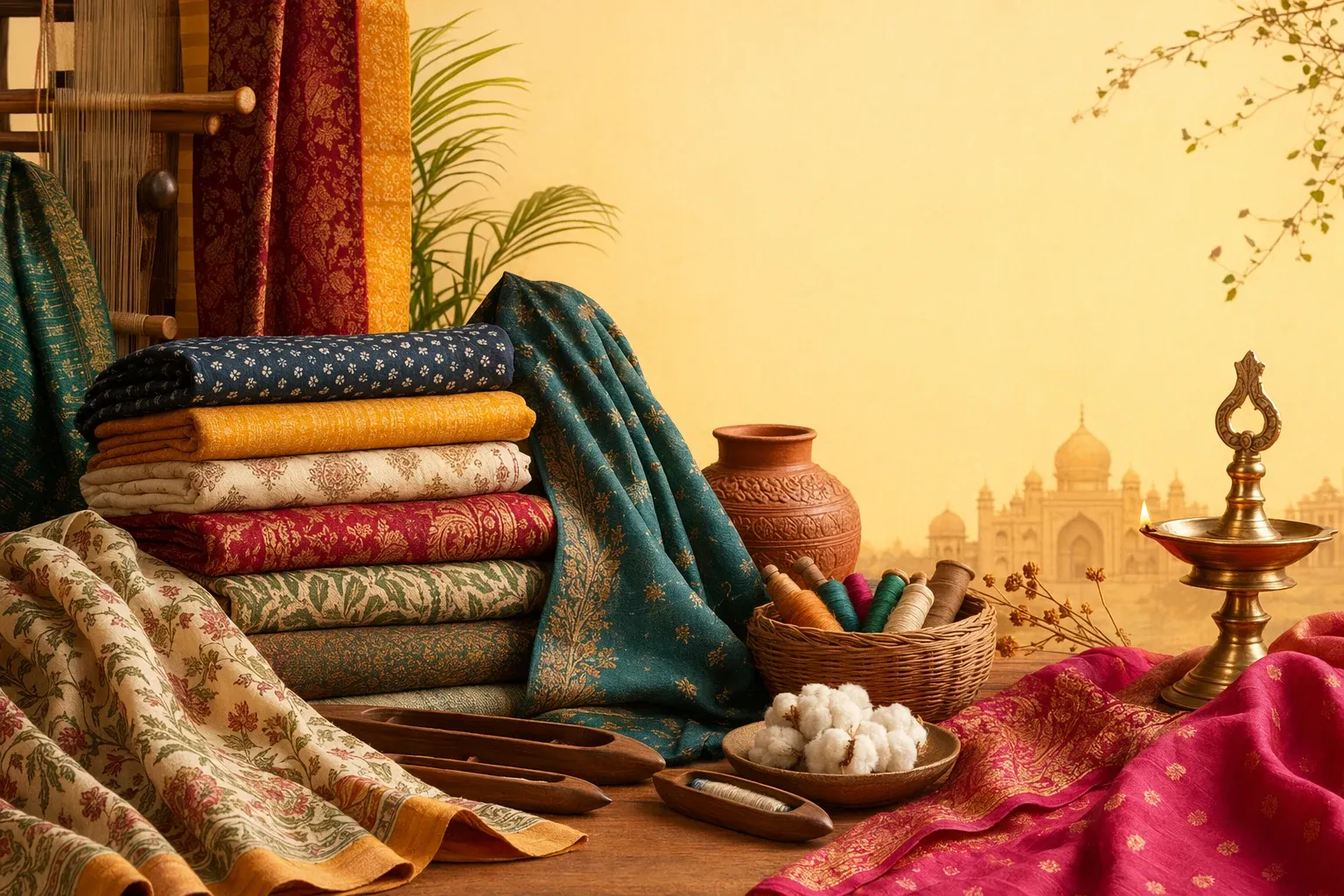
Indian textiles are the many cloth traditions of India: cottons, silks, wools, handwoven fabrics, printed cloth, dyed cloth, embroidered garments, home textiles, and ceremonial pieces. The word does not point to one single fabric. It points to a large living world where farmers, spinners, dyers, weavers, printers, embroiderers, designers, traders, and families all play a role.
At the simplest level, a textile is cloth made from fibre. In India, that fibre may be cotton from warm regions, silk from sericulture traditions, wool from colder belts, or plant fibres such as jute. The cloth may be woven on a loom, printed with carved blocks, decorated with embroidery, painted by hand, tied and dyed, or finished with borders and motifs that carry local memory.
Why India is known for textiles
India has been famous for cloth because the subcontinent combined three strengths for centuries: fibre, skill, and trade. Cotton grew well in many regions. Silk weaving developed in several royal and temple-linked centres. Natural dyes such as indigo, madder, turmeric, lac, and pomegranate rind gave cloth a rich colour language. Skilled communities then turned raw material into saris, turbans, shawls, dhotis, dupattas, quilts, floor spreads, and everyday household cloth.
Indian textiles also travelled. Fine cottons, painted cloth, chintz, brocades, shawls, and dyed fabrics moved through ports, caravan routes, courts, and markets. That is why Indian cloth is not only a fashion subject. It is also part of economic history, craft history, ritual life, and regional identity.
Main examples of Indian textiles
Handloom fabrics are among the clearest examples. A handloom textile is woven manually on a loom, with the weaver controlling rhythm, tension, pattern, and finishing. Banarasi brocade, Kanjeevaram silk, Chanderi, Maheshwari, Paithani, Jamdani, Ikat, Muga silk, and many regional cottons show how different one Indian textile can be from another.
Printed textiles form another major group. Block printing uses carved wooden blocks to stamp patterns onto cloth. Ajrakh, Bagru, Sanganeri, and Dabu printing are often discussed in this family, though each has its own materials, designs, and community knowledge. Kalamkari is known for painted or drawn storytelling on cloth, especially in parts of Andhra Pradesh and Telangana.
Dyed textiles include Bandhani, Leheriya, Ikat, and other resist-dye traditions. In these fabrics, threads or cloth are tied, bound, folded, or arranged before dyeing so that pattern appears after the resist is opened. The result can be dots, waves, blurred geometry, or complex forms that require planning before the cloth is complete.
Embroidery traditions add another layer. Phulkari from Punjab, Kantha from Bengal, Chikankari from Lucknow, Kutch embroidery from Gujarat, Zardozi, Toda embroidery, and mirror work all show how needlework can carry beauty, memory, and social meaning.
Everyday use and sacred use
Indian textiles are not only museum pieces. They appear in daily clothing, school functions, weddings, festivals, home decoration, temple offerings, dance costumes, and family heirlooms. A cotton sari worn in summer, a wool shawl used in winter, a silk veshti at a ceremony, a hand-block-printed bedsheet, or an embroidered dupatta can all belong to the textile world.
Some cloth is chosen for comfort. Some is chosen for auspiciousness. Some is chosen because it connects a family to a region, community, or memory. A wedding sari may be preserved for decades. A temple cloth may be offered with devotion. A handwoven shawl may carry the pride of a hill region. These uses make Indian textiles both practical and emotional.
How textiles differ by region
Regional diversity is one reason the subject feels so vast. Gujarat and Rajasthan are strongly associated with tie-dye, mirror work, and block printing. Varanasi is famous for brocade weaving. Tamil Nadu is known for strong silk sari traditions such as Kanjeevaram. Assam has Muga and Eri silk traditions. Kashmir is associated with fine shawls and needlework. Odisha, Telangana, Andhra Pradesh, and parts of Gujarat are important for Ikat. Bengal has Jamdani and Kantha. Central India has Chanderi and Maheshwari.
This does not mean every textile belongs to only one place forever. Designs travel, markets change, and artisans adapt. Still, region helps beginners understand why Indian textiles have so many names and why the same garment type can look different from state to state.
What beginners should notice first
If you are new to Indian textiles, start with five questions. What fibre is used? Is it handwoven, mill-made, printed, dyed, embroidered, or painted? Which region or community is associated with it? What is the cloth used for? What makes its pattern, border, colour, or texture special?
These questions are more useful than memorising long lists. They help you look carefully at a sari, shawl, stole, kurta fabric, cushion cover, or wall hanging. They also help you respect the labour behind cloth. A textile is not only a product. It is time, touch, skill, and inherited knowledge.
A simple way to remember Indian textiles
Think of Indian textiles as stories made wearable and usable. Some stories are told through the loom, some through dye, some through the block, some through the needle, and some through the way families use the cloth. A printed cotton and a silk brocade may look completely different, but both can carry Indian craft intelligence.
For a regional map of cloth centres, see famous textile cities of India. For a nearby visual tradition, Warli art from Maharashtra shows how handmade forms can preserve community memory in another medium.
The best beginner takeaway is this: Indian textiles are not one fabric or one style. They are a family of cloth traditions shaped by geography, devotion, climate, trade, artistry, and everyday Indian life.