
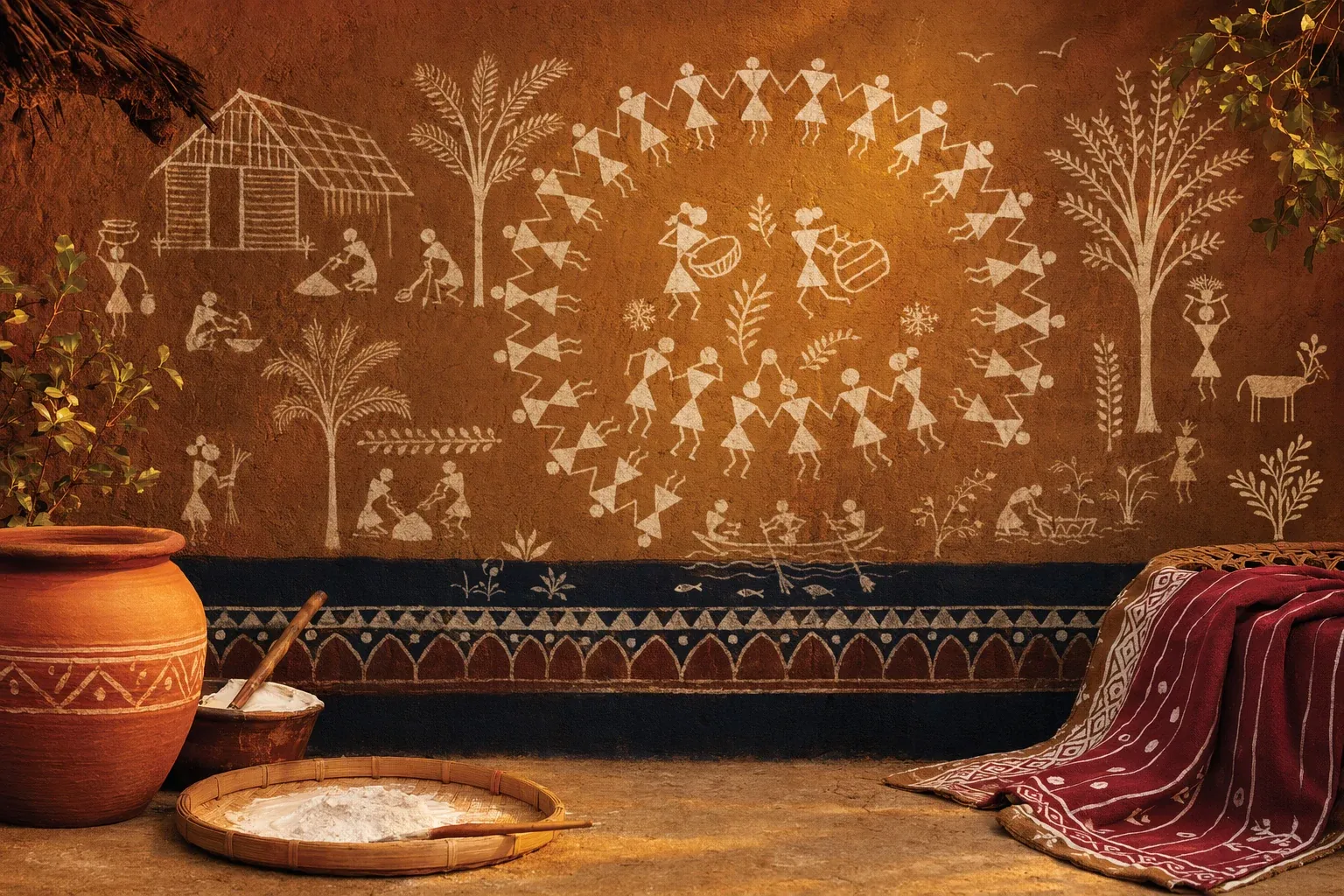
Warli art is strongly associated with the Warli community of Maharashtra and nearby regions. At first glance it may look simple: white figures, triangles, circles, lines, animals, houses, trees, and dance scenes on an earthy background. But that simplicity carries a deep sense of community life.
Simple answer
The style is famous for human figures built from basic shapes. A circle may suggest the head, triangles may form the body, and lines create movement. These figures often appear in farming, dancing, music, wedding, animal, forest, or village scenes.
The best beginner understanding is: Warli art is not just a “minimal tribal pattern”. It is a community-rooted visual tradition connected with lived experience, ritual memory, nature, and social life.
The bigger context
Indian folk art is not one single school with one fixed look. It is a family of living and inherited visual traditions shaped by region, community, ritual, occupation, local ecology, storytelling, and handmade practice. Some forms are painted on walls or floors, some on cloth or paper, some on scrolls, and some now appear in classrooms, galleries, products, and digital designs.
This is why the same broad phrase can include wall paintings, scroll paintings, textile traditions, threshold designs, ritual images, and modern artist-led adaptations. The category is wide, but the best learning always returns to place and people.
Where does Warli art come from?
Warli art is linked with Adivasi communities in Maharashtra, especially the Warli people, and also nearby regions. Traditionally, paintings could appear on walls using simple materials such as rice paste on an earthen surface. Modern Warli-inspired work may appear on paper, canvas, textiles, and digital designs.
Why the figures look geometric
The geometry makes the style instantly recognisable. The body made from triangles, the circular dance formations, and the clean white lines create rhythm. But the figures are not empty icons. They show people working, celebrating, worshipping, and living with nature.
Common themes
Common Warli scenes include tarpa dance, harvest, weddings, animals, trees, huts, farming, musicians, and community gatherings. These themes show that the art values relationship: humans with each other, humans with land, and humans with seasons.
Respectful learning
A beginner can practise Warli-inspired figures, but should not claim ownership of the tradition or sell copied sacred/community designs without understanding. Credit the Warli tradition, learn about the community, and support real artists when possible.
Why Warli still feels modern
The clean geometry makes Warli feel contemporary, which is why it appears in education, murals, decor, and design. Its modern appeal should not erase its roots. The power of Warli is that it can look simple while still carrying a whole world of memory.
How to read the artwork without overclaiming
- Name the art form if you know it instead of calling everything “tribal” or “ethnic”.
- Look for region, community, material, motif, story, and ritual context.
- Notice repeated symbols, borders, figures, animals, and nature forms, but do not assume one universal meaning.
- Separate handmade originals, inspired practice work, prints, and commercial replicas.
- When sacred images or community-specific motifs appear, slow down and learn before using them casually.
This approach keeps the article useful for beginners while avoiding two common mistakes: reducing living traditions to pretty patterns, or making exaggerated claims that the art itself cannot support.
Respectful learning checklist
The respectful way to learn is to name the tradition when you can, credit artists and communities, avoid copying sacred or community-specific motifs carelessly, and remember that folk art is culture before it is decoration. A beginner does not need to be afraid of learning, but should avoid treating every design as a free pattern without context.
- Credit the tradition and artist whenever possible.
- Do not trace or sell copied artwork from living artists.
- Use words such as “inspired by” when your practice drawing is not an authentic traditional work.
- Support real artisans, cooperatives, museums, or trusted craft sources when buying.
- Teach children the story and region along with the drawing.
Common beginner mistakes
- Mixing motifs from many traditions and presenting the result as one authentic style.
- Using deity images or sacred diagrams only as decoration.
- Believing every online caption about a symbol without checking context.
- Calling machine prints handmade originals.
- Forgetting that many folk-art traditions are still practised by living artists and communities.
Why this matters today
Indian folk art is now seen in homes, schools, tourism, fashion, packaging, murals, digital illustrations, and social media. That visibility can help artists and traditions reach new audiences, but it can also lead to shallow copying. A responsible reader can enjoy the beauty while asking better questions: Who made this? Which tradition is it from? What does it mean? Was the artist credited fairly?
For young readers, this is especially important. Folk art is an easy entry point into Indian culture because it is visual and memorable. But the lesson should not stop at copying a design. The deeper lesson is how communities use art to remember seasons, stories, devotion, nature, work, and celebration.
Helpful next reads
For more context, read Compare Indian art forms and Kolam as a living art form. These public Bhaktilipi guides give related background without forcing unrelated links.
Final takeaway
Indian folk art becomes easier to understand when you see it as living culture, not just surface design. Start with the name of the form, learn the community and region behind it, notice the motifs carefully, and practise or decorate with respect. That balance keeps the learning simple, useful, and honest.