
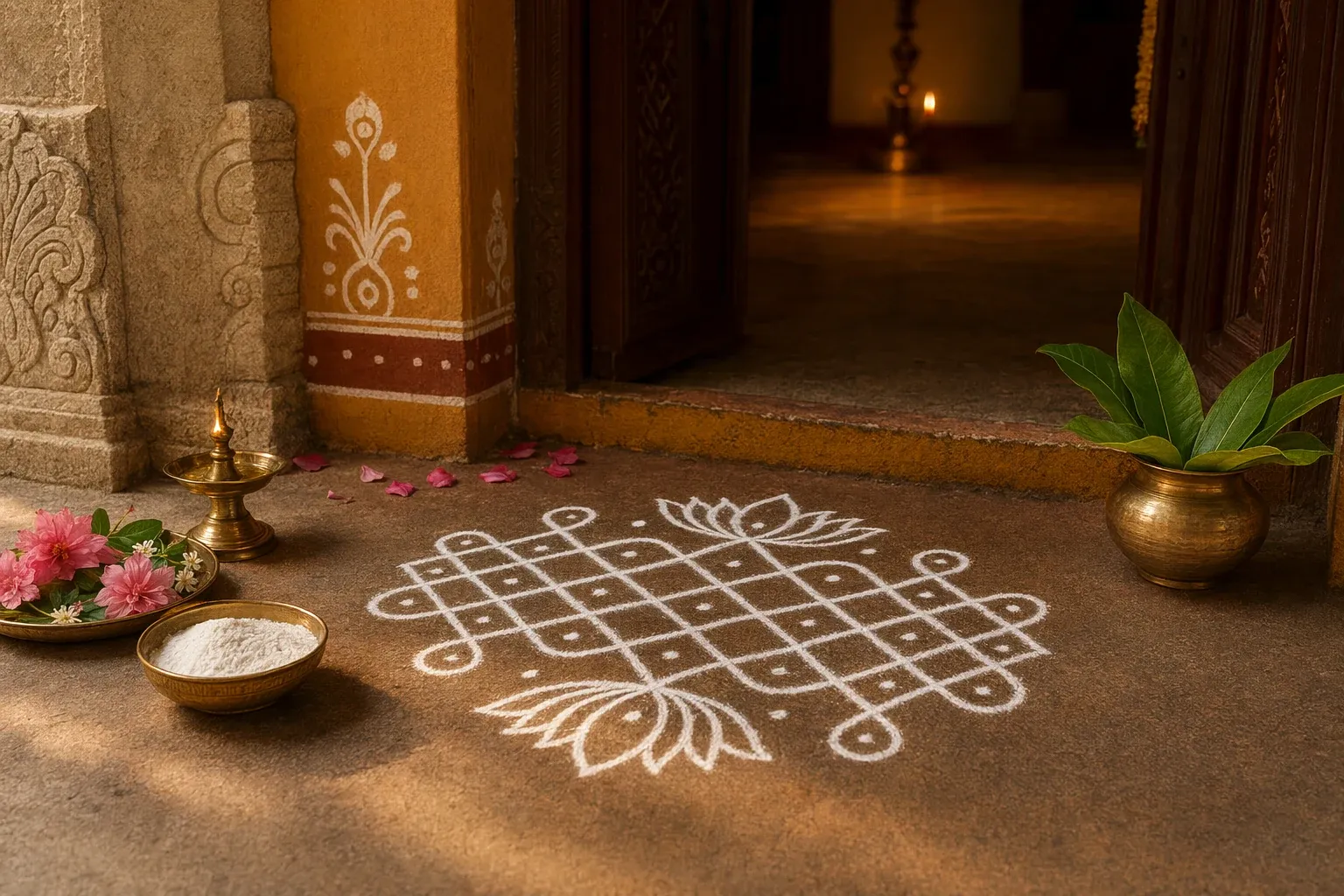
Kolam is one of those Indian art forms that can look simple from far away and magical when you pause to notice it. Early in the morning, someone bends near the entrance of a home, lets white powder fall through the fingers, and slowly turns dots, lines, curves, loops, and symmetry into a beautiful design. By evening, footsteps, wind, rain, birds, and daily life may fade it away. The next morning, it can return again.
In simple words, kolam is a traditional floor drawing made especially in Tamil Nadu and other parts of South India, usually near the doorway, courtyard, or prayer space. It is often made with rice flour, stone powder, chalk powder, or coloured powders. But kolam is more than decoration. It is a daily cultural practice that brings together beauty, discipline, welcome, memory, and devotion.
What does kolam mean?
The word kolam is commonly used in Tamil for decorative floor designs. In nearby regions, similar traditions may be known by names such as muggu, muggulu, rangavalli, rangoli, or alpana, depending on language and place. Each tradition has its own style, materials, and local meaning, so it is better not to treat all of them as exactly the same.
A kolam can be very small, like a few dots outside an apartment door, or very large, covering a courtyard during festivals. Some are freehand floral designs. Some are built around dot grids. Some use only white powder. Others use colours, flowers, lamps, or festival themes.
A daily art, not only a festival art
Many people first notice kolam during Pongal, Deepavali, weddings, or temple events. But in many homes, kolam has been a daily morning habit. The ground is cleaned, sometimes sprinkled with water, and then the design is drawn. This daily rhythm matters. It turns the entrance of the home into a cared-for space.
Because kolam is often temporary, it teaches a gentle idea: beauty does not have to last forever to be meaningful. A design can be made with care, enjoyed for a few hours, and then allowed to disappear. The value is not only in the final picture; it is also in the act of making it.
Tradition, interpretation, and historical context
In tradition, kolam is linked with auspiciousness, hospitality, cleanliness, and the welcoming of positive energy into the home. It may be connected with prayer, festivals, goddess traditions, and family customs. In some households, drawing kolam is part of beginning the day with order and gratitude.
In interpretation, people often see kolam as a symbol of harmony. The dots and lines suggest that life has pattern, relationship, and flow. When rice flour is used, it can also feed tiny creatures such as ants and birds, reminding us that the home is part of a larger living world.
Historically, kolam belongs to a long family of Indian floor-art practices passed through observation, family teaching, community memory, and regional creativity. It has lived more in hands and courtyards than in textbooks. That makes it a powerful example of everyday heritage.
Why kolam matters today
For young people, kolam can be a doorway into culture without feeling heavy. It teaches geometry without a lecture, patience without preaching, and tradition without needing a museum. It also shows how women’s everyday creativity has shaped public beauty in Indian homes and streets for generations.
Kolam also fits modern life surprisingly well. A small design outside a flat, a simple dot pattern in a notebook, or a digital kolam illustration can keep the spirit alive. The key is respect: learn the meaning, avoid treating sacred or cultural symbols like random decoration, and give credit to the communities that preserved the practice.
A simple way to begin
If you want to understand kolam, start by watching one design slowly. Notice how the hand moves, where the line turns, and how symmetry appears. Then try a tiny pattern with four or six dots. Do not worry if it is uneven. Kolam is learned through repetition.
That is the quiet beauty of this art. It does not demand perfection on the first day. It invites you to return, try again, and make the doorway a little more beautiful. In a fast world, kolam reminds us that culture can live in small daily acts done with attention.
How to notice a kolam properly
The next time you see a kolam, do not only take a fast photo. Look at the starting point, the balance of both sides, and the way the line controls empty space. Notice whether the design is made from dots, freehand curves, flowers, lamps, or a border. These details tell you what kind of design you are seeing.
Also notice the setting. A small apartment kolam, a large Pongal courtyard design, and a temple-side festival kolam all carry different moods. One may be quiet and daily. Another may be joyful and public. The art changes with the occasion, but the basic spirit of care remains.
Common misunderstandings
One misunderstanding is thinking kolam is only women’s decoration. In reality, it is also design knowledge, mathematical thinking, ritual culture, ecological memory, and community identity. Another misunderstanding is thinking temporary art is less valuable. Kolam proves the opposite. Something can be temporary and still be deeply meaningful.
Kolam matters because it turns the ordinary entrance into a place of attention. It teaches that culture does not always need a stage, frame, or ticket. Sometimes it appears quietly on the ground, made by hand, before the day begins.