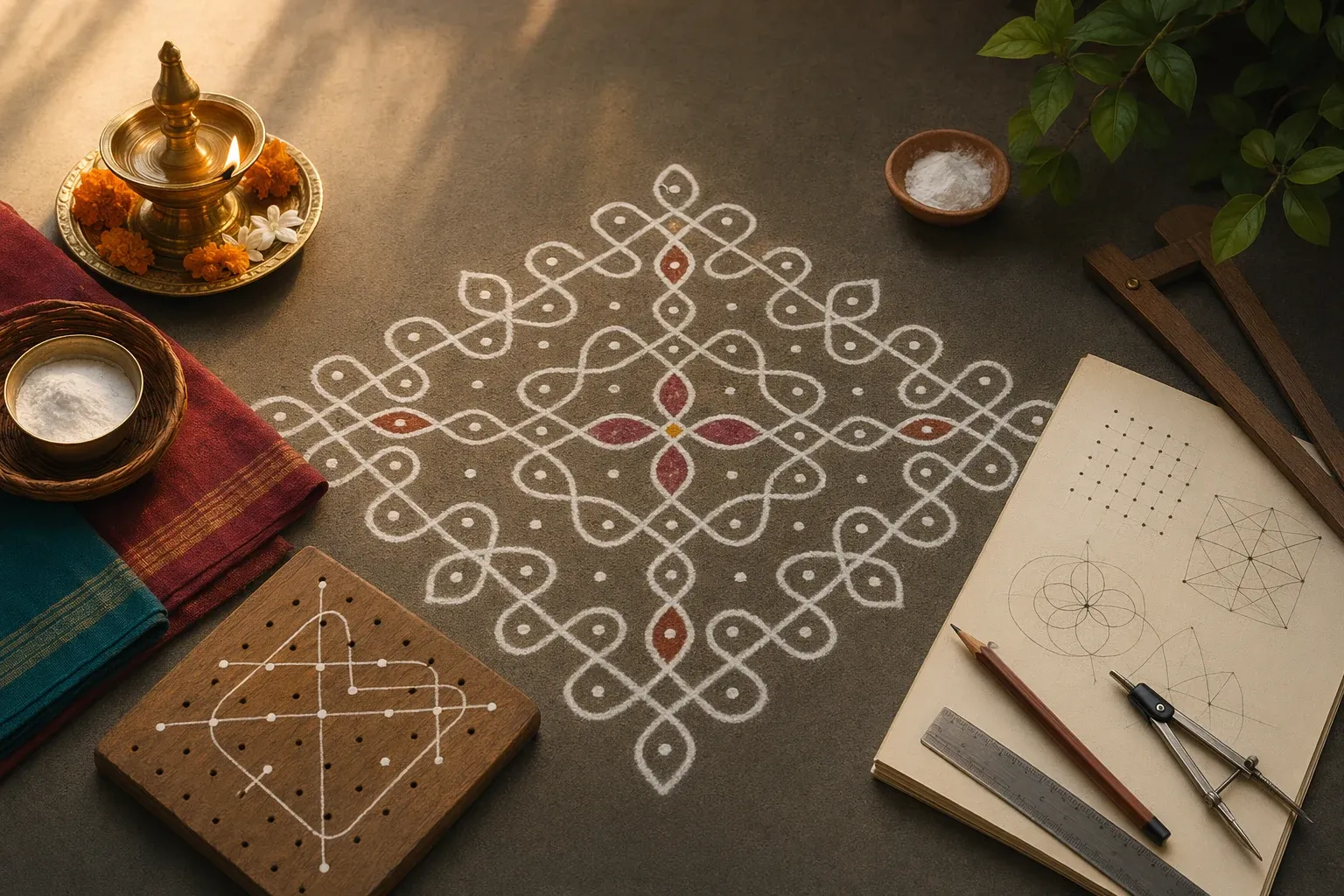
Kolam is not only art. It is also a quiet mathematics lesson drawn at the doorway. When someone places dots in a grid, draws loops around them, repeats a shape, balances left and right, or creates a pattern that returns to its starting point, they are using mathematical thinking even if they do not call it that.
For students, kolam is a beautiful example of how culture and mathematics can meet. It shows that geometry is not only in textbooks and exams. It can live in homes, courtyards, streets, festivals, and the hands of people who learned patterns by watching elders.
Why kolam is a pattern system
A pattern is something that follows a rule or rhythm. Kolam often uses repeated dots, lines, curves, loops, and mirrored shapes. The artist may not write the rule in algebra, but the rule is still there. For example, a line may go around each dot, turn at the same angle, and repeat until the whole design is complete.
This is why a kolam can feel satisfying to look at. The mind enjoys order. When the parts match, repeat, and balance, the design feels complete. Beauty and logic work together.
Dots as grids and coordinates
In pulli kolam, dots act like a grid. A simple 3 by 3 dot arrangement is similar to points on graph paper. The artist understands where the centre is, how far each dot is from the next, and how the line should move around them. This is basic spatial reasoning.
Students can think of each dot as a coordinate. The line travels near the dots, crosses spaces, turns around corners, and creates shapes. Even without numbers, the hand is reading distance and direction. That is mathematics in action.
Symmetry in kolam
Symmetry means balance across a line, point, or rotation. Many kolams have reflection symmetry, where the left side matches the right side. Some have rotational symmetry, where the same shape appears after turning the design around a centre. Festival designs with lamps or flowers often use this kind of circular balance.
Symmetry is one reason kolam is useful for students. You can fold a paper design in your mind and ask whether both sides match. If one petal is larger or one curve is too far away, the eye notices. The design becomes a gentle teacher.
Loops, paths, and repetition
Some kolams use one continuous line that loops around dots and returns to the beginning. This can introduce ideas related to paths, networks, and algorithms. An algorithm is simply a set of steps. In kolam, the steps might be: start near the top dot, curve around the next dot, turn left, repeat the loop, and close the pattern.
Computer scientists and mathematicians have studied kolam-like patterns because they show rule-based design, recursion, symmetry, and visual logic. This does not mean every household artist was doing computer science formally. It means traditional art can contain deep pattern intelligence.
Tradition, interpretation, and historical context
In tradition, kolam is primarily a living cultural practice connected with home, auspiciousness, discipline, welcome, and devotion. Families draw it because it belongs to daily life, not because they are trying to solve a school problem.
In interpretation, we can respectfully notice the mathematics inside the art. This does not reduce kolam to math alone. It adds another layer of appreciation. A kolam can be cultural, artistic, spiritual, ecological, and mathematical at the same time.
Historically, kolam knowledge passed through observation and practice. People learned by seeing where to place dots, how to turn lines, and how to correct mistakes. This kind of embodied learning is powerful because the body remembers patterns through repetition.
A simple classroom activity
Try this activity: draw a 4 by 4 dot grid on paper. First, connect the dots with straight lines to make squares. Then draw curves around the dots instead of through them. Next, create a design where the left side mirrors the right side. Finally, rotate the paper and see if the design still feels balanced.
Students can mark lines of symmetry with a pencil. They can count dots, compare distances, identify repeated shapes, and discuss which rules created the design. This turns kolam into a bridge between art class, math class, and cultural learning.
What kolam teaches beyond formulas
Kolam teaches patience, correction, proportion, and attention. A small mistake does not always ruin the design; sometimes it teaches you how to adjust the next curve. That is a useful lesson for mathematics too. Learning grows through practice, not panic.
The best part is that kolam makes mathematics feel human. It shows that patterns are not only printed in books. They are drawn by hands, remembered by families, and placed at the entrance of homes. When students see that, both culture and mathematics become more alive.
Why this matters for students
Many students think mathematics is separate from culture, but kolam proves otherwise. A person drawing a pattern may be estimating distance, checking symmetry, following a rule, and correcting proportion all at once. These are mathematical actions, even when they happen silently through the hand and eye.
This can change how students feel about both subjects. Culture becomes more intelligent, and mathematics becomes less frightening. A kolam pattern says that logic can be beautiful and beauty can have structure. That is a powerful lesson for anyone who has ever wondered why geometry matters outside the classroom.
Teachers can invite students to interview family members about patterns they know. This brings elders, language, art, and mathematics into the same conversation, making the lesson warmer and more memorable.