Kolam and rangoli are often used as if they mean the same thing. That is understandable because both are Indian floor-art traditions made near homes, temples, courtyards, and festival spaces. Both can be colourful, welcoming, and deeply connected with family culture. But they are not exactly identical.
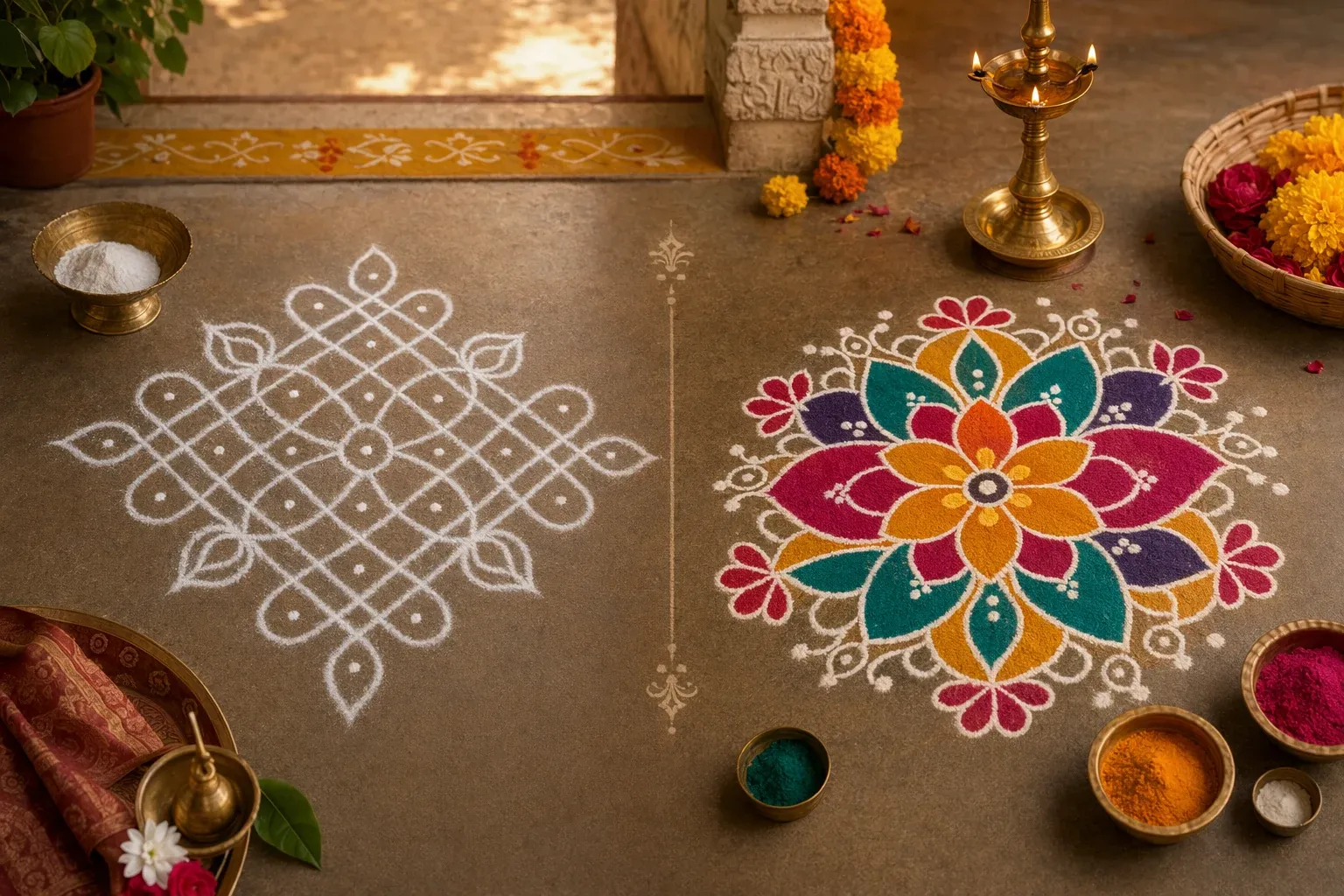
The simple difference is this: kolam is especially associated with Tamil Nadu and South Indian traditions, often drawn daily with rice flour or white powder using dots and flowing lines. Rangoli is a broader term used in many parts of India for decorative floor designs, especially during festivals, often made with coloured powders, flowers, grains, or other materials. There is overlap, but each word carries its own regional flavour.
Region and language
Kolam is a Tamil word and is strongly linked with Tamil homes, temples, and festivals. Related practices exist across South India with names like muggu or muggulu in Telugu-speaking regions and rangavalli in Kannada and Sanskrit-influenced contexts.
Rangoli is commonly used in North, West, and Central India, though it is also understood widely because of school activities, festivals, and social media. In Bengal, similar floor art may be called alpana. In Kerala, floral designs for Onam are called pookalam. These names are not just labels; they carry local materials, stories, and styles.
Daily practice and festival practice
Kolam is often a daily practice. In many households, a small design is made every morning after cleaning the threshold. During festivals, the designs may become larger and more colourful, but the daily rhythm is important to the identity of kolam.
Rangoli is often seen more strongly during festivals such as Deepavali, Navratri, weddings, housewarmings, and community celebrations. Of course, some families make rangoli regularly too. The difference is not a strict rule, but a common pattern in how people experience these traditions.
Materials and visual style
Traditional kolam is often made with rice flour, limestone powder, or chalk-like white powder. Many classic kolams use a dot grid, with lines drawn around or through the dots. This can create loops, knots, flowers, lamps, birds, and geometric patterns.
Rangoli often uses coloured powders and may include flowers, diyas, grains, pulses, sand, or petals. It can be geometric, floral, devotional, festive, or pictorial. A rangoli may show a diya, lotus, peacock, kalash, deity symbol, or festival greeting.
Tradition, interpretation, and historical context
In tradition, both kolam and rangoli are connected with auspiciousness, welcome, beauty, and care for the home. They mark a space as clean, loved, and ready to receive guests, family, and divine presence.
In interpretation, kolam often highlights rhythm, symmetry, discipline, and repetition. Rangoli often highlights celebration, colour, and festive expression. But these are gentle tendencies, not fixed boxes. A kolam can be colourful, and a rangoli can be geometric and disciplined.
Historically, Indian floor-art traditions grew through regional households, festivals, women’s artistic labour, temple culture, agricultural life, and community celebrations. They were passed down by watching elders, not only by reading manuals. That oral and practical learning is part of their charm.
Why people confuse the two
People confuse kolam and rangoli because both appear at entrances and both use powder on the ground. Social media also blends regional words quickly. A design from Tamil Nadu may be called rangoli online because more people search that word. A rangoli may be called kolam if it uses dots and white lines.
This mixing is not always harmful, but respectful language matters. If you know a design comes from a Tamil kolam tradition, call it kolam. If you are speaking broadly about Indian floor art, say that. Specific words help protect cultural detail.
A simple way to remember
Remember it like this: kolam is a specific South Indian, especially Tamil, floor-art tradition with a strong daily doorway practice and many dot-based patterns. Rangoli is a wider, commonly used term for decorative Indian floor designs, especially colourful festival designs in many regions.
Both traditions are beautiful. The point is not to rank them. The point is to see India’s cultural diversity clearly. When we use the right names with respect, we enjoy the art more deeply and honour the hands that kept it alive.
Similarities you should not miss
While the differences are useful, the similarities are equally beautiful. Both kolam and rangoli are made close to the ground, often at the entrance of a home or a shared celebration space. Both use pattern, repetition, and colour or contrast to make daily life feel special. Both are connected with welcome and auspiciousness.
Both also show how Indian art lives outside galleries. A grandmother teaching a child to place dots, a family filling colours before Deepavali, or neighbours admiring a festival design are all part of the art world in a very real sense.
How to speak about them respectfully
If you are unsure what to call a design, describe it carefully instead of guessing. You can say “a South Indian kolam-style floor design” or “a colourful rangoli design for the festival.” If someone from that region tells you the local name, use that name.
This respectful language is especially important online. A design may travel far from its original community through screenshots and reposts. Using the right word is a small way of keeping its cultural roots visible.
A good comparison should make both traditions clearer, not smaller. Kolam and rangoli share a love for pattern and welcome, while also preserving different regional voices. Holding both truths together is the most respectful way to learn.