
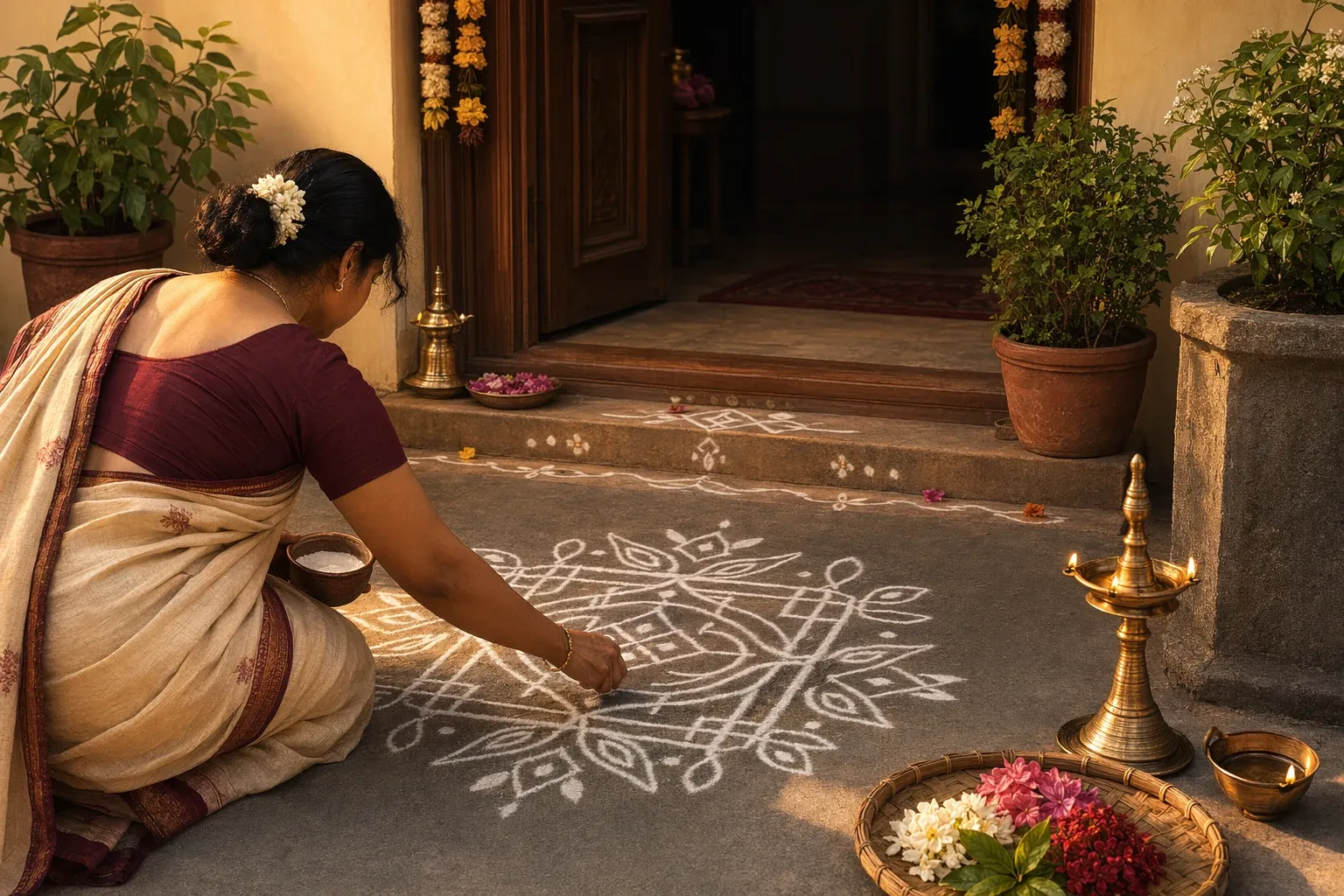
A kolam outside a home can feel like a small thing: a few lines of white powder near the doorway. But for many families, it carries a lot of meaning. It says the house is awake. It says the entrance has been cleaned and cared for. It says guests are welcome. It also says that beauty can begin before anyone steps inside.
People draw kolam outside homes for many reasons: auspiciousness, cleanliness, devotion, hospitality, discipline, artistic expression, and connection with nature. The exact meaning changes from family to family and region to region, but the doorway is important because it is the place where the private home meets the outside world.
A sign of welcome
The entrance of a home is not only a physical space. It is a social and emotional space. People arrive there, pause there, remove footwear there, greet each other there, and enter family life through it. A kolam makes that threshold feel cared for.
In many homes, drawing kolam is a way of welcoming guests, neighbours, and positive energy. It gives the front of the house a gentle dignity. Even a very simple design can make a doorway feel warm and alive.
Cleanliness and daily order
Kolam is often drawn after cleaning the entrance area. The act is linked with beginning the day in an orderly way. Sweep the ground, sprinkle water if needed, draw the design, and only then move into the day’s work. This rhythm turns cleaning into culture.
For young readers, this is a useful lesson. Tradition is not always about big ceremonies. Sometimes it is about small habits repeated with care. A clean doorway and a fresh kolam can create a feeling of mental freshness too.
Auspiciousness and devotion
In many households, kolam is connected with auspiciousness. It may be seen as inviting blessings and creating a positive atmosphere. During festivals, special designs may include lamps, lotuses, sugarcane, pots, peacocks, or other sacred and seasonal motifs.
Some families connect kolam with goddess traditions, especially the idea of welcoming prosperity, grace, and sacred presence. Others may not explain it in formal religious language but still feel that the practice brings goodness to the home.
In modern flats and busy city life, this practice may become smaller, simpler, or occasional, but the heart of it can remain the same: pause at the threshold, clean the space, create beauty, and begin the day with attention. A tiny white kolam outside a door can carry the same message as a larger courtyard design — this home welcomes goodness, remembers tradition, and treats the entrance as more than just a passageway.
Tradition, interpretation, and historical context
In tradition, kolam belongs to the everyday cultural life of South Indian homes. It has been learned by watching mothers, grandmothers, neighbours, and community members. The knowledge often passes through practice rather than lectures.
In interpretation, the doorway kolam can be seen as a bridge between beauty and duty. It makes the home attractive, but it also teaches attention, patience, symmetry, and responsibility for shared space. Because it is visible to the street, it quietly contributes to the beauty of the neighbourhood.
Historically, kolam has been part of domestic art, women’s creative labour, festival culture, and local identity. It reminds us that cultural history is not only made by kings, wars, and monuments. It is also made by ordinary hands shaping ordinary mornings.
Rice flour and care for living beings
One meaningful explanation is that traditional rice flour kolams can feed small creatures such as ants and birds. Not every modern kolam uses rice flour, and not every surface allows it, but the idea is beautiful. The home is not isolated from nature; it shares space with other life.
This does not mean every kolam must be explained only as ecology. It has many layers. But the rice-flour idea shows how Indian traditions often connect beauty with generosity and daily life with the natural world.
Why it still matters
In apartments and busy cities, many people make smaller kolams, sticker kolams, chalk kolams, or festival-only designs. The form changes, but the feeling can remain: start the day with care, make the entrance welcoming, and keep a link with family memory.
A kolam outside the home is a quiet cultural sentence. It says, “This space is cared for.” It says, “Beauty belongs in daily life.” Most importantly, it reminds us that tradition survives not only when we talk about it, but when we practise it with attention.
A practice that builds belonging
Kolam also creates a sense of belonging. In streets where many homes draw designs, the whole neighbourhood can feel connected by a shared morning rhythm. People may recognise each other’s styles, learn patterns from one another, or admire a special festival design. Culture becomes visible in public space without needing a formal event.
For children, the doorway kolam can become a memory of home. They may remember the sound of sweeping, the smell of wet earth, the bowl of powder, or the patient hand of an elder. Years later, a simple white design can bring back that feeling.
Modern changes
Today, the practice has changed in many places. Busy schedules, apartment rules, tiled floors, pollution, and lack of open space can make daily kolam difficult. Some people use small chalk designs, ready-made stencils, stickers, or only festival kolams. These changes are not automatically a loss if the meaning is still respected.
The main idea is care. Whether the design is large or tiny, daily or occasional, handmade or adapted, it should carry respect for the tradition and for the people who share the space.
That is why a doorway kolam can feel emotional even when it is simple. It is a small public sign of private attention: someone woke up, cleaned this place, and offered beauty before beginning the day.