
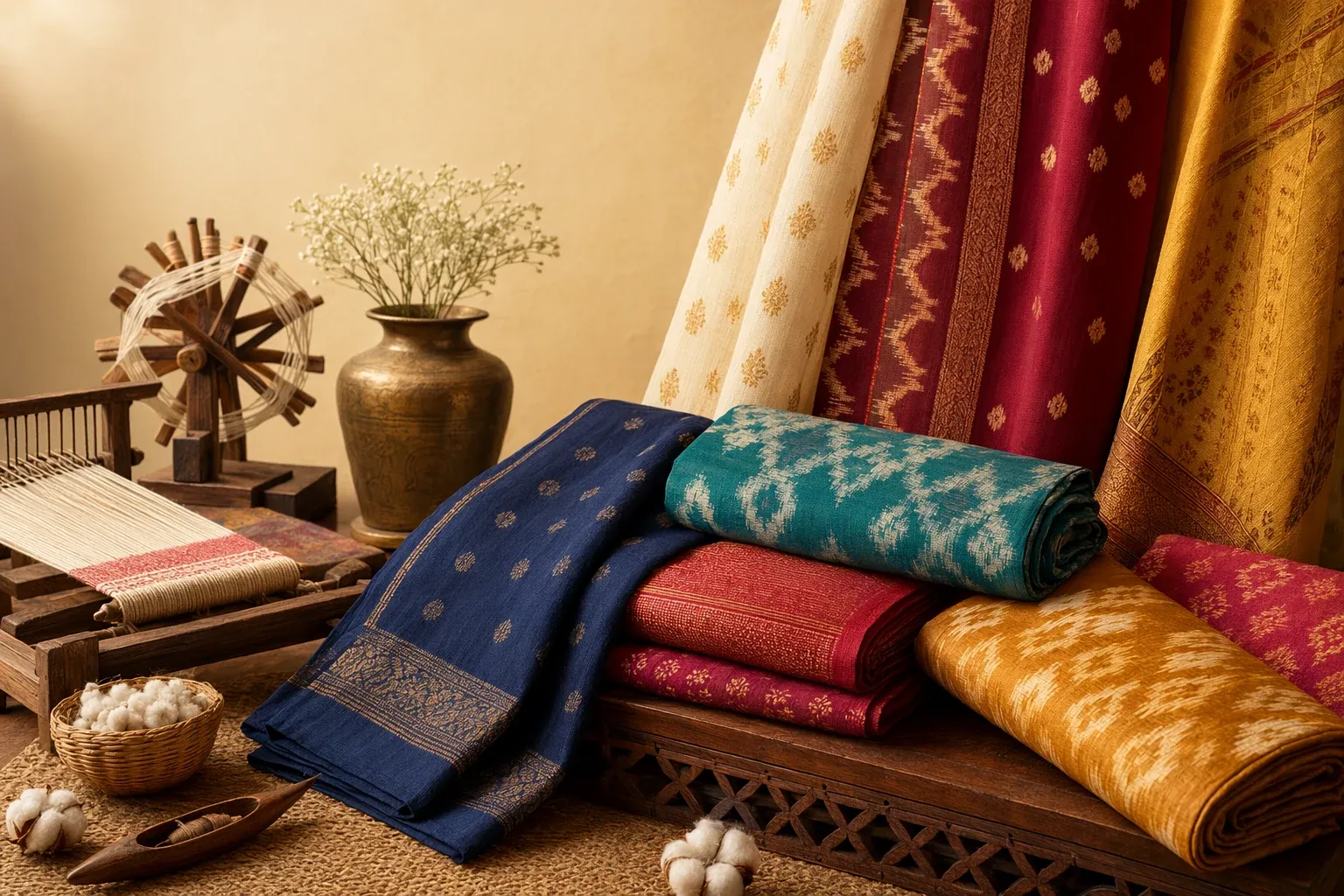
Traditional Indian textiles are easier to understand when you group them by technique rather than trying to memorise every name at once. Some are famous because of weaving, some because of dyeing, some because of printing, and some because of embroidery. A beginner does not need to know every regional variation immediately. The first step is to recognise the broad families and the feeling each one carries.
India’s textile traditions grew from local climate, available fibres, courtly patronage, temple life, community skill, trade routes, and everyday clothing needs. That is why a fine silk sari, a printed cotton, a wool shawl, a tie-dyed odhani, and an embroidered phulkari can all be traditional textiles, even though they look and feel very different.
Banarasi brocade
Banarasi textiles are closely associated with Varanasi and are especially famous for silk brocades. Many Banarasi saris use metallic-looking zari work, floral patterns, paisleys, jaal designs, and rich borders. They are often worn for weddings and formal occasions because they carry a sense of celebration and dignity.
A beginner should notice the weight, shine, border, and woven pattern. Banarasi cloth is not simply decorated after weaving; much of its beauty comes from the weaving itself.
Kanjeevaram silk
Kanjeevaram, or Kanchipuram silk, is one of South India’s most respected sari traditions. These saris are known for strong silk, vivid colours, contrast borders, temple-inspired motifs, checks, stripes, and a grand festive presence. They are closely linked with weddings, classical events, and family heirlooms.
The important idea is that textile tradition can carry both beauty and social memory. A Kanjeevaram sari may be treasured not only for price or design, but because it marks a ceremony or a family moment.
Chanderi and Maheshwari
Chanderi and Maheshwari textiles from Madhya Pradesh are loved for lightness, elegance, and wearable grace. Chanderi is often associated with sheer texture and delicate motifs. Maheshwari fabrics may show stripes, checks, reversible borders, and a balance of cotton-silk comfort.
These textiles help beginners see that traditional does not always mean heavy. Some Indian fabrics are valued because they are airy, subtle, and suited to warm weather.
Ikat traditions
Ikat is a resist-dye technique in which yarns are dyed before weaving. The pattern is planned into the threads, so the final cloth often has a slightly blurred, rhythmic look. India has important Ikat traditions in Odisha, Telangana, Andhra Pradesh, and Gujarat, among other places.
For beginners, Ikat is a good example of hidden planning. The design appears in the finished cloth, but the thinking begins before the weaving. That makes it different from surface printing.
Bandhani and Leheriya
Bandhani is a tie-dye tradition strongly associated with Gujarat and Rajasthan. Tiny tied points create dotted designs after dyeing. Leheriya, especially linked with Rajasthan, creates flowing wave-like stripes through rolling and tying cloth before dyeing.
These textiles are often bright, festive, and full of movement. They show how dye can create pattern without a brush or printed block.
Ajrakh, Bagru, and Sanganeri prints
Block-printed textiles are made by pressing carved wooden blocks onto cloth with dye or pigment. Ajrakh is known for complex geometry and deep colours, often associated with Kutch and Sindh-linked traditions. Bagru and Sanganeri printing from Rajasthan are known for distinctive floral and natural forms, though their processes and visual moods differ.
Block printing teaches an important lesson: repetition does not mean machine-like sameness. A handmade repeat carries small variations that reveal human touch.
Jamdani
Jamdani is a fine weaving tradition associated with Bengal and Bangladesh. It is known for delicate motifs that seem to float on light cloth. The work demands great patience, because the pattern is created during weaving with extra weft techniques.
Beginners can remember Jamdani as an example of quiet luxury: light, detailed, and graceful rather than loud.
Paithani
Paithani from Maharashtra is known for silk, rich borders, and motifs such as peacocks, lotuses, and vines. It is often seen as a heritage sari tradition and may be worn during weddings and important ceremonies.
Paithani reminds us that motifs are not random decoration. They often carry auspicious, natural, or regional meaning.
Phulkari, Kantha, and Chikankari
Embroidery traditions are another major group. Phulkari from Punjab is known for colourful threadwork and floral energy. Kantha from Bengal often uses running stitches and can transform old cloth into layered, meaningful textiles. Chikankari from Lucknow is famous for delicate whitework and refined floral patterns.
Embroidery adds intimacy to cloth because each stitch sits on the surface like a mark of time. It can be festive, domestic, refined, or deeply personal.
Pashmina and woollen shawls
Indian textiles also include wool traditions. Kashmir’s fine shawls are famous, especially pashmina-related work, though buyers should be careful because the market includes many blends and imitations. Other Himalayan and hill regions also have wool weaving traditions suited to cold climates.
This shows how geography shapes cloth. Warm regions often favour cotton and airy weaves; colder regions develop shawls, blankets, and thicker fabric traditions.
How to study traditional textiles without confusion
A useful beginner method is to make four columns: woven, dyed, printed, embroidered. Place each textile name under the technique that best explains it. Banarasi, Kanjeevaram, Chanderi, Maheshwari, Jamdani, and Paithani begin with weaving. Bandhani, Leheriya, and many Ikats involve resist dyeing. Ajrakh, Bagru, and Sanganeri belong to printing. Phulkari, Kantha, Chikankari, Kutch work, and Zardozi belong to embroidery.
Some textiles combine more than one technique, so this is only a starting map. Still, it helps you see the logic behind the variety.
For place-based learning, famous textile cities of India is a useful next read. If you enjoy handmade visual culture beyond cloth, what is Kolam shows how design, repetition, and daily practice can also become cultural memory.
The simple takeaway is that traditional Indian textiles are not frozen antiques. They are living skills. Some are ceremonial, some everyday, some luxurious, some humble, but all show how cloth can carry identity, artistry, and inherited knowledge.