
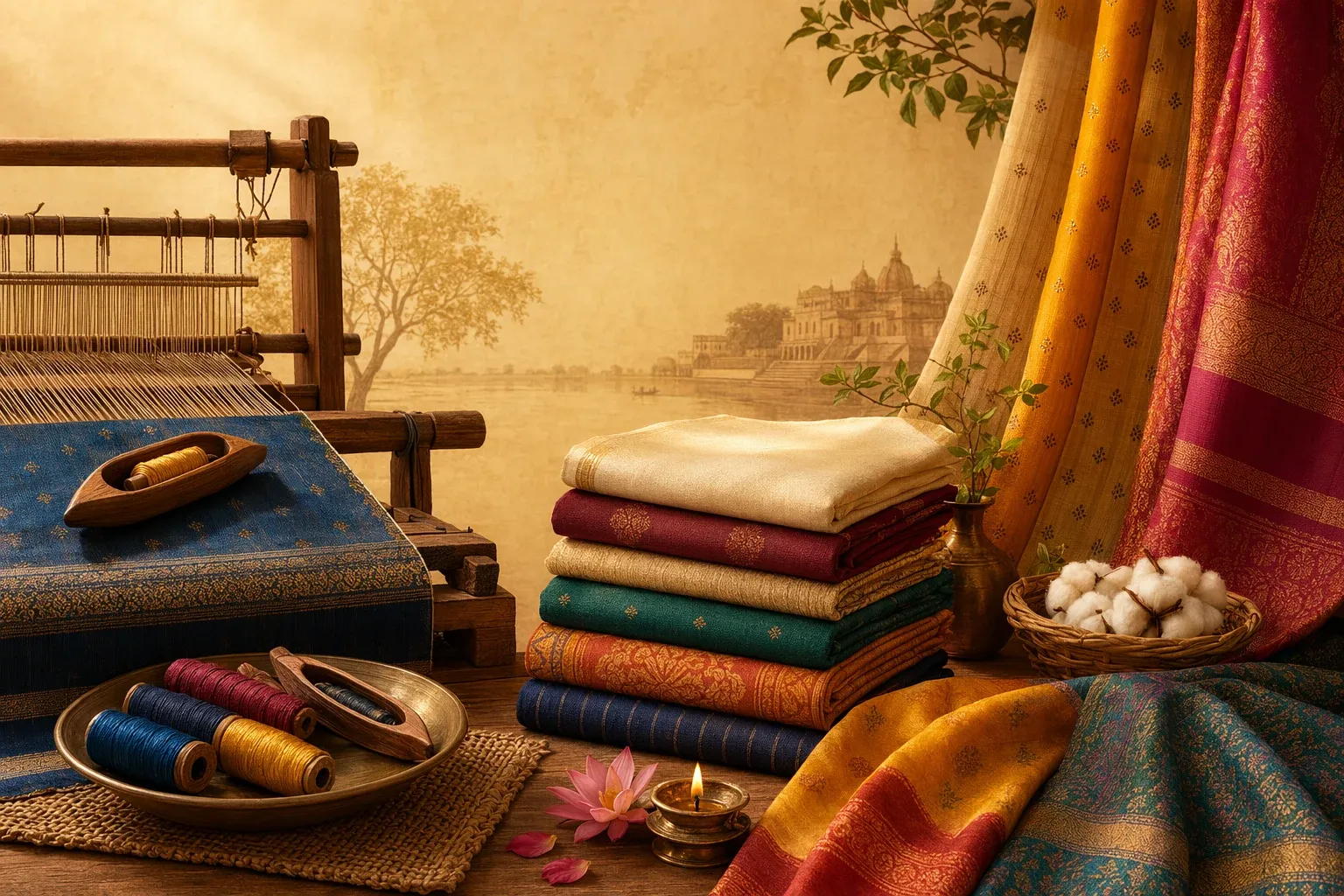
Indian handloom textiles are fabrics woven manually on a loom rather than produced entirely by automated industrial machinery. The word handloom does not mean rough, old-fashioned, or only rural. It means that human skill remains central to the making of the cloth. A weaver controls the rhythm, thread tension, pattern, edges, and many small decisions that affect the final fabric.
For beginners, the easiest way to understand handloom is to imagine cloth as interlaced threads. The lengthwise threads are called warp. The crosswise threads are called weft. A loom holds the warp in place while the weaver passes the weft across it again and again. From that repeated movement, fabric grows.
Why handloom feels different
Handloom cloth often has a texture that feels alive. It may show tiny irregularities, soft slubs, slight changes in tension, or small variations in pattern. These are not always flaws. In many handmade fabrics, they are signs of human making. The cloth may breathe differently from powerloom fabric, fall differently on the body, and age with a softer character.
This does not mean every handloom fabric is automatically superior to every mill-made fabric. Different cloths serve different needs. But handloom deserves respect because it preserves skill, supports craft communities, and keeps regional design languages active.
What makes a textile handwoven
A handwoven fabric begins with yarn. The yarn may be cotton, silk, wool, linen, jute, or a blend. It may be dyed before weaving or after weaving. The warp is prepared carefully because any error can disturb the structure of the cloth. The weaver then uses the loom to interlace warp and weft.
Some handloom cloth is plain and everyday. Some is highly decorative. A simple cotton towel, a checked lungi, a fine sari, a shawl, a stole, and a ceremonial border can all come from handloom traditions. The common factor is not luxury. The common factor is the central role of the loom and the weaver.
Famous handloom examples in India
India has many handloom traditions. Banarasi brocade from Varanasi is known for elaborate weaving and festive use. Kanjeevaram silk from Tamil Nadu carries strong borders and ceremonial presence. Chanderi and Maheshwari from Madhya Pradesh are admired for lightness and elegance. Jamdani is known for delicate woven motifs. Paithani from Maharashtra is loved for rich silk and ornate borders. Muga silk from Assam has a natural golden tone and regional pride.
There are also countless everyday handloom cottons that may not be as famous in tourist language but are deeply important in daily life. A region’s plain weave can be just as meaningful as its grandest sari, because it shows how craft meets climate and use.
Handloom and regional identity
Handloom textiles often carry the identity of a place. A border style, colour pairing, motif, or weave structure may immediately remind people of a district, town, community, or weaving cluster. This place identity matters because textiles are not only made for the market. They are also made for weddings, rituals, family gifts, festivals, dance, temple visits, and seasonal comfort.
A handloom sari from one region may signal auspiciousness. A shawl from another region may signal winter, hospitality, or status. A cotton weave may be loved because it suits local heat. A temple border may carry architectural memory in fabric form.
Why handloom can cost more
Handloom can be more expensive because time is part of the price. Preparing yarn, setting the loom, dyeing, weaving, finishing, and checking cloth all require labour. If the textile includes complex borders, extra weft, fine counts, natural dyeing, or detailed motifs, the time increases.
A low price is not always a bargain if it hides unfair labour or mislabelling. A high price is not always proof of authenticity either. Beginners should ask careful questions: who made it, what fibre is used, where it comes from, what technique is involved, and whether the seller gives clear information.
Handloom and sustainability
Handloom is often discussed with sustainability, but the topic needs balance. Manual weaving can use less energy than industrial production, and natural fibres can be comfortable and long-lasting. Many handloom pieces are repaired, inherited, or used for years. These are real strengths.
At the same time, dyeing, transport, fibre sourcing, and market pressure still matter. A respectful view does not turn handloom into a perfect slogan. It recognises that supporting skilled makers, buying fewer but better pieces, caring for cloth properly, and avoiding fake labels are practical ways to value the tradition.
How to appreciate handloom as a beginner
Look closely at the edges, the fall, the texture, and the reverse side. Notice whether the design is woven into the cloth or printed on top. Ask if the fabric has a known region or weaving centre. Learn the difference between handloom, handspun, hand-block-printed, and hand-embroidered, because these words describe different kinds of work.
You can also compare similar pieces. Place a powerloom imitation beside a handwoven fabric if a trusted seller or teacher can explain the difference. Over time, your eye will start noticing rhythm, structure, and touch.
Care for handwoven cloth
Handloom fabrics often last longer when handled gently. Avoid harsh washing unless the seller says it is safe. Store silks and fine cottons away from direct sunlight. Air out heirloom textiles occasionally. Fold heavy saris differently from time to time so the same crease does not weaken the cloth. Use breathable storage when possible.
The care itself is part of respect. A handmade cloth has already passed through many hands before it reaches your home.
For a wider regional map, read famous textile cities of India. For another handmade Indian tradition with strong community identity, Warli art from Maharashtra is a helpful comparison.
The simple takeaway is this: Indian handloom is not just cloth made slowly. It is cloth made with knowledge. Every handwoven piece carries decisions about fibre, region, use, pattern, and dignity. When you learn to see those decisions, the fabric becomes more than something to wear. It becomes a record of skilled human work.