
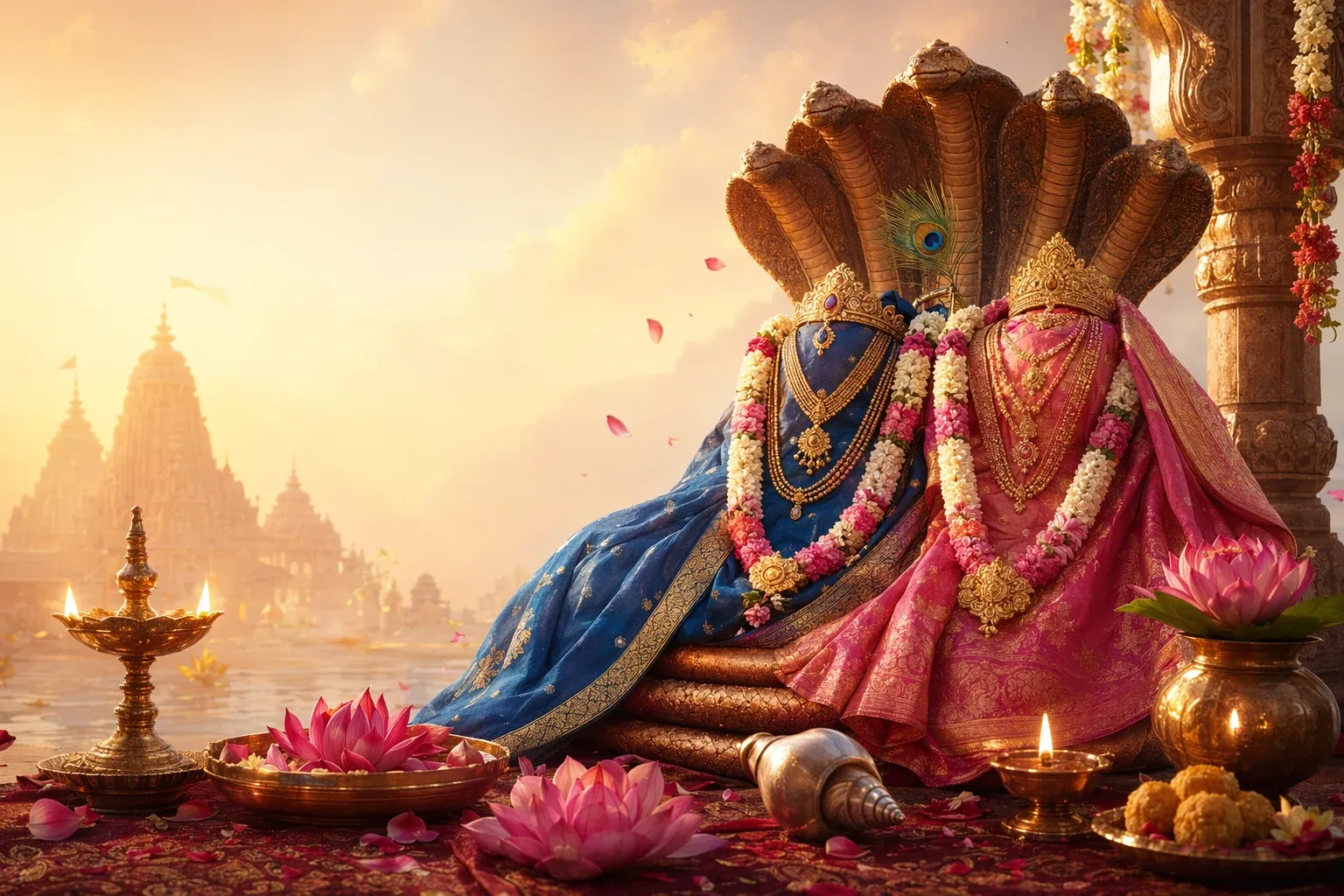
Vishnu and Lakshmi are among the most beloved divine pairs in Hindu worship. Vishnu is the preserver who protects dharma and cosmic order. Lakshmi is the goddess of prosperity, beauty, dignity, nourishment, and auspiciousness. Together they teach that a well-lived life needs both order and grace.
Why Vishnu and Lakshmi are worshipped together
Prosperity by itself can become restless or selfish. Order by itself can feel dry or severe. Vishnu and Lakshmi together show prosperity guided by dharma and preservation softened by compassion. Their pairing is not merely romantic. It is theological, ethical, and devotional.
In many homes and temples, devotees pray to them for wellbeing, stability, harmony, and righteous abundance. The prayer is not only for money. It is also for enoughness, dignity, generosity, and the wisdom to use resources well.
Lakshmi-Narayana meaning
The combined name Lakshmi-Narayana honours the divine couple as one devotional focus. Narayana is a major name of Vishnu, and Lakshmi is inseparable from his auspicious presence. When devotees say Lakshmi-Narayana, they are remembering protection and prosperity together.
This matters because Hindu worship often avoids separating power from responsibility. Wealth should serve dharma. Protection should nourish life. Blessing should become generosity.
Their marriage in sacred imagination
Stories describe Lakshmi choosing Vishnu during the churning of the ocean. As divine treasures emerge, Lakshmi appears with beauty and radiance. She chooses Vishnu because he is steady, righteous, and worthy of trust. The story suggests that true prosperity rests where there is balance and virtue.
Their marriage is therefore more than a family detail. It is a lesson about what kind of life can hold abundance without being corrupted by it.
Lakshmi at Vishnu’s side
Images often show Lakshmi near Vishnu, sometimes serving his feet, sometimes seated with him, sometimes worshipped as part of the divine pair. Modern readers may misunderstand these images if they see only hierarchy. In devotional interpretation, Lakshmi’s presence is powerful and indispensable.
She is not an accessory. She is Shri, auspicious radiance. Vishnu’s preservation is experienced as gracious because Lakshmi is with him. Her compassion makes divine order feel welcoming.
Prosperity with responsibility
The couple’s teaching is very practical. A family may pray for income, but the deeper prayer is for income used well. A leader may pray for success, but the deeper prayer is for success that protects others. A student may pray for opportunity, but the deeper prayer is for opportunity joined with humility.
Lakshmi without dharma can become greed. Dharma without kindness can become pride. Lakshmi-Narayana holds the two together.
Different forms and names
In South Indian temples, Vishnu and Lakshmi are worshipped through forms such as Venkateswara with Padmavati, Ranganatha with Ranganayaki, or Narayana with Shri Devi and Bhu Devi. These forms show how local devotion gives intimate names to the same sacred relationship.
Each temple tradition has its own poetry, songs, festivals, and stories. The shared heart is the same: divine preservation is never empty of grace.
For a broader frame, you may also enjoy Kalki Avatar explained and Bhaktilipi’s guide to common Hindu yantras.
What beginners can take from this pairing
A beginner does not need to master every story at once. Start with the central lesson. Vishnu and Lakshmi teach that the good life is not built by power alone or wealth alone. It is built by protection, beauty, generosity, steadiness, and moral purpose.
When devotees bow to Vishnu and Lakshmi together, they are asking for a life that is secure without becoming hard, prosperous without becoming selfish, and beautiful without forgetting dharma.
What their pairing teaches about wealth
Lakshmi’s presence is often associated with wealth, but Hindu tradition gives wealth a moral frame. Wealth should nourish, not merely accumulate. It should support family duties, hospitality, learning, charity, worship, and social responsibility. When Lakshmi is remembered with Vishnu, prosperity is placed under the guidance of dharma.
This is a valuable lesson for modern readers. Success is not wrong, comfort is not wrong, and beauty is not wrong. The question is whether these blessings make a person more generous, steady, and grateful, or more anxious and proud. Lakshmi-Narayana points toward the first path.
What their pairing teaches about protection
Vishnu’s protection is also enriched by Lakshmi. Protection is not only the defeat of danger. It is the creation of conditions where life can flourish. A protected home has food, dignity, trust, kindness, and hope. A protected society has justice as well as care. Lakshmi’s presence makes preservation feel warm and life-giving.
This is why the pair is so beloved in household worship. Devotees are not asking only for cosmic order in an abstract sense. They are asking for a life where virtue and wellbeing can live together.
A beginner-friendly prayerful understanding
A simple prayer to Vishnu and Lakshmi might ask for enough resources, a clean heart, wise decisions, and the ability to share. That prayer captures the spirit of their relationship better than a shallow request for wealth alone.
Their divine marriage teaches that prosperity should sit beside righteousness, and righteousness should be filled with compassion. When both are present, life becomes not only successful but auspicious.