
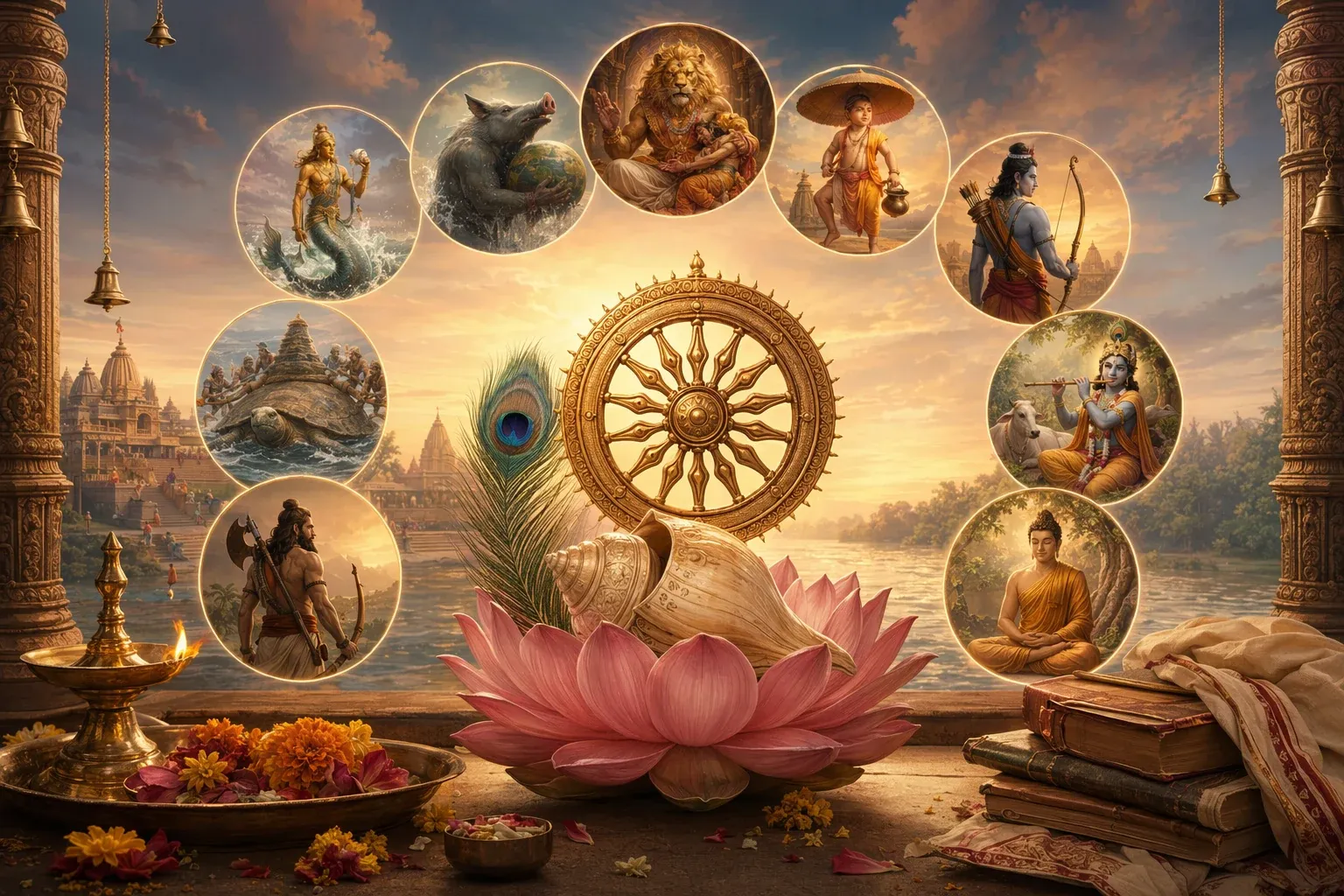
Vishnu avatars are often introduced as a list of ten famous forms, but the deeper idea is simpler and more moving: whenever dharma needs protection, the divine comes close to the world in a form people can recognise. An avatar is not just a costume or a mythic episode. It is a descent of compassion, shaped for the need of that moment.
What an avatar means
The Sanskrit word avatara means a descent. In Vishnu traditions, this descent shows that preservation is active, not passive. Vishnu does not merely watch the world from a distance. He enters stories, families, forests, battlefields, rivers, kingdoms, and humble homes when balance has to be restored.
For beginners, this is the key: each avatar answers a different kind of disorder. Sometimes the danger is cosmic pride. Sometimes it is violence, greed, forgetfulness, or misuse of power. The form changes because the problem changes.
The Dashavatara at a glance
The best-known list is called the Dashavatara, the ten avatars. Many people learn them in this order: Matsya the fish, Kurma the tortoise, Varaha the boar, Narasimha the man-lion, Vamana the dwarf, Parashurama the warrior sage, Rama the righteous king, Krishna the divine guide, Buddha or Balarama depending on the tradition, and Kalki, the future restorer.
Lists can vary by region and tradition, so it is wise not to treat one list as the only possible one. The pattern matters more than memorising every debate. From water to land, from animal forms to royal and teaching forms, the sequence shows divine help meeting creation at many levels.
Why the early forms matter
Matsya protects sacred knowledge during a flood. Kurma supports the churning of the ocean, becoming the steady base beneath a cosmic effort. Varaha lifts the earth when she is dragged into darkness. These early avatars feel vast because they deal with survival, stability, and the rescue of the world itself.
They also teach a practical lesson. Preservation often begins with support. Before there can be wisdom or justice, there must be a world to stand on, knowledge to remember, and patience to carry a heavy task.
Narasimha and Vamana: power with precision
Narasimha appears in a form that is neither fully human nor animal, neither inside nor outside, neither day nor night. The story shows that arrogance cannot outsmart truth forever. The divine answer is exact, not random. Protection comes fiercely for Prahlada, the child devotee, but it is not cruelty for its own sake.
Vamana, by contrast, is small and gentle. He asks for three steps of land and then reveals cosmic majesty. This avatar teaches that humility can contain immeasurable strength. Vishnu does not always arrive with visible force; sometimes he arrives as a quiet request that exposes pride.
Rama and Krishna: dharma in human life
Rama and Krishna bring the teaching closer to ordinary human concerns. Rama is remembered for duty, restraint, kingship, loyalty, and the painful cost of righteous action. Krishna is remembered as friend, guide, strategist, beloved child, cowherd, and teacher of the Bhagavad Gita.
Together they show that dharma is not abstract. It appears in family choices, public responsibility, friendship, grief, courage, and devotion. A beginner need not reduce them to one lesson. Their stories remain powerful because they hold many lessons at once.
Kalki and the hope of renewal
Kalki, the future avatar, points toward renewal when disorder becomes overwhelming. The idea is not meant to encourage fear or date-setting. It reminds devotees that decline is not the final word. Dharma can be restored even when things look beyond repair.
For a broader frame, you may also enjoy Kalki Avatar explained and Bhaktilipi’s guide to common Hindu yantras.
A respectful way to understand the avatars
The avatars are best read as sacred teaching stories, devotional forms, and philosophical symbols together. They are not merely entertainment, and they are not only historical claims to be argued about. For many devotees, they are living reminders that divine protection can be gentle, fierce, hidden, playful, royal, or future-facing.
If you remember one thing, remember this: Vishnu’s avatars show preservation as love in action. The form changes, but the purpose remains the same: to protect dharma, guide beings, and keep hope alive.
How to read avatar stories without confusion
A good beginner approach is to ask three questions of each avatar story. What disorder is present? What form does Vishnu take? What value is restored? Matsya protects memory and wisdom. Kurma supports a difficult shared effort. Varaha rescues the earth. Narasimha protects devotion from tyranny. Vamana humbles pride without arriving as a conqueror. Rama shows the discipline of righteous action. Krishna teaches wisdom in the middle of moral conflict.
This method keeps the stories from becoming a scattered collection of miracles. It also prevents a narrow reading where every avatar is treated only as a battle scene. The stories are about restoration. Sometimes restoration is gentle support, sometimes moral instruction, sometimes protection of a devotee, and sometimes the defeat of destructive arrogance.
Common beginner mistakes
One common mistake is to argue only about the exact list. Another is to treat the sequence as a simple chart of evolution and stop there. Such comparisons may be interesting, but they do not replace the devotional meaning. The Dashavatara is loved because it gives people courage: when the world faces different kinds of imbalance, the divine response can meet that need in a fitting way.
A daily-life lesson
The avatars also invite a practical question: what kind of protection is needed now? A family may need patience like Kurma. A student may need clear vision like Krishna’s teaching. A community may need courage like Narasimha’s protection of Prahlada. The stories become useful when they help people protect truth, humility, and compassion in ordinary life.