
# What Is Vishnu Purana? Author, Stories, and Why It Matters
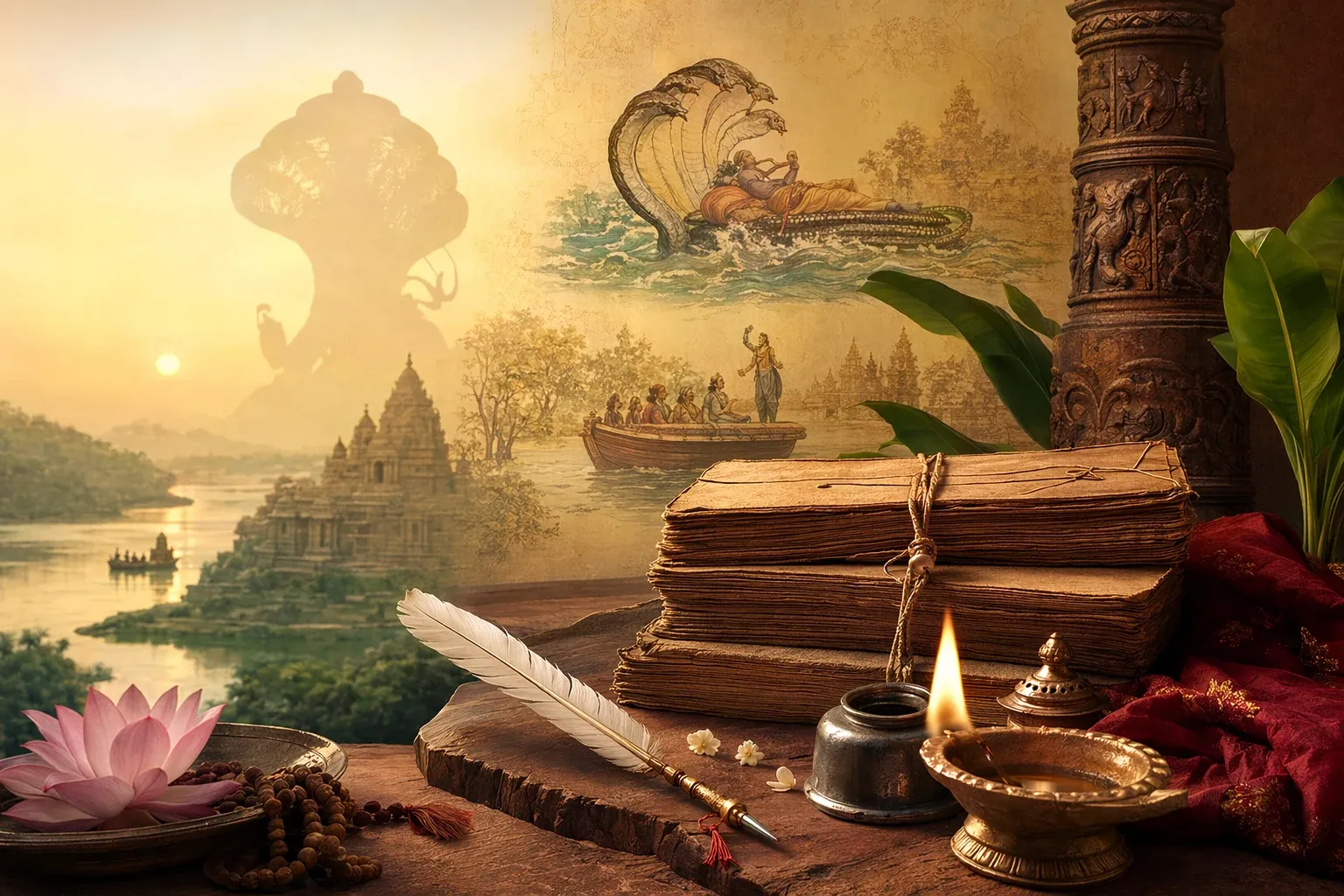
The Vishnu Purana is one of the important Puranas of Hindu tradition and a central text for understanding Vishnu as the sustaining, supreme, and compassionate presence in the universe. A beginner may hear the title and assume it is only a book of stories about one deity. It is better understood as a layered sacred text: part mythology, part cosmology, part genealogy, part devotional teaching, and part cultural memory.
Like many Hindu texts, the Vishnu Purana is not meant to be read only as a modern history book. It preserves religious imagination, moral teaching, sacred geography, and devotional insight. Its stories help readers ask how the world is ordered, why dharma matters, and how Vishnu is remembered across time.
What does “Purana” mean?
The Sanskrit word Purana is often connected with what is ancient or old, but a Purana is not simply “an old book.” Puranas are a genre of Hindu literature that retell sacred knowledge through stories, lineages, creation accounts, cycles of time, places of worship, vows, festivals, and teachings. They helped carry complex ideas into forms that families, communities, priests, poets, and devotees could remember.
A Purana may discuss the creation of the universe, the ages of time, the duties of people, the stories of sages and kings, and the greatness of particular deities. The Vishnu Purana presents this world through a Vaishnava lens, meaning Vishnu is central to its understanding of cosmic order and liberation.
Who wrote the Vishnu Purana?
Traditionally, the Vishnu Purana is attributed to the sage Vyasa, who is also associated with arranging the Vedas and with the Mahabharata tradition. Within the text’s own teaching setting, sacred knowledge is passed through sages. This matters because Hindu texts often present wisdom as heard, remembered, taught, and transmitted through a lineage rather than as the private invention of one author.
Modern scholars may discuss layers of composition, oral transmission, regional recensions, and historical development. A respectful beginner can hold both points together: tradition honours Vyasa and the sage lineage, while academic study asks how the text reached its present form over time. These approaches need not be treated as enemies. They answer different kinds of questions.
What is inside the Vishnu Purana?
The Vishnu Purana includes accounts of creation, cosmic cycles, genealogies of gods, sages and kings, stories connected with Vishnu’s forms, teachings about dharma, and descriptions of the world. It also contains devotional passages that praise Vishnu as the supreme reality and the support of all beings.
One of the reasons the text matters is that it links cosmic scale with human responsibility. The universe is vast, time moves through immense cycles, and yet a person’s conduct still matters. Dharma is not lost in the size of the cosmos. It becomes even more important because life is part of a larger moral and spiritual order.
Vishnu at the centre
In the Vishnu Purana, Vishnu is not merely one character among many. He is the sustaining principle behind the universe. He protects dharma, appears through forms, receives devotion, and is praised as the source and refuge of existence. This is why the text is especially important for Vaishnava traditions.
For readers familiar with Vishnu’s avatars, the Purana gives a larger frame for those stories. Avatars are not isolated miracles. They are part of the recurring pattern of divine care for the world. If you want an accessible starting point on that idea, read Bhaktilipi’s guide to Vishnu avatars and the Dashavatara.
Stories, memory, and teaching
Puranic stories often teach through memorable scenes rather than abstract lectures. A king asks a question. A sage replies. A cosmic event unfolds. A devotee is tested. A deity acts in a way that reveals the deeper structure of dharma. This style makes the teaching portable. A story can be retold in a home, temple, classroom, or festival setting.
The Vishnu Purana’s stories also shape how Vishnu is imagined: as protector, as cosmic support, as the divine behind the order of worlds, and as the one to whom devotion can be directed. The stories do not always move like a modern novel. They may shift from genealogy to cosmology to praise. That is part of the Purana style.
Is it the same as the Bhagavata Purana?
No. The Vishnu Purana and the Bhagavata Purana are related in the broad Vaishnava world, but they are not the same text. The Bhagavata Purana is especially famous for its detailed devotional focus on Krishna, including the childhood and Vrindavan stories beloved in bhakti traditions. The Vishnu Purana also discusses Krishna and Vishnu’s forms, but its structure and emphasis are different.
A beginner should not worry about mastering every Purana at once. Start by understanding what each text is trying to highlight. The Vishnu Purana gives a strong vision of Vishnu as the cosmic preserver and supreme refuge.
Why it matters today
The Vishnu Purana matters because it helps modern readers see how Hindu culture remembers time, duty, devotion, and divine protection. It also shows that Hindu learning is not limited to short definitions. Ideas are carried through stories, names, places, rituals, lineages, and poetic praise.
For young readers, this can correct a common misunderstanding. Hindu texts are not only rulebooks or myth collections. They are living reservoirs of meaning. They ask readers to connect imagination with ethics and devotion with responsibility.
The text also helps explain why Vishnu is worshipped through many names and forms. Narayana, Hari, Krishna, Rama, and other names carry different devotional moods. To understand the living tradition around Vishnu, it helps to read the Purana alongside temple practice, chanting, festival observances, and family storytelling.
How a beginner can approach it
A beginner does not need to start by reading the entire Sanskrit text alone. A good path is to read a reliable translation or summary, note the main themes, and keep a small list of repeated ideas: creation, cosmic time, dharma, devotion, avatars, kings, sages, and liberation. When a genealogy or long list appears, do not panic. Ask what the passage is doing in the larger teaching.
It is also helpful to compare the text with related Bhaktilipi guides, such as where Vishnu lives in Vaikuntha and Kshira Sagara or Vishnu and Lakshmi. These topics make the Purana’s imagery easier to recognise.
Simple takeaway
The Vishnu Purana is a major Hindu sacred text that presents Vishnu as the sustaining and supreme reality, teaches through stories and cosmic frameworks, and preserves a Vaishnava vision of dharma. Tradition links it to Vyasa and the sage lineage. Its value is not only in old stories, but in the way those stories help readers understand protection, devotion, time, moral order, and the place of Vishnu in Hindu thought.