# Why Is Vishnu Blue? Symbols, Four Hands, and Meaning Explained
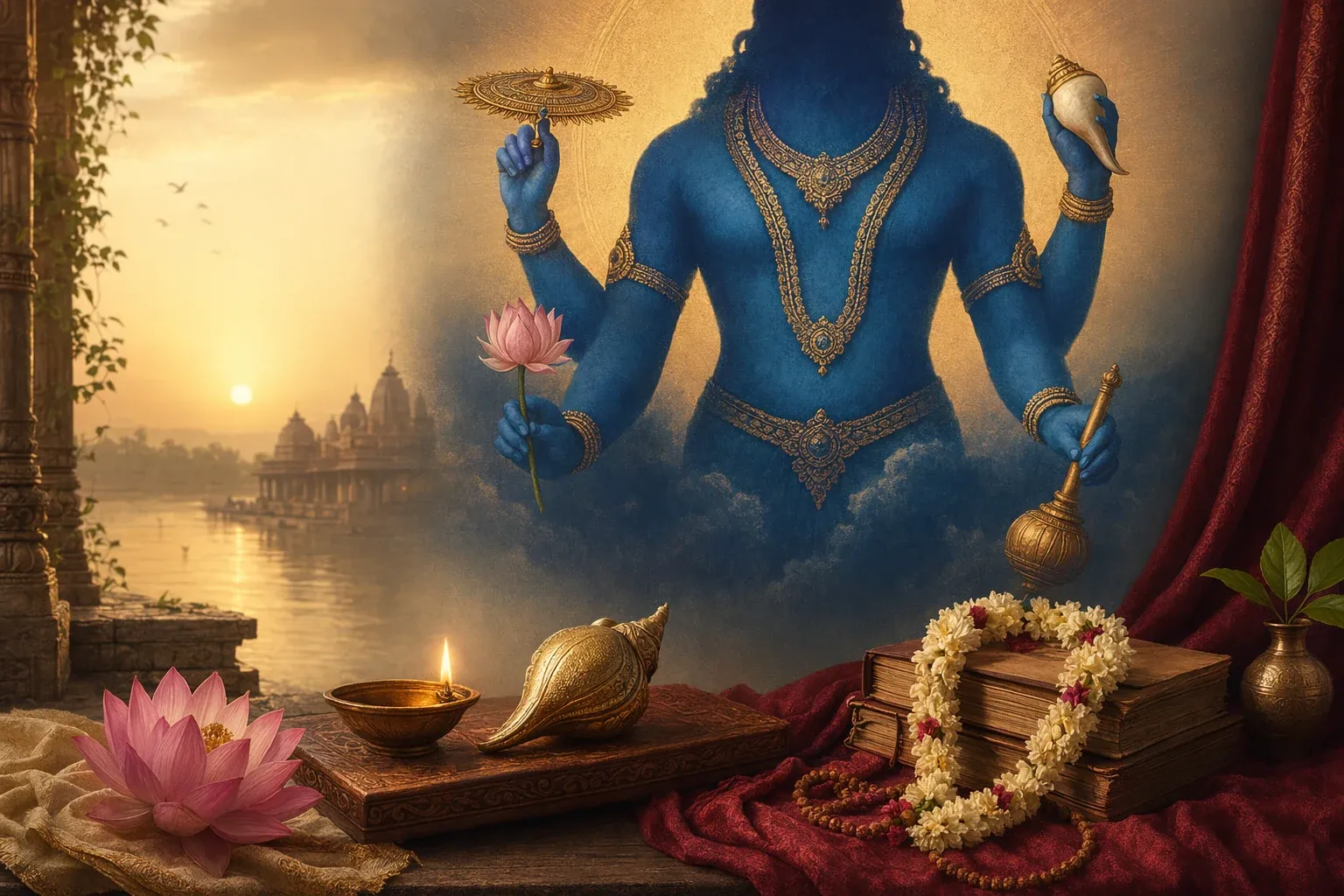
Vishnu is often shown with a serene blue form, four arms, a crown, and sacred objects in his hands. For a new reader, this can look mysterious. The image is not meant to be a realistic portrait in the ordinary sense. It is a visual teaching. Hindu sacred art uses colour, posture, gesture, ornaments, vehicles, and companions to express qualities that words alone cannot fully hold.
The blue colour, four hands, conch, chakra, mace, lotus, Garuda, and Shesha all invite the viewer to understand Vishnu as vast, protective, composed, and compassionate. Each symbol works like a doorway into meaning.
Why Vishnu is shown blue
Blue is often used for vastness. The sky looks blue, the ocean appears blue, and both suggest something larger than the human eye can measure. When Vishnu is shown blue, the colour can point to depth, infinity, calmness, and the divine presence that surrounds life. It is not simply a decorative choice.
Blue also carries emotional softness. Vishnu’s protection is usually shown as steady rather than frantic. He is powerful, but the power is controlled. He preserves order without losing compassion. A blue form helps express that cool, expansive, balanced quality.
Krishna, one of Vishnu’s most beloved forms in many Vaishnava traditions, is also commonly shown dark blue or cloud-coloured. The connection reminds devotees that the divine can be intimate and playful while still being immeasurable. A colour can therefore carry both cosmic and personal feeling.
Four hands: more than human limitation
Vishnu’s four arms tell the viewer that this is not an ordinary human figure. Extra arms in Hindu iconography often show expanded ability, not fantasy for its own sake. They communicate that divine power can protect, guide, bless, and restore at once.
The four hands also create a balanced image. Vishnu does not hold only weapons. He holds a conch, discus, mace, and lotus. Sound, awareness, strength, and purity appear together. This balance is important. Protection without purity becomes harsh. Beauty without strength becomes fragile. Sound without discipline becomes noise. Vishnu’s hands show an integrated vision of dharma.
Shankha: the conch
The conch, or shankha, is linked with sacred sound. In temples and rituals, the sound of a conch can mark a holy moment, awaken attention, and announce worship. In Vishnu’s hand it suggests that divine order begins with awakening. The mind is called back from distraction.
The conch also has a watery association, which suits Vishnu’s cosmic imagery. Narayana is often linked with the waters of existence, and Vishnu is shown resting on the cosmic ocean. The conch therefore belongs naturally to his visual world: sound emerging from depth.
Chakra: the discus
The chakra, especially Sudarshana Chakra, is one of Vishnu’s most famous symbols. It is often translated as a discus, but its meaning is richer than a weapon. The word can suggest a wheel, and a wheel points to motion, order, time, and precise turning. In Vishnu’s hand, the chakra shows alert protection and the cutting away of disorder.
Sudarshana can be understood as “good vision” or auspicious sight. That is a beautiful clue. Vishnu’s protection is not blind force. It is sharp vision joined with righteousness. The chakra reminds devotees that dharma needs clarity.
Gada: the mace
The mace, or gada, expresses strength. Vishnu’s strength is not displayed as uncontrolled anger. It is disciplined strength, used when protection requires firmness. The mace tells the viewer that compassion is not weakness. A preserver must sometimes resist cruelty, arrogance, and harm.
For a beginner, this is a useful lesson. Hindu symbols often avoid simple opposites. Gentleness and strength can belong together. Vishnu’s calm face and mace teach that power is most worthy when governed by wisdom.
Padma: the lotus
The lotus, or padma, is one of India’s most widely recognised sacred symbols. It grows from mud but opens clean and beautiful. In Vishnu’s hand, the lotus suggests purity, spiritual unfolding, and auspicious life. It balances the sharper energy of the chakra and mace.
The lotus also connects Vishnu to creation imagery. In many accounts, Brahma emerges from a lotus connected with Vishnu. That picture shows preservation and creation as related, not isolated. The world is sustained so that life can unfold.
Garuda and Shesha
Vishnu’s vehicle is Garuda, the great eagle-like being associated with speed, courage, and devotion. Garuda shows active movement: the divine arriving for protection. Shesha, the cosmic serpent on whom Vishnu rests, shows another mood: stillness, depth, and cosmic support.
Together they teach two sides of Vishnu’s presence. He can move swiftly when dharma needs help, and he can rest in the timeless depth beneath the universe. This is why Vishnu’s imagery can feel both majestic and peaceful.
Readers who want the larger setting can explore where Vishnu lives: Vaikuntha, Kshira Sagara, and Shesha. For the connection between Vishnu and his forms, see Vishnu avatars explained.
Lakshmi beside Vishnu
Lakshmi often appears with Vishnu because prosperity and protection are joined in the devotional imagination. Lakshmi brings grace, auspiciousness, beauty, and abundance. Vishnu brings sustaining order. Their presence together says that wealth and wellbeing should be held within dharma, not separated from it.
This is why Lakshmi-Narayana worship is so meaningful in homes and temples. It is not only about material success. It is about blessed living, ethical order, and gratitude.
How to read the image respectfully
A helpful way to look at Vishnu’s image is to pause with each detail. Notice the calm face first. Then notice the blue colour. Then the four hands. Then the conch, chakra, mace, and lotus. Ask what kind of divine character is being shown. The answer is not one word. Vishnu is vast like the sky, deep like the ocean, alert like the chakra, strong like the mace, pure like the lotus, and awakening like the conch.
Simple takeaway
Vishnu’s blue form and symbols are a compact visual lesson. Blue suggests vastness and calm depth. Four hands show divine capacity beyond ordinary limits. The conch awakens, the chakra protects with clear vision, the mace shows disciplined strength, and the lotus points to purity and auspicious unfolding. Together, they present Vishnu as the compassionate preserver whose power is steady, beautiful, and rooted in dharma.