
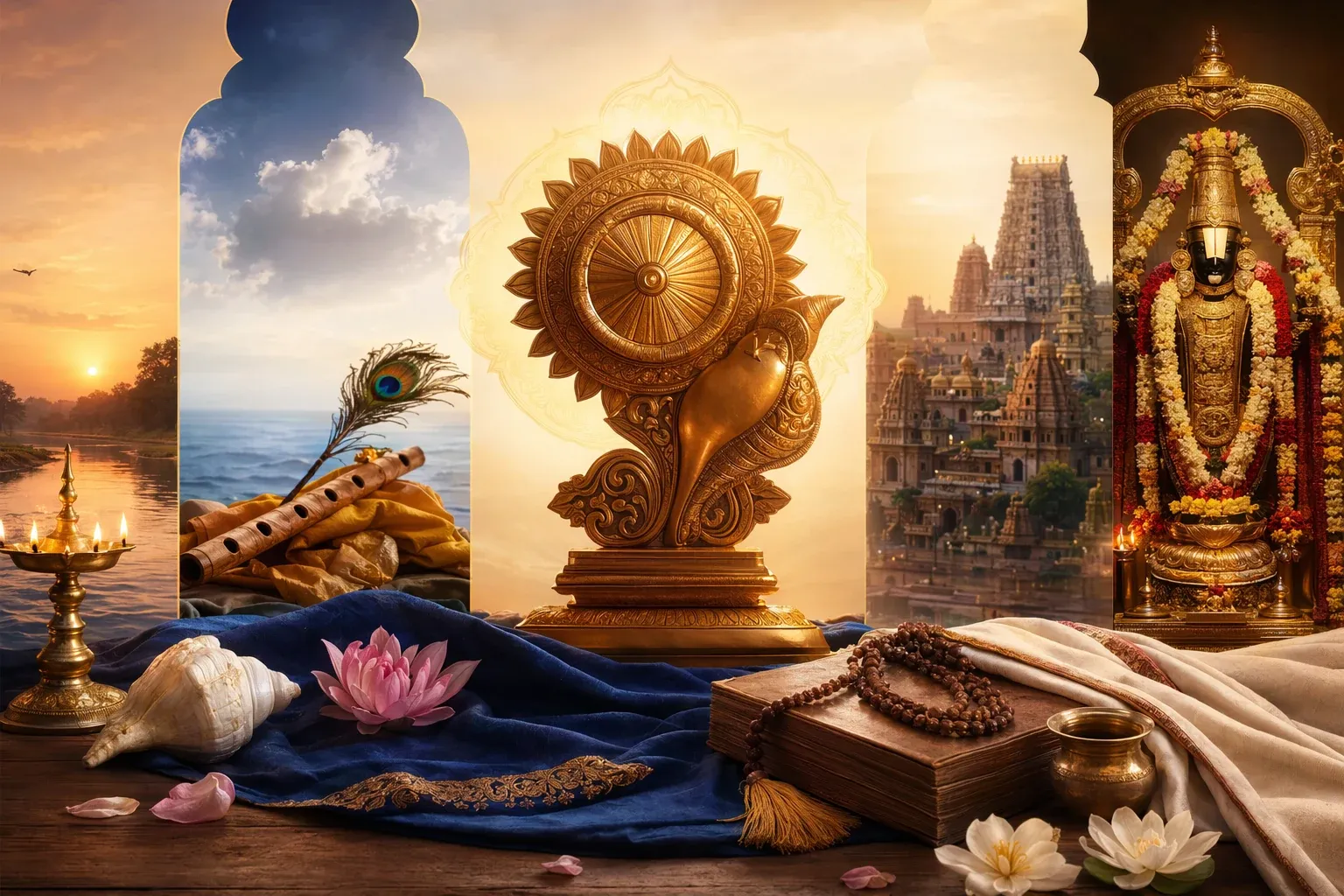
Hindu devotion uses many names and forms for the divine. Vishnu, Krishna, Narayana, and Venkateswara are closely connected, yet they are not always spoken about in exactly the same way. A respectful answer must leave room for devotion, philosophy, temple tradition, and regional practice.
Vishnu as the preserver
Vishnu is widely known as the preserver, the divine who protects dharma and sustains cosmic order. In many traditions, Vishnu is the supreme Lord who appears in different forms for the welfare of the world. His well-known symbols include the conch, discus, mace, and lotus.
When people ask whether Krishna or Venkateswara is Vishnu, they are usually asking how these beloved forms relate to this larger identity of the preserver.
Narayana as a deep name of Vishnu
Narayana is one of the most important names associated with Vishnu. It carries a sense of the supreme being, the refuge of all beings, and the one connected with the cosmic waters. In many prayers and temples, Vishnu and Narayana are used almost interchangeably.
Still, the name Narayana can feel more philosophical or cosmic, while Vishnu may feel more familiar as the preserver in stories and images. Both names point toward the same vast divine reality in many Vaishnava traditions.
Krishna as avatar and supreme Lord
Krishna is often described as an avatar of Vishnu, especially in broad beginner summaries. In many Vaishnava traditions, however, Krishna is not treated as merely one form among many. He is loved as the supreme Lord himself, the source of sweetness, wisdom, play, and grace.
This is why a simple chart can be misleading. One tradition may say Krishna is Vishnu’s avatar. Another may say Vishnu expands from Krishna. A beginner does not need to fight these views. It is better to understand which tradition is speaking.
Venkateswara as Vishnu worshipped at Tirumala
Venkateswara, also called Balaji or Srinivasa, is a beloved form of Vishnu worshipped especially at Tirumala. Devotees approach him as the Lord who receives prayers, vows, offerings, and gratitude. His form is intensely personal for millions of people.
In everyday devotion, many worshippers will simply say Venkateswara is Vishnu. More precisely, he is a specific temple form through which Vishnu is loved, served, and encountered.
Same reality, different devotional moods
One helpful way to understand the relationship is through devotional mood. Vishnu may evoke majesty and preservation. Narayana may evoke cosmic refuge. Krishna may evoke intimacy, love, music, friendship, and teaching. Venkateswara may evoke temple darshan, vows, and personal dependence on grace.
The divine reality is closely connected, but the emotional doorway differs. Hindu worship values these doorways because people relate to the sacred in different ways.
Why the answer changes by tradition
A Sri Vaishnava teacher, a Gaudiya Vaishnava devotee, a Tirumala pilgrim, and a general Hindu studies book may phrase the relationship differently. That does not automatically mean one is careless. Each is speaking from a devotional and philosophical setting.
Beginners should avoid mocking these differences. They show how rich Vishnu devotion is across India and beyond.
For wider context, see Bhaktilipi’s guide to Kalki Avatar and the overview of common Hindu yantras.
A simple respectful answer
For a beginner, the safest answer is this: Vishnu, Narayana, Krishna, and Venkateswara are deeply related names and forms of the divine in Vaishnava devotion. Many Hindus understand them as the same supreme Lord approached in different forms, while particular traditions explain the order and emphasis differently.
This answer honours both unity and difference. It lets Krishna remain Krishna, Venkateswara remain Venkateswara, and Narayana remain the cosmic refuge, without breaking their connection to Vishnu.
Why names matter in devotion
Names in Hindu devotion are not merely labels. A name carries relationship. A person may say Narayana when seeking refuge, Krishna when remembering sweetness and guidance, Venkateswara when thinking of Tirumala and vows, and Vishnu when thinking of cosmic preservation. The name shapes the mood of prayer.
This is why devotees may use several names in one home shrine without feeling confused. The names are different doors into reverence. Some doors feel majestic, some intimate, some philosophical, and some deeply tied to a place of pilgrimage.
What not to oversimplify
It is tempting to say all forms are exactly the same and stop there. It is also tempting to insist that every form must be ranked in one fixed order. Both approaches can miss something. Hindu traditions often preserve both unity and particularity. Krishna’s childhood stories, Venkateswara’s temple worship, Narayana’s cosmic language, and Vishnu’s preserving role each have their own flavour.
A respectful learner allows each form to speak in its own voice. That makes the shared identity richer, not weaker.
How to answer someone simply
If a child or new reader asks the question, you might say: yes, these names are closely connected to the same divine reality in Vishnu devotion, but each name shows a different relationship. Krishna is loved through stories of play, love, and teaching. Venkateswara is loved through temple darshan and vows. Narayana is invoked as refuge. Vishnu is honoured as the preserver.
That answer is simple without being careless. It leaves room for deeper study later.