
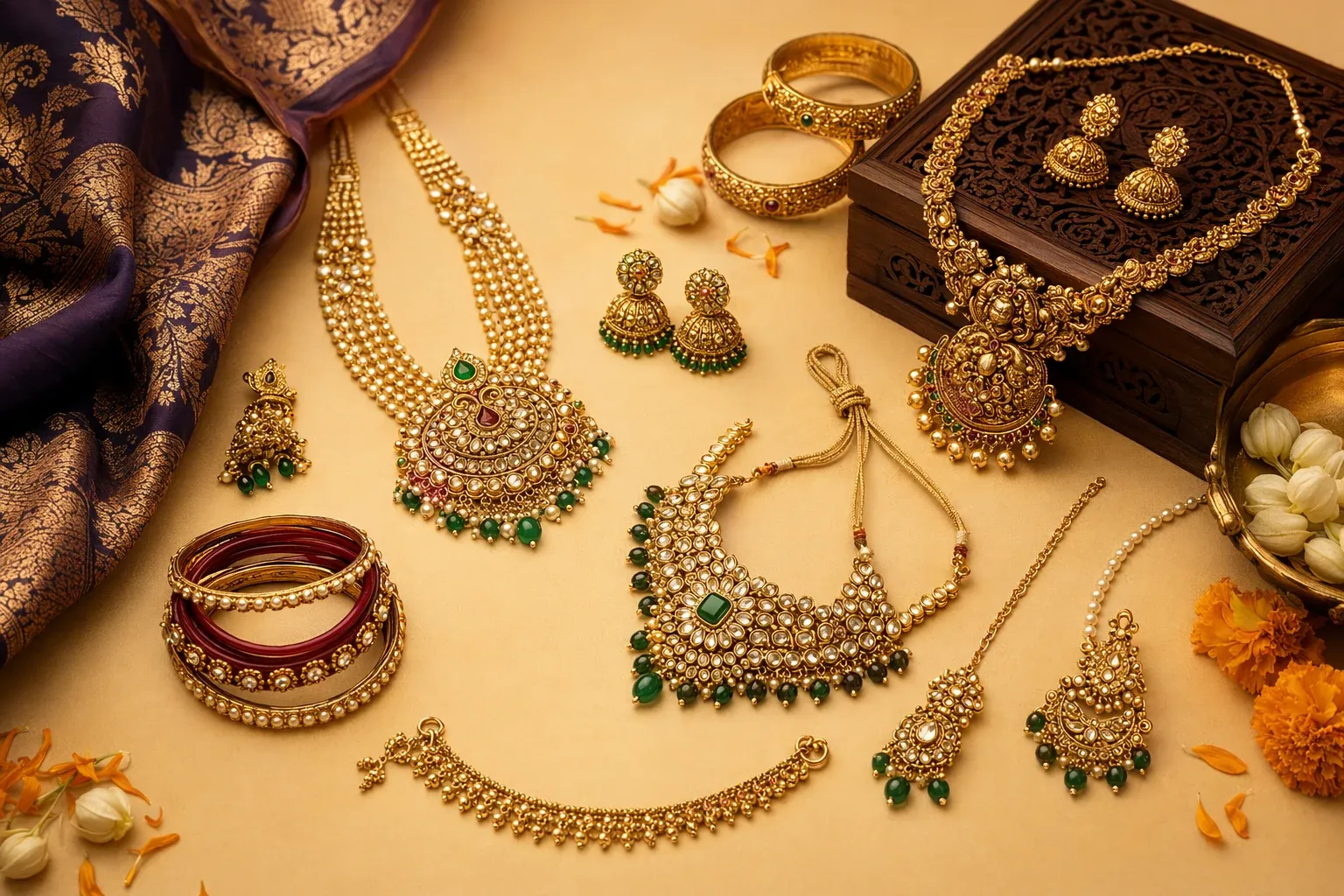
Indian jewellery names can feel confusing at first because people use several systems at the same time. One person may say “kundan set,” another may say “bridal haar,” another may say “temple jewellery,” and a shop may describe the same look as “ethnic necklace set.” The trick is not to memorise every name in one day. Start with four simple questions: Where is it worn on the body? When is it worn? Which region or community is it connected with? What craft technique gives it its look?
Once you use those four questions, the map becomes much easier. A maang tikka and a payal are different because they sit on different parts of the body. A choora and a temple necklace are different because one is a bangle tradition and the other is a devotional and dance-linked jewellery style. Kundan and meenakari are not body parts at all; they describe how a jewel is made or decorated.
Jewellery often overlaps with costume, performance and visual art. For related context, see Mudras in Bharatanatyam: Hand Gestures, Storytelling, and Meaning, regional textile traditions in Which Cities Are Famous for Textiles in India? A Simple Regional Map, and ornament details in Famous Indian Sculptures: Examples Every Beginner Should Know.
Neck ornaments: chokers, haars, and long layers
Necklaces are often the centre of Indian jewellery. A choker sits close around the neck and can be made in gold, pearls, kundan, oxidised silver, beads, or fabric-backed designs. A haar usually means a longer necklace. A rani haar is a grand, long, royal-looking necklace that may be layered over a choker for weddings. A gulbandh is a close necklace, and a thushi is a compact Maharashtrian choker style made with closely packed gold beads.
Some necklaces are named by motif. A kasumala or coin necklace uses coin-like units. A manga mala uses mango-shaped elements, especially in South Indian and temple-inspired jewellery. A mangalsutra is a marriage necklace in many Hindu communities, though its design changes widely by region, caste, family, and modern taste. These are not just fashion labels; many are tied to family ceremonies and community memory.
Ear ornaments: from studs to jhumkas
Indian earrings range from tiny daily studs to large ceremonial pieces. Jhumkas are bell-shaped earrings and are among the most recognised forms. They can be small and playful, heavy and bridal, oxidised and folk-inspired, or gold and temple-styled. Chandbalis have a crescent shape and are often associated with courtly and Mughal-influenced aesthetics. Karnaphool literally suggests an ear flower, often a floral earring form.
Heavier wedding earrings may come with a support chain that hooks into the hair, reducing pressure on the ear. This small detail teaches an important point: Indian jewellery is designed for lived use. It must move with dance, sit through long rituals, survive photographs, and still feel beautiful.
Hand and arm jewellery: bangles, kadas, rings, and hathphool
Bangles are circular ornaments worn around the wrist. They may be glass, gold, silver, lac, conch, metal, plastic, wood, or gemstone-studded. A kada is usually thicker and more cuff-like. Brides in Punjab may wear a red-and-white choora. Bengali married women may wear shakha-pola, traditionally conch and red bangles. Maharashtrian bridal looks often include green glass bangles. Rajasthan is famous for colourful lac bangles.
Rings can be simple or ceremonial. A hathphool connects rings to a bracelet across the back of the hand, making the hand look like a decorated flower. A bajuband or armlet is worn on the upper arm, visible in sculpture, dance costume, and bridal styling. These forms show how Indian jewellery frames gesture. The hand that offers aarti, touches elders’ feet, plays an instrument, or performs mudras can itself become part of the ornamented expression.
Head and forehead jewellery: tikka, matha patti, borla, and passa
A maang tikka is worn from the centre parting of the hair, with a pendant resting on the forehead. It is common in bridal and festive looks. A matha patti is wider, with chains spreading across the forehead. A borla is a rounded Rajasthani forehead ornament, often seen in bridal styling. A passa or jhoomar sits to one side of the head and is associated with Mughal and Hyderabadi-influenced looks.
The bindi and sindoor are not the same as jewellery, though they often appear in the same visual field. A bindi is a forehead mark. Sindoor is vermilion applied in the hair parting by many married Hindu women. A maang tikka is an ornament. Keeping these categories separate helps beginners describe Indian adornment more respectfully.
Foot jewellery: payal, nupur, ghungroo, and toe rings
Anklets are known by names such as payal, pajeb, nupur, or golusu depending on language and region. Many are silver, partly because several customs avoid wearing gold below the waist, though practices vary. Some anklets are delicate chains, some are heavier silver forms, and some include tiny bells.
Ghungroo are rows of bells tied by dancers around the ankles. They are not simply decoration; they make rhythm audible in dance forms such as Kathak and Bharatanatyam. Toe rings, called bichiya in North India and metti in parts of South India, are often connected with marriage customs. Again, the same body area can include beauty, sound, ritual, and identity.
Craft-style names: kundan, polki, meenakari, jadau, and filigree
Some jewellery types are named by technique. Kundan involves setting stones with refined gold foil in a prepared framework. Polki refers to uncut diamonds used in traditional settings. Meenakari is enamel work, often colourful and sometimes hidden on the reverse side of a jewel. Jadau describes elaborate stone-setting associated with handmade bridal pieces. Filigree uses delicate metal wire work; Odisha’s silver tarakashi is a famous Indian example.
These techniques often overlap. A necklace may be kundan on the front and meenakari on the back. A bridal set may combine polki, pearls, enamel, and gold. So when a shop says “kundan jewellery,” it may be pointing to the visible style, the setting method, or a modern imitation inspired by it. Beginners should ask what material is actually used, especially when buying.
Devotional and performance jewellery
Temple jewellery is inspired by South Indian temple art, deity ornaments, and classical dance. It often shows Lakshmi, Ganesha, peacocks, lotus forms, mango motifs, coin chains, and kemp-style red and green stones. Enroute Indian History traces temple jewellery to South Indian temple offerings, royal patronage, specialised artisans, and its later use by dancers. Today, Bharatanatyam dancers and brides may wear real gold, silver-gold finish, or imitation versions depending on budget and need.
There are also folk, tribal, and pastoral jewellery traditions that do not fit neatly into “bridal gold” categories. Heavy silver neck rings, coin ornaments, bead work, shell jewellery, brass pieces, and amulets can represent community identity, protection, mobility, and local aesthetics. These deserve respect, not the lazy label of “costume jewellery.”
A beginner way to remember the categories
If a name confuses you, place it in one of these buckets. Body part: necklace, earring, bangle, anklet, headpiece. Occasion: daily, festival, wedding, dance, ritual. Region: Rajasthan, Bengal, Maharashtra, Kerala, Tamil Nadu, Odisha, Punjab, Gujarat, or another community context. Technique: kundan, polki, meenakari, filigree, lac, glass, gold, silver, beads. Once you sort the name, the tradition becomes less intimidating and more enjoyable.
Indian jewellery is famous because it combines all these layers. It can be artistic, auspicious, stylish, practical, historical, and deeply personal at the same time. That is why one small ornament can open a whole story.