Traditional Indian jewellery is the art of adorning the body with ornaments that carry beauty, memory, status, craft skill, and cultural meaning. A necklace is not only a necklace. A pair of bangles may mark a festival, a wedding, a family custom, a region, or a personal style. A temple necklace may echo sculpture and dance. A silver anklet may remind us of household traditions that are older than many modern fashion labels.
For a beginner, the easiest way to understand Indian jewellery is to see it as material culture: objects people wear, gift, inherit, save, repair, and bring into important life moments. Some pieces are made in precious gold and gemstones. Others are glass, lac, silver, shell, beads, thread, brass, or imitation metal. Both can matter. The value is not always only price; it can also be workmanship, family memory, ritual use, or regional identity.
To place jewellery in the wider visual world of Indian culture, compare the ornament details seen in Famous Indian Sculptures: Examples Every Beginner Should Know and the costume traditions around The 8 Classical Dance Forms of India Explained Simply.
A living tradition, not one single style
India does not have one uniform jewellery style. The subcontinent has many languages, climates, courts, temple traditions, trade routes, and craft communities. This is why a Rajasthani borla, a Maharashtrian nath, a Bengali shakha-pola set, a South Indian temple haar, an Odia silver filigree piece, and a Punjabi bridal choora can all be Indian jewellery while looking completely different.
Historical context helps. Indian ornaments are visible in sculpture, painting, court objects, and archaeological material across long periods. Later, imperial and regional courts shaped new fashions. Christie’s notes that Mughal-era jewellery used earrings, necklaces, bangles, rings, turban ornaments, jewelled objects, enamel, pearls, emeralds, spinels, and diamonds as signs of rank, taste, and power. This does not mean every Indian ornament is Mughal. It means Indian jewellery has absorbed many influences while remaining deeply local.
Body, occasion, region, and meaning
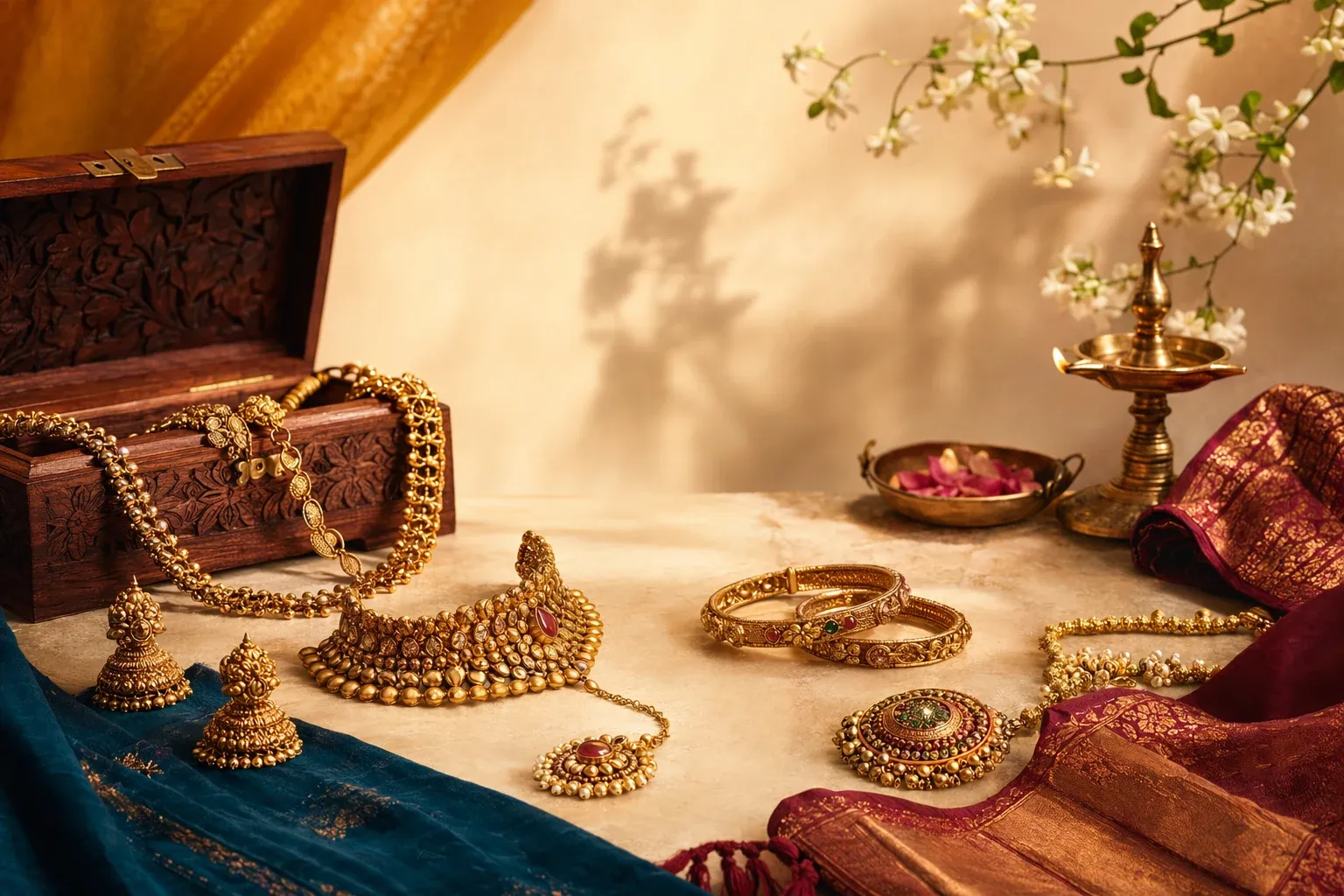
One useful beginner map is the body. Necklaces include chokers, long haars, bead strings, coin necklaces, mangalsutra forms, rani haars, temple necklaces, and regional collars. Ear ornaments include studs, jhumkas, chandbalis, karnaphool designs, and heavier wedding earrings supported by chains. Hands and arms have rings, hathphool, bangles, kadas, bajuband armlets, and sometimes palm ornaments. Feet have payal, nupur, toe rings, and dance bells. The head and forehead have maang tikka, matha patti, borla, passa or jhoomar, and hair ornaments.
Another map is occasion. Daily jewellery may be light: a small chain, simple studs, a pair of bangles, or a silver anklet. Festival jewellery can be brighter and more symbolic. Wedding jewellery is usually layered because it represents family blessing, wealth, auspiciousness, and ceremony. Dance jewellery is built for stage visibility and movement. Temple jewellery, for example, is strongly associated with Bharatanatyam and South Indian devotional aesthetics, with motifs such as Lakshmi, peacocks, mango shapes, lotus forms, and coin chains.
Materials tell their own story
Gold has a special place in many Indian households. It is beautiful, durable, portable, and culturally associated with prosperity and auspiciousness. In some families, gold jewellery is also a form of savings passed through generations. But Indian jewellery is not only gold. Silver is widely used for anklets, toe rings, tribal ornaments, belts, amulets, and everyday pieces. Glass bangles, lac bangles, conch bangles, beads, shells, enamel, pearls, coral, ivory substitutes, and cloth or thread ornaments also belong to the wider story.
Gemstones can be decorative, symbolic, or both. Mughal and courtly pieces made special use of emeralds, rubies, spinels, pearls, diamonds, and enamelled surfaces. Navaratna jewellery brings nine gemstones into one arrangement, linked in tradition to the nine planetary deities. A careful cultural guide should say “linked in tradition” rather than claiming a guaranteed effect. Jewellery can carry belief without needing exaggerated miracle language.
Craft techniques beginners should recognise
Kundan is a setting style associated especially with North Indian and Rajasthani jewellery, where stones are held with highly refined gold foil in a prepared framework. Polki usually refers to uncut diamonds set in traditional designs. Meenakari is enamel work, often seen as bright colour on the back or surface of a jewel. Jadau is a broader term connected with setting stones in elaborate handmade pieces. Filigree uses delicate wire-like metal work; Odisha’s tarakashi tradition is a well-known silver example.
Temple jewellery has its own visual language. Enroute Indian History describes South Indian temple jewellery as connected with offerings to deities, royal patronage, dance, and specialised craft communities. Pieces may show Lakshmi, Ganesha, Saraswati, Vishnu forms, peacocks, serpents, elephants, parrots, mango motifs, and coin chains. Modern versions may be gold, silver with gold finish, or imitation materials used by dancers and brides.
Regional examples make the idea clearer
In Rajasthan, kundan, meenakari, aad necklaces, borla forehead ornaments, and lac bangles are often part of the visual vocabulary. In Bengal, married women may wear shakha and pola bangles, traditionally connected with conch and red material. In Maharashtra, the nath nose ring and thushi choker are recognisable forms. Kerala has gold-heavy necklaces such as kasu mala and palakka-style designs. Tamil Nadu and nearby regions are strongly associated with temple jewellery and dance ornament sets. Odisha is known for silver filigree. Tribal and pastoral communities across India have their own powerful silver, bead, shell, coin, and metal traditions.
These examples are not rigid rules. Families migrate, shops mix designs, and modern brides often combine regions. A Gujarati lehenga may be styled with kundan; a South Indian bride may layer temple jewellery with diamond pieces; a young student may wear oxidised silver jhumkas with jeans. Tradition is not frozen. It survives because people keep adapting it respectfully.
Jewellery in weddings and family life
Wedding jewellery is where many beginners first notice the depth of Indian ornament. A bridal look may include necklaces, earrings, bangles, rings, waist belt, anklets, toe rings, head ornaments, nose ring, and hair accessories. Each community has its own priorities. Some focus on gold, some on glass bangles, some on conch, some on silver, some on a sacred necklace, and some on heirloom pieces from the mother or grandmother.
The meaning can be layered. There is beauty, yes, but also blessing, continuity, identity, protection, status, and belonging. A bride may wear a piece because it suits the outfit, because an elder gifted it, because it marks marriage, because it belongs to a regional custom, or simply because she loves it. Good cultural writing leaves room for all of these reasons.
A simple beginner glossary
Haar means a necklace, often a longer one. Choker sits close to the neck. Jhumka is a bell-shaped earring. Kada is a thicker bangle or cuff. Payal is an anklet. Maang tikka rests on the forehead from the hair parting. Matha patti is a wider head ornament with side chains. Bajuband is an armlet. Kundan, polki, and meenakari describe craft or setting styles, not just shapes.
If you remember one thing, remember this: traditional Indian jewellery is a conversation between the body, the family, the region, the artisan, and the occasion. It can be royal or everyday, sacred or fashionable, inherited or newly bought. Its richness comes from that mix.