
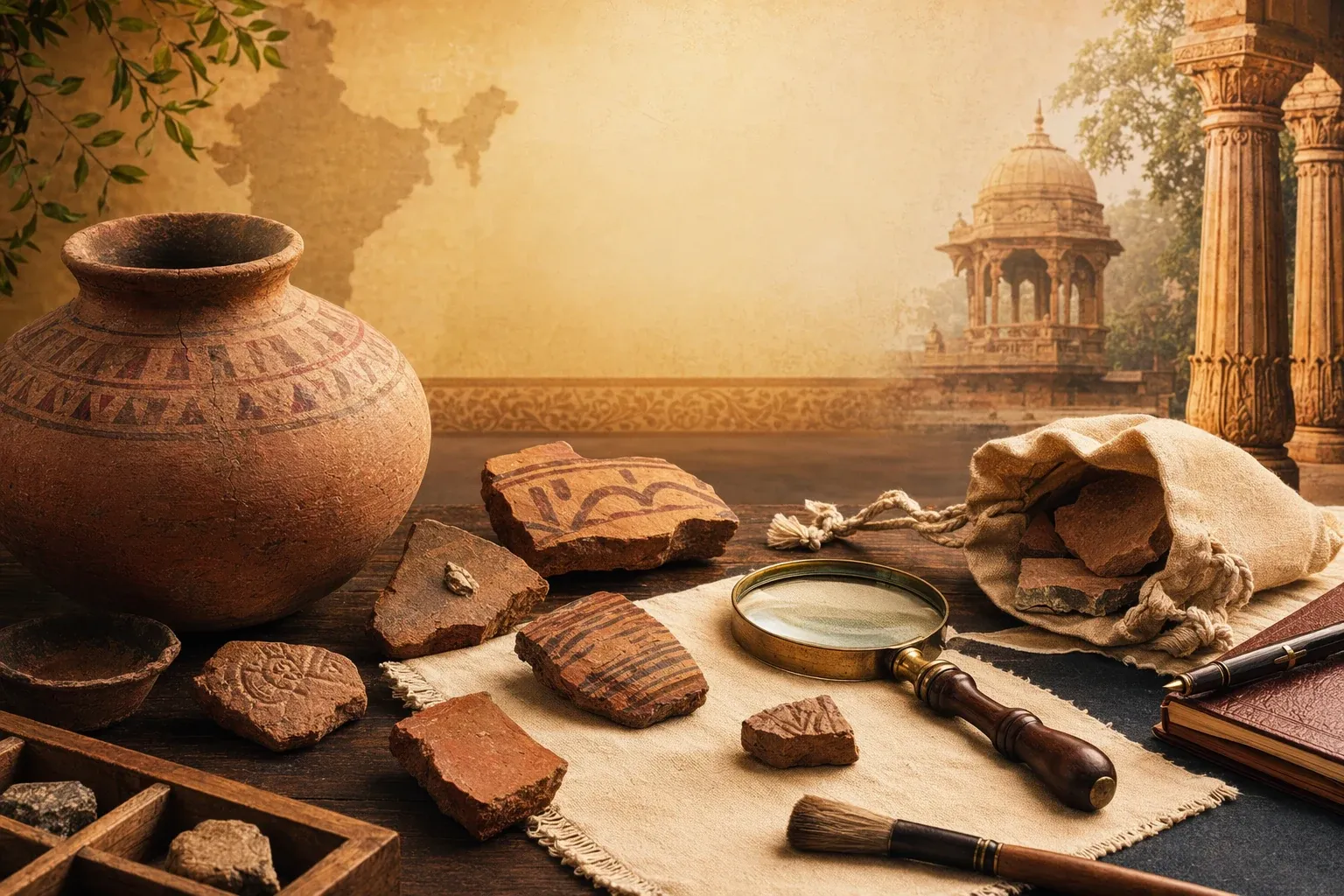
First rule: do not remove the shard
If you see an old-looking pottery piece in a field, near a mound, beside a temple tank, around an old settlement, or during construction, the most important advice is not “identify it quickly”. The first advice is: do not pick it up, clean it, sell it, drill it, scratch it, or move it away from its place. A pottery shard may look like a small broken object, but for archaeologists it is part of a larger story. Its position, depth, nearby objects, soil layer, and relation to walls, hearths, drains, burials, or habitation areas may matter more than the shard alone.
For historical context behind pottery finds, read Ancient Indian Pottery: What Clay Vessels Tell Us About History. For the broader craft background and decorative clues, see What Is Indian Pottery? Meaning, History, and Why It Matters and Indian Pottery Designs: Patterns, Symbols and Painting Styles.
This is why responsible identification begins with restraint. Take clear photographs if it is safe and legal to do so. Note the location in a general way. Avoid public posting that reveals exact site coordinates if the place may be vulnerable. If the object appears to come from an archaeological area, a protected monument, or a large scatter of old material, contact the relevant heritage authority, local museum, university archaeology department, or district administration rather than treating it as a collectible.
What archaeologists notice first
A trained archaeologist studies pottery through many clues together, not through one dramatic sign. The first clues are fabric, thickness, colour, hardness, inclusions, surface treatment, form, and context. “Fabric” means the clay body itself: is it fine, sandy, gritty, compact, porous, red, grey, black, buff, or mixed? Small grains, mica, shell, sand, or crushed material inside the clay can tell experts about preparation and local geology.
Thickness gives another clue. A heavy storage jar, a cooking pot, a small bowl, and a lamp will not have the same wall. A rim fragment can be more informative than a plain body piece because the rim shape may show the opening, vessel type, and style. A base fragment may suggest whether the vessel stood flat, had a ring foot, or was rounded. Curvature can help estimate whether the original vessel was small like a cup or large like a storage jar.
Surface, decoration, and firing clues
The outside surface may be plain, slipped, burnished, painted, incised, stamped, cord-marked, glazed, or blackened by use. A slip is a thin coating of refined clay that can give a red, cream, black, or other surface. Burnishing means polishing the surface before firing, often creating a smooth shine. Incised lines, dots, grooves, bands, floral designs, geometric patterns, or painted motifs may help connect a piece with a region or period, but such comparisons need caution.
Firing also leaves signs. Terracotta reds often come from iron-rich clay fired with oxygen. Grey or black surfaces may come from firing conditions, smoke, or later burning. A cooking pot may show soot, heat marks, or mineral deposits. A water vessel may show wear around the neck or inner surface. But a modern pot can also look old after burial, smoke, or weathering. So appearance alone cannot prove age.
Context matters more than a single object
The strongest clue is context. One shard on a roadside may be recent rubbish, old fill soil, or a fragment moved by ploughing. Hundreds of similar shards with brickbats, slag, beads, bones, shells, or structural remains may suggest a site. The relationship between objects is what creates meaning. If someone removes “interesting” pieces and leaves the rest, future study becomes weaker. It is like tearing pages from a book and then asking a historian to read the story.
Indian heritage protection is not only about grand temples and forts. Archaeological sites can include Neolithic remains, megalithic burials, settlement mounds, early historic habitations, inscriptions, pottery scatters, and excavated remains. The Archaeological Survey of India describes its responsibility for protected monuments and archaeological sites of national importance, and the wider principle is clear: old material needs careful protection, not casual handling.
How to document without causing harm
If you are a student, traveller, farmer, or construction worker who notices old pottery, make a calm record. Photograph the piece in place from above and from the side. Place no coin or hand on it if touching is avoidable; if scale is needed, use a ruler near it without disturbing it. Photograph the surrounding ground. Write down the date, general area, and what else was visible. Do not wash the shard, because soil, residue, soot, or deposits may contain information.
Do not try home tests with acid, scraping, fire, oil, or chemicals. These can damage the surface. Do not rely on viral claims such as “this design proves it is Harappan” or “black pottery means it is thousands of years old”. Indian pottery traditions continued across long periods, and similar colours or shapes can appear in different times. Identification needs comparison with excavated material, stratigraphy, scientific analysis, and expert study.
Common Indian pottery categories beginners may hear
You may hear terms such as Red Ware, Painted Grey Ware, Northern Black Polished Ware, Black-and-Red Ware, terracotta, glazed ware, and medieval pottery. These are useful names, but they are not magic labels. For example, “red ware” can be very broad. “Northern Black Polished Ware” refers to a more specific early historic ceramic tradition known for a fine glossy surface. “Terracotta” simply means baked clay and can describe everything from toys to plaques to architectural decoration.
A responsible beginner can learn the vocabulary without pretending to be an expert. Notice colour, texture, thickness, rim shape, decoration, and context. Compare with museum displays and excavation reports when available. Visit a local museum and observe how labels mention site, period, material, and function. Good labels rarely say only “old pot”; they connect object, place, date range, and cultural setting.
Why buying and selling is risky
Old pottery pieces are sometimes sold online as “ancient”, “Harappan”, “temple”, or “rare”. Be careful. Without legal provenance, such objects may be stolen, fake, misidentified, or removed from a site where they belonged. Even when a broken shard has little market value, collecting it for display can encourage more removal. Heritage is not only the polished museum object; it is also the humble fragment that helps reconstruct ordinary life.
The best attitude is seva toward knowledge. If a piece is genuinely old, preserving its context helps everyone. If it is recent, careful observation still teaches you how pottery weathers and breaks. Either way, the dharmic path is not greed, excitement, or possession. It is protection, patience, and respect for the people whose lives left those traces behind.
Questions people ask about this topic
How to identify old Indian pottery?
Observe the clay body, wall thickness, colour, surface treatment, rim or base shape, decoration, signs of use, and where it was found. Do not claim a date without expert comparison.
How to identify Indian pottery shards?
Indian pottery shards are identified by fabric, form, decoration, firing, wear, and archaeological context. A rim or base fragment is often more informative than a plain body shard.
Indian pottery artifacts?
Indian pottery artifacts can include vessels, lamps, toys, terracotta figures, plaques, tiles, beads, and ritual objects. Their meaning depends heavily on site context.
Indian pottery identification?
Good identification uses photographs, measurements, context notes, museum comparisons, excavation reports, and expert advice. Guessing from colour alone is unsafe.
Old Indian pottery pieces?
Old Indian pottery pieces should not be removed, washed, sold, or altered. Record them carefully and contact suitable heritage authorities if they may be archaeological.