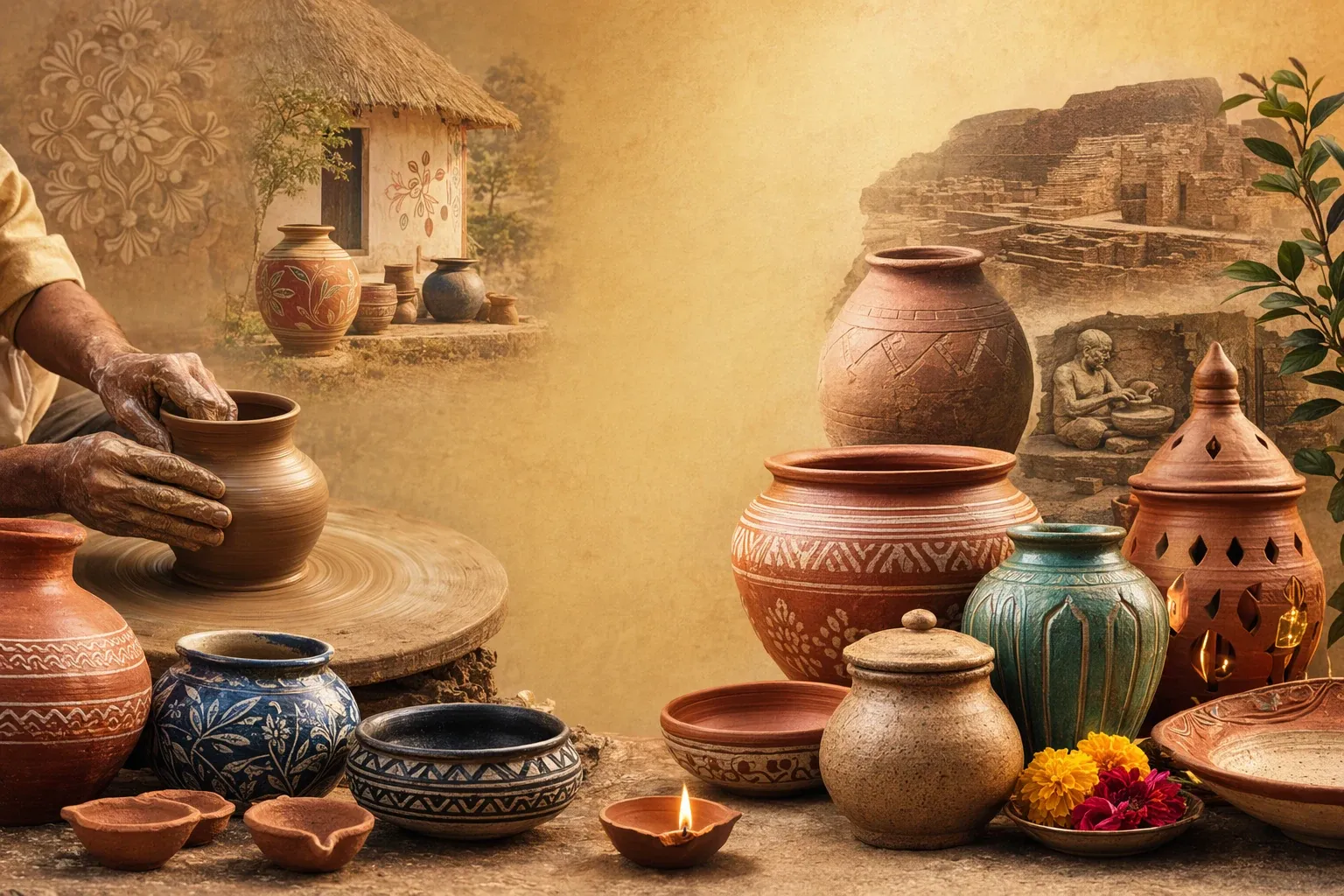
Indian pottery is the art and skill of shaping clay into useful, beautiful, or meaningful objects in the Indian subcontinent. That simple sentence covers a surprisingly large world: cooking pots, water jars, diyas, terracotta horses, temple plaques, painted vessels, children’s toys, storage jars, ritual objects, tiles, and archaeological fragments found under the soil.
At Bhaktilipi, it helps to begin with one correction. In many search results, “Indian pottery” may point to Native American pottery because of the English word “Indian” in another historical context. This article is about pottery of India: the clay traditions connected with Indian homes, craft communities, ancient settlements, village markets, temples, festivals, and museums.
For a concrete example of Indian terracotta becoming a cultural symbol, see Bankura Horses: Heritage, Significance in Indian Culture. To compare clay objects with another visual-art tradition, read What Is Indian Sculpture? A Simple Beginner Guide.
Clay, hand, fire, and everyday life
Pottery begins with earth. Clay is cleaned, kneaded, shaped by hand or on a wheel, dried slowly, and fired so that it becomes stronger than raw mud. In India, this work has often been done by specialist artisan families, commonly called kumhars in many North Indian languages, though names and community histories vary by region. The work looks simple only from a distance. A good potter knows how wet the clay should be, how fast the wheel can turn, when a vessel is dry enough, and how fire will change the final colour.
That is why pottery belongs to both art and daily life. A matka used for water is not just a container; its porous clay can keep water cool through evaporation. A diya lit during Deepavali is not just a lamp; it turns earth, oil, cotton, flame, and devotion into one tiny ritual object. A terracotta toy is not just play; it shows how children, animals, carts, and village life entered the world of craft.
A long story from villages to archaeology
The history of Indian pottery is very old. Archaeological discussions connect clay and terracotta objects with early sites such as Mehrgarh and with the Harappan or Indus civilisation. Sahapedia’s essay on the Harappan terracotta repertoire notes early clay objects at Mehrgarh and places Harappan terracotta within a much larger history of production and use. This matters because pottery survives when wood, cloth, food, and many other daily materials disappear.
For archaeologists, broken pottery is not “waste” in the ordinary sense. A shard can reveal the kind of clay used, the firing technique, the shape of a vessel, traces of design, and sometimes the wider cultural period to which a settlement belonged. In Harappan contexts, pottery and terracotta objects sit beside seals, beads, tools, figurines, and other remains that help scholars understand urban life, trade, craft, storage, food habits, play, and ritual possibilities.
What Indian pottery can look like
Indian pottery does not have one single look. Some vessels are plain red or brown because the clay and firing give them a natural earthen colour. Some are painted with black lines, geometric bands, leaves, animals, flowers, or local symbols. Some remain unglazed and porous; others, such as Khurja pottery in Uttar Pradesh, are known for glazed surfaces and bright decoration. Terracotta work in Bengal or Rajasthan may appear as plaques, horses, panels, figurines, or votive objects rather than only round pots.
Black pottery is another striking example. In places such as Nizamabad in Uttar Pradesh, artisans are known for dark, polished-looking pottery with incised decoration filled in a lighter tone. The black surface is not magic; it comes from controlled firing, smoke, and finishing techniques. This is a good example of how craft knowledge works: a visual effect depends on material science, inherited practice, and patient skill.
Why pottery matters in Indian culture
Pottery matters because it is close to ordinary people. Palaces and temples tell one part of history, but clay vessels tell the story of kitchens, courtyards, farms, village wells, markets, festivals, and family rituals. A wedding may use clay pots. A festival may use lamps. A village shrine may receive terracotta offerings. A student in a museum may see a small pot and suddenly understand that ancient people also stored grain, drank water, cooked food, decorated homes, and cared about beauty.
This closeness to life is also why pottery carries dharmic value. Dharma is not only in grand speeches; it is also in work done well, objects made honestly, and communities sustaining useful knowledge. A humble water pot may not look “famous”, but it serves life. A diya may be inexpensive, but it carries light. A craft family may not appear in a textbook chapter, yet its skill preserves memory through the hand.
Tradition and evidence need different lenses
When we speak about Indian pottery, we should separate tradition, interpretation, and evidence. Tradition may remember an object as part of a festival, a local deity, a marriage custom, or an inherited village practice. Interpretation asks what the object means to the people using it. Historical and archaeological evidence asks a different question: what can be shown from excavation, material, date, context, comparison, and museum records?
Respecting all three lenses protects us from two mistakes. One mistake is to exaggerate every clay object into a miracle claim. The other is to treat living tradition as if it has no knowledge because it is not written in academic language. A balanced reader can honour potters, listen to local memory, and still ask careful historical questions.
Learning Indian pottery respectfully
If you are a beginner, start by noticing form and use. Is the object a storage jar, lamp, toy, vase, plaque, tile, cooking vessel, or ritual offering? Is it handmade, wheel-thrown, moulded, painted, burnished, glazed, or left natural? Where is it from? Was it made for daily use, decoration, worship, trade, tourism, or museum display? These questions are better than rushing to call everything “ancient” or “rare”.
The most respectful way to learn is to connect objects with people. Visit museums, read labels, watch artisans when they allow it, buy fairly when you can, and avoid disturbing archaeological sites. Indian pottery is not only a style for home decor. It is a long conversation between earth, fire, skill, community, and memory.
People also ask
What is Indian pottery?
Indian pottery means clay objects made in India for daily, artistic, ritual, or archaeological purposes. It includes vessels, lamps, figurines, plaques, toys, tiles, and regional crafts.
What is Indian pottery called?
There is no single name for all Indian pottery. Words such as mitti ke bartan, terracotta, kulhad, matka, diya, and regional craft names may be used depending on object, language, and place.
What does Indian pottery look like?
It can be plain red earthenware, painted pottery, glazed ceramics, black pottery, terracotta sculpture, ritual plaques, or simple daily vessels. Region, clay, firing, and use shape the final look.