
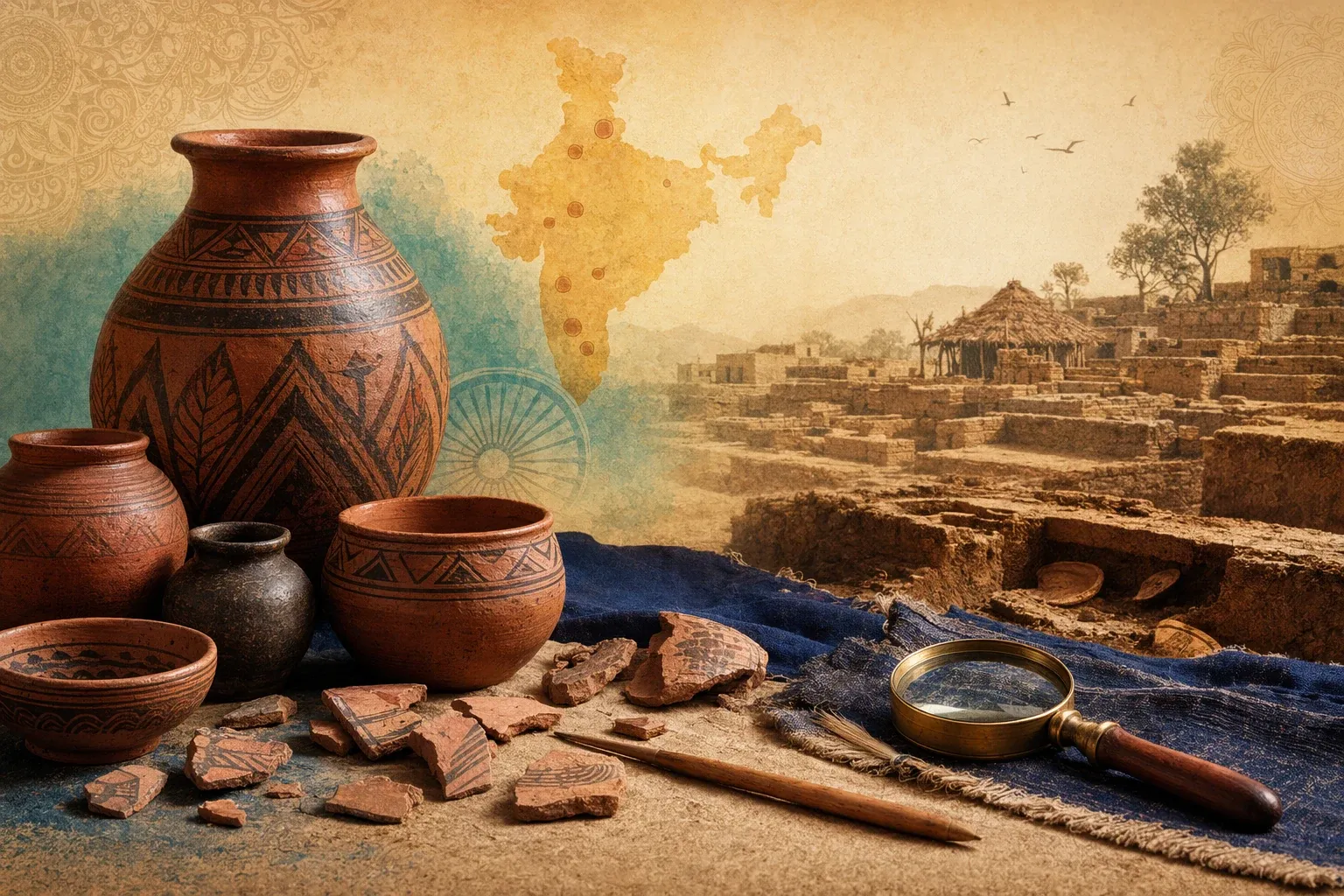
Ancient Indian pottery is one of the most useful kinds of evidence for understanding the past. A stone inscription may record a king. A temple wall may show a grand vision. But a broken pot from an old settlement can bring us close to ordinary life: water, grain, cooking, storage, trade, play, and the hands of people who shaped clay long before us.
This is why archaeologists take pottery seriously. Clay objects are durable after firing, common in settlements, and often found in layers that can be compared with other remains. A small shard may not look exciting in a display case, but in the field it can help identify a cultural phase, a type of vessel, a firing method, or a pattern of contact between regions.
For another artifact-focused window into early Indian history, read Chirand's Artifacts: Excavation Reveals Ancient Heritage. To compare pottery with written evidence, see What Are Indian Inscriptions? Meaning, History, and Why They Matter.
Broken pots as historical evidence
The first lesson is simple: ancient pottery is not valuable only when it is complete. In fact, most archaeological pottery is fragmentary. A rim can suggest the mouth of a vessel. A base can suggest how it stood. A handle, spout, perforation, painted band, or burnished surface can give clues about use and technique. When many such pieces are studied together, patterns begin to emerge.
These patterns can point to food habits, storage needs, craft production, or movement of goods. Large jars may suggest storage. Bowls and dishes suggest serving or eating. Perforated vessels may have had special uses, though archaeologists must be careful before giving one fixed answer. Pottery is strong evidence, but it still needs context: where it was found, what was found with it, and how securely it can be dated.
Harappan cities and fired clay
The Harappan or Indus civilisation gives one famous window into ancient pottery and terracotta. Sahapedia describes the Harappan period roughly around c. 2700–1900 BCE in the northwest and west of the subcontinent, while also connecting terracotta production with older layers at Mehrgarh. National Museum source checks also point to Harappan galleries where pottery, terracotta figurines, toy carts, seals, and other objects help visitors imagine urban life.
Harappan pottery is often discussed for its wheel-made forms, red surfaces, black painted designs, storage vessels, and everyday utility. Along with terracotta figurines of humans, animals, carts, and other forms, these objects show that clay was not a minor material. It was part of household life, craft knowledge, play, symbolic expression, and possibly ritual. At the same time, careful writers should avoid pretending that every Harappan symbol has one settled meaning, because the script remains undeciphered and context can be debated.
Painted designs, vessels, and daily use
Ancient pottery often carries designs: lines, circles, leaves, animal forms, fish-like motifs, peepal-like shapes, or geometric bands depending on the culture and region. These designs are beautiful, but they are not automatically secret codes. Sometimes decoration may mark identity, habit, skill, or aesthetic taste. Sometimes it may carry symbolic value. The honest answer depends on evidence, comparison, and archaeological context.
Daily use is just as important. A pot could store grain, hold water, cook food, pour liquid, strain something, or serve offerings. In a hot climate, porous earthen vessels could be practical. In a farming settlement, storage mattered. In an urban centre, standardised vessels may suggest organised production and repeated needs. The clay object becomes a witness to both technology and routine.
Pottery and regional change after the Harappan world
Ancient Indian pottery did not stop with the Harappan world. Different archaeological cultures and periods are known through ceramic traditions such as Painted Grey Ware, Northern Black Polished Ware, Black-and-Red Ware, megalithic pottery traditions, and many regional types. These names may sound technical, but their purpose is practical: they help scholars group material evidence and compare sites.
For a beginner, the exact textbook sequence is less important than the method. Pottery changes over time because people change where they live, what they eat, how they trade, what technologies they use, and what styles they prefer. A change in pottery does not always mean a new people suddenly replaced an old people. It may reflect trade, imitation, function, status, local clay, or changes in firing. Good archaeology resists one-line conclusions.
What archaeologists can and cannot know
Pottery can tell us a lot, but it cannot tell us everything. It can show material, technique, shape, design, and context. It may help date a layer or compare one site with another. It can suggest food storage, craft skill, exchange, or social habits. But it cannot always reveal the exact name of the maker, the spoken language of the user, or the full meaning of a painted motif.
This caution is not weakness. It is intellectual honesty. In Indian history, we often love big claims because they feel satisfying. But ancient pottery teaches a quieter kind of wonder. It asks us to look closely, accept uncertainty, and still feel respect for the people who lived before us. A clay pot does not need exaggeration to be meaningful.
Why ordinary objects matter
The beauty of ancient pottery is that it brings history down to human scale. We can imagine a potter preparing clay, a family storing grain, a child playing with a terracotta cart, a trader moving goods, or a settlement depending on vessels for everyday survival. These are not small details. Civilisation is made from repeated daily actions, not only from famous battles and royal names.
For young readers, pottery is also a good training ground for historical thinking. Instead of asking only “Who ruled?” we learn to ask “How did people live?” Instead of looking only for gold, we learn to respect clay. That shift is deeply Indian in spirit: value is not always in glitter. Sometimes the most truthful object is the one that quietly served life.
People also ask
How old is Indian pottery?
Clay and terracotta traditions in the subcontinent are very old, with early evidence discussed from sites such as Mehrgarh and later Harappan settlements. Exact dates depend on site, layer, and object type.
What does pottery tell us about Indian history?
It can tell us about daily life, craft technology, storage, food habits, trade, settlement patterns, design, and sometimes ritual or symbolic behaviour, when studied with proper context.
Why do archaeologists find so much pottery?
Fired clay survives well compared with many organic materials. Since pottery was widely used in daily life, broken pieces are common at old habitation sites.