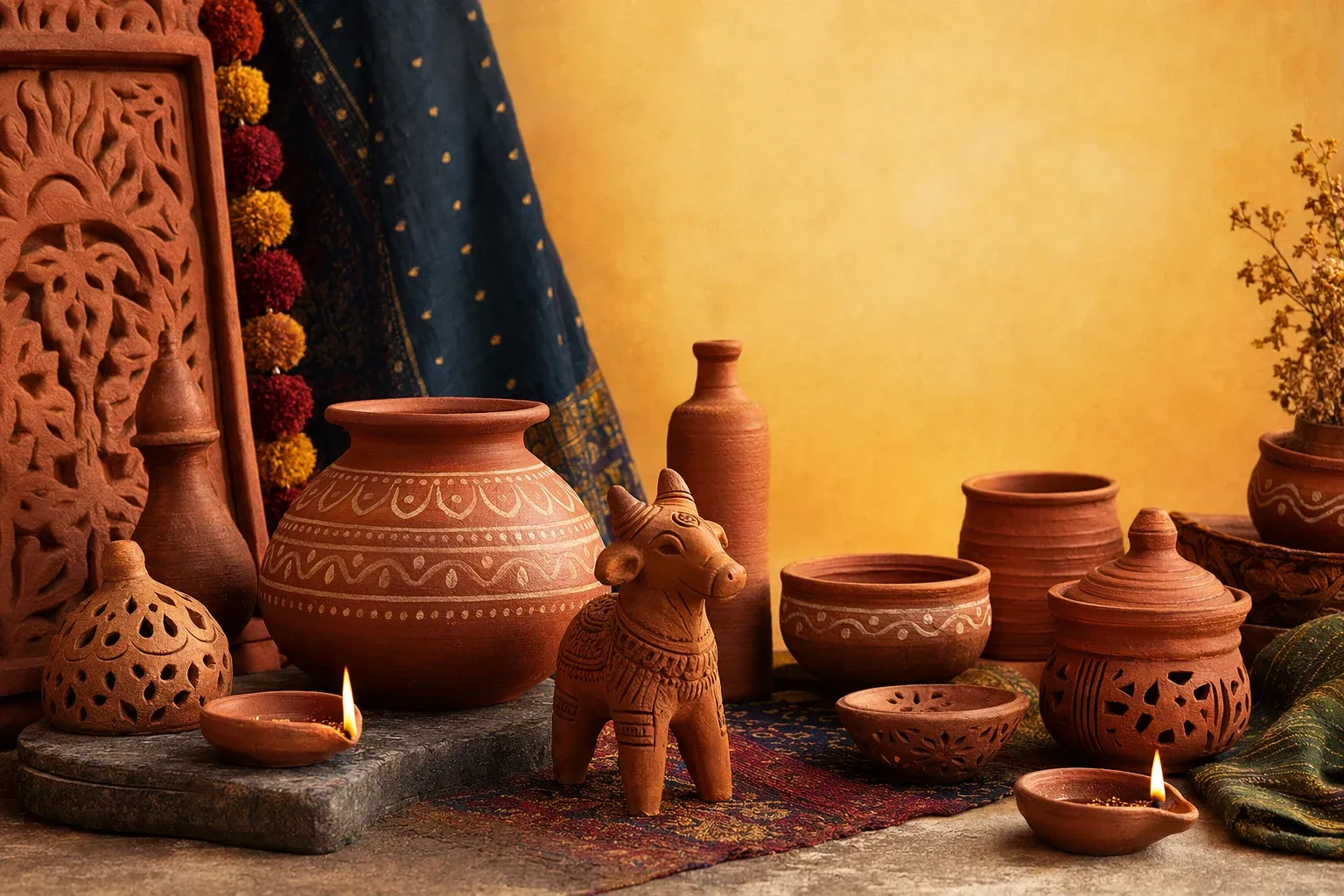
Indian terracotta pottery begins with a very simple idea: earth can be shaped, dried, fired, and made useful. The word terracotta is often explained as “baked earth” or “fired earth”. In India, this fired earth appears in homes, shrines, markets, museum cases, village festivals, craft fairs, and even modern apartments where a small clay diya or planter carries the warmth of handmade material.
The beauty of terracotta is that it does not pretend to be royal or distant. It is close to daily life. A diya holds flame. A matka cools water. A figurine remembers a local deity, animal, or story. A tile decorates a wall. A clay horse may stand in a ritual setting or on a shelf as craft decor. One material can move between use, devotion, play, memory, and art.
For the broader clay-craft background, read What Is Indian Pottery? Meaning, History, and Why It Matters. For a famous terracotta symbol from West Bengal, see Bankura Horses: Heritage, Significance in Indian Culture.
Fired earth, not ordinary mud
Raw mud dissolves when water returns to it. Terracotta changes because fire hardens the clay. After shaping and drying, the object is fired in a kiln or firing pit. The heat makes it stronger, though still porous unless it is glazed or treated differently. The final colour depends on clay, minerals, firing temperature, smoke, and air flow. Many terracotta objects appear red, orange, brown, or yellowish; if vents are sealed and smoke is trapped, clay can darken towards grey or black.
This is why terracotta is not just a “rustic look”. It is material science learned through practice. A potter knows how wet the clay should be, when the surface has dried enough, how thick a wall can be, how a handle may split, and how the fire will behave. In many craft families, this knowledge is passed through observation and correction rather than a written manual.
Diyas, vessels, toys, and figurines
The most familiar terracotta object for many Indians is the diya. During Deepavali and other rituals, a simple clay lamp brings together earth, oil, cotton wick, and flame. It is inexpensive, but it is not meaningless. It shows how a humble object can carry a sacred feeling without needing gold, marble, or expensive decoration.
Terracotta also appears as vessels, storage jars, cups, roof tiles, toys, planters, bells, wall hangings, and figures of animals or humans. In archaeological contexts, terracotta carts, wheels, animals, and figurines help us imagine childhood, movement, symbolic life, and craft habits in ancient settlements. In living craft markets, similar forms may be made for worship, decoration, seasonal fairs, or tourism.
Regional clay memories
India’s terracotta traditions change from place to place because soil, water, climate, ritual practice, and local taste change. Dhubri district’s official page on Asharikandi in Assam describes it as a major terracotta and pottery cluster of North East India, where families shape items from local Hiramati soil. The same source mentions the Hatima doll, a distinctive Asharikandi form associated with the late Sarala Bala Devi.
In West Bengal, Bankura and Panchmura are strongly associated with terracotta horses. In Tamil Nadu, large village terracotta horses connected with Aiyanar worship are part of local guardian-deity traditions. In Rajasthan, Molela is known for clay plaques connected with local deities and folk memory. These examples show that terracotta is not one “pan-Indian design”. It is local culture made visible in clay.
Terracotta in temples and sacred spaces
Terracotta is not limited to small objects. Bengal’s temple architecture, especially in places such as Bishnupur, is famous for terracotta panels that carry stories, figures, floral patterns, animals, social scenes, and decorative borders on temple walls. Here, fired clay becomes a surface for storytelling and sacred architecture.
In village settings, terracotta offerings can also mark prayer, gratitude, protection, or community memory. A clay horse, elephant, serpent, or deity figure may not be “just decor” in its original setting. It may belong to a relationship between community, land, deity, promise, and festival. When such forms travel into modern homes as craft pieces, we should still remember the cultural world they came from.
Home decor and safe daily use
Modern terracotta is popular for planters, wall plates, lamps, vases, wind chimes, jewellery, and tableware. It brings an earthy texture that machine-made plastic or metal cannot copy. But usefulness depends on how the piece was made. Unglazed terracotta is porous; it can absorb water, oil, soap, or smell. A decorative vase may not be safe for food. A cooking vessel needs specific preparation and trustworthy sourcing.
For home use, ask simple questions. Is it decorative or food-safe? Is it glazed? If glazed, is the glaze certified for food use? Can it go on flame, in an oven, or only hold dry flowers? Should it be soaked before first use? Should it be cleaned without harsh detergent? Respecting the material helps the object last longer and keeps people safe.
Tradition, interpretation, and evidence
Terracotta needs three lenses. Tradition tells us how communities remember and use an object: as diya, votive horse, village deity image, toy, or festival item. Interpretation asks what it may mean: light, protection, fertility, learning, play, or beauty. Historical evidence asks what can be shown through excavation, museum study, craft documentation, and dated context.
A good cultural explanation keeps these lenses separate. We should not claim that every terracotta shape has one ancient hidden meaning. We should also not dismiss local tradition because it is expressed through everyday objects. The mature path is respectful and careful: honour living craft, enjoy beauty, and avoid unsupported certainty.
Why terracotta still feels alive
Terracotta survives because it is practical, affordable, renewable in spirit, and emotionally warm. It connects the five familiar elements of Indian imagination in a visible way: earth is shaped with water, dried in air, hardened by fire, and used in spaces where people seek meaning. Even if we do not make a grand claim from that symbolism, the feeling is easy to understand.
For Bhaktilipi’s kind of learning, terracotta is a perfect beginner subject. It teaches that culture is not only in royal monuments or thick books. Culture is also in the lamp lit by a grandmother, the pot made by a village artisan, the toy found in an excavation, and the planter on a balcony. Fired earth reminds us that simple things can carry deep memory.
Questions people ask
What is Indian terracotta pottery?
Indian terracotta pottery means fired-clay objects made for daily use, ritual use, art, decoration, architecture, toys, or craft traditions in India. It includes diyas, vessels, figurines, plaques, horses, tiles, and more.
What is terracotta used for in India?
It is used for lamps, water pots, planters, figurines, home decor, ritual offerings, temple panels, toys, tiles, jewellery, wall hangings, and seasonal festival objects.
Is terracotta safe for food and cooking?
Only some terracotta is made for food or cooking. Decorative pieces should not be used for food unless the maker or seller clearly confirms food-safe material, glaze, and firing.