
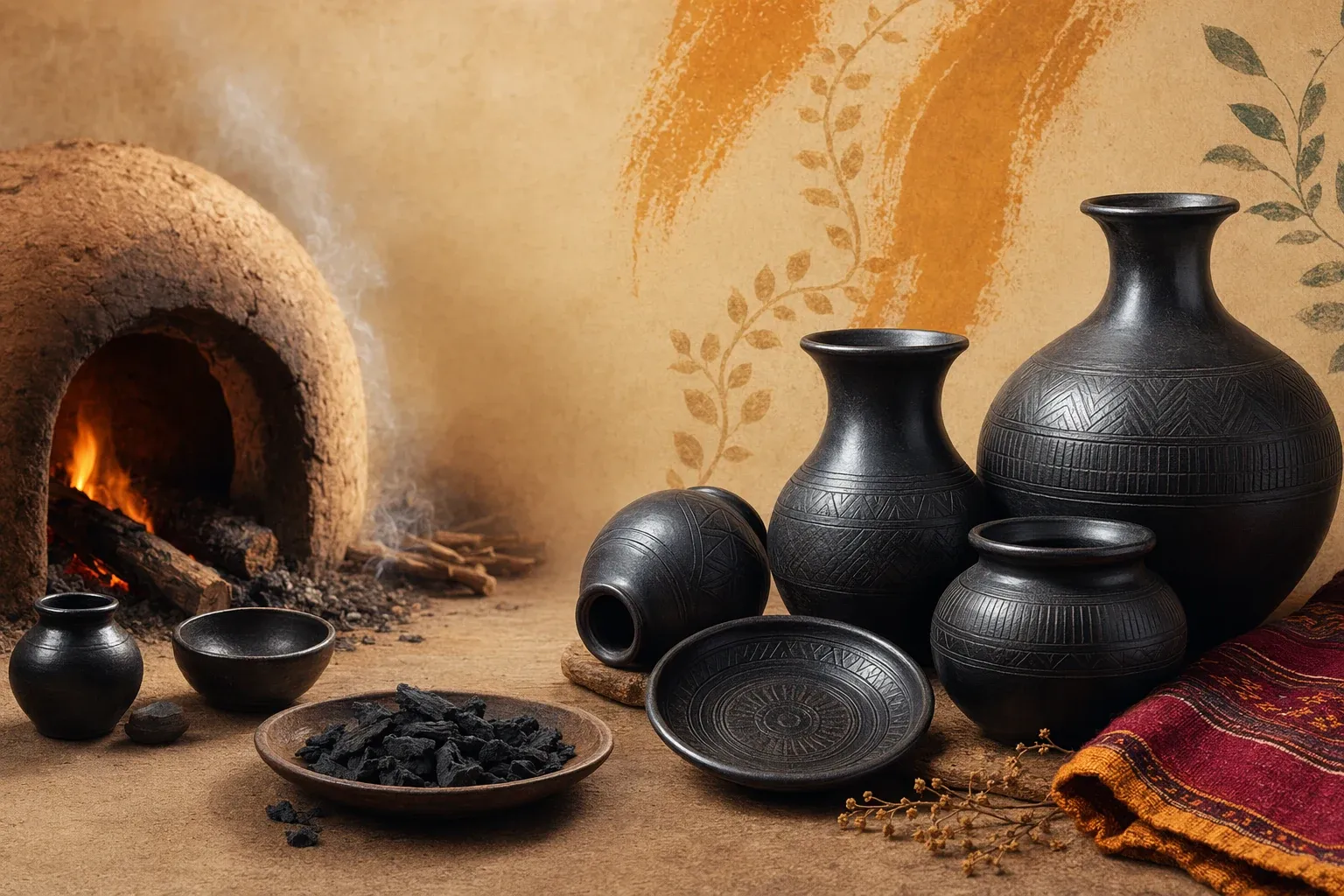
Black pottery in India catches the eye because it looks almost metallic, smoky, or stone-like. At first glance, many people assume it has simply been painted black. In many traditional methods, that is not the real story. The dark colour often comes from firing, smoke, clay composition, polishing, and careful finishing. The surface becomes black because the making process changes how the clay receives fire and carbon.
Two well-known Indian references help beginners understand the range: Nizamabad black pottery from Uttar Pradesh and Longpi pottery from Manipur. They are not the same craft, and their materials and styles differ. But both remind us that black pottery is a serious knowledge tradition, not a shortcut decoration.
For the larger pottery context, start with What Is Indian Pottery? Meaning, History, and Why It Matters. To see how clay objects also help us understand history, read Ancient Indian Pottery: What Clay Vessels Tell Us About History.
The colour comes from the firing atmosphere
Ordinary red terracotta often gets its warm colour when iron-rich clay is fired with enough oxygen. When the firing space is made oxygen-poor, the result can be very different. Smoke and carbon enter the clay surface, and the piece may turn grey, black, or deep brown. Potters may create this low-oxygen atmosphere by sealing vents, covering the firing area, or using organic material such as husk, sawdust, leaves, or dung depending on local practice.
In simple words, black pottery is shaped by controlled absence. The potter does not only add heat; the potter manages air. That is a beautiful lesson in craft: colour can come from what is withheld as much as what is added. The skill is not just “burning clay”. It is reading moisture, temperature, smoke, timing, and surface readiness.
Nizamabad black pottery
Incredible India’s page on Nizamabad black pottery describes a craft connected with Azamgarh district in Uttar Pradesh. The account notes clay preparation, wheel shaping, drying, mustard oil application, etching by women artisans, kiln firing, and the special black colour produced by an oxygen-free environment. It also says silver paint is used to fill the etched grooves, producing the famous contrast on the dark body.
This visual style makes Nizamabad pottery easy to recognise: black body, shining finish, and delicate light-coloured patterns. Floral, vine-like, and geometric designs are common. The craft is sometimes compared visually with Bidri-style contrast, though the material and process are different. The important point is that the final beauty depends on many hands and steps, not only on one dramatic kiln moment.
Longpi pottery from Manipur
Longpi, also called Nungbi in many references, is associated with the Ukhrul region of Manipur and the Tangkhul Naga community. Popular craft documentation describes it as a hand-shaped black pottery tradition made without the usual potter’s wheel. Its material is often described as a mix of special clay and stone powder, shaped by hand and finished with polishing and firing.
Longpi pieces often feel different from wheel-thrown clay pots. They can look matte, deep black, strong, and almost like carved stone or metal. Many buyers know Longpi through cooking pots, kettles, bowls, and tableware. Here again, we should avoid one-size-fits-all claims. A piece may be traditional, modernised for urban kitchens, decorative, or functional depending on maker, finish, and seller guidance.
Burnishing, smoke, and surface shine
Burnishing means polishing the clay surface before firing or during finishing with a smooth tool such as a stone. This compresses the surface and can make it smoother and more reflective. When a burnished surface meets smoky firing, the result can be a deep, attractive finish. Some black pottery traditions also use oil, leaves, lacquer, or rubbing methods to improve shine after heating.
For a beginner, the main difference is between paint and process. Paint sits on top. A smoke-fired or reduction-fired black surface is part of the making journey. That does not mean every black object is ancient or handmade; modern copies exist. But when you see real artisan black pottery, remember that the colour is evidence of technical control.
Patterns on black pottery
Black pottery often uses contrast. Nizamabad-style work may have incised lines filled with a lighter material, making flowers, creepers, borders, and geometric forms stand out clearly. Other black pieces may use minimal decoration because the form and surface already carry visual strength. A plain black cooking pot can be as beautiful as a heavily decorated vase if its shape is balanced.
The designs also tell us how craft adapts to market. Older functional shapes may continue, while new shapes appear for lamps, planters, bottles, office decor, tableware, or gifting. This is not automatically a loss of tradition. Crafts survive when artisans can meet contemporary needs without losing the core knowledge that makes the craft distinct.
Care, use, and safety
If you buy black pottery, do not assume every piece can be used for cooking or serving food. Ask whether it is decorative, food-safe, flame-safe, microwave-safe, or only suitable for dry display. Some traditional cooking vessels need seasoning. Some decorated pieces may include surface materials that are not meant for food contact. The safe rule is simple: function should be confirmed by the maker or seller, not guessed from appearance.
Clean gently. Avoid harsh scrubbing that can damage finish. Dry fully before storage. If a pot is porous, it may absorb moisture or smell. If it has a polished surface, treat it like a craft object, not a steel utensil. Good care is a way of respecting the artisan’s labour.
A craft lesson beyond colour
Black pottery teaches us that Indian craft traditions are not only about ornament. They involve chemistry, material choice, local ecology, community knowledge, gendered labour in some processes, market adaptation, and regional identity. The black colour is only the doorway. Behind it are clay pits, wheels or hand-building, drying courtyards, kilns, polishing stones, family memory, and buyers who either value or undervalue the work.
A dharmic way to look at craft is to honour work honestly. That means enjoying beauty, but also asking who made it, how fairly they are paid, what the object is meant for, and whether we are repeating claims carefully. Black pottery does not need hype. Its strength is already visible in the quiet intelligence of smoke, earth, and human skill.
Questions people ask
How does Indian black pottery become black?
Many black pottery traditions use low-oxygen or smoke-rich firing. Carbon and firing conditions darken the clay surface. Some pieces are also burnished, oiled, etched, or polished for shine and decoration.
Where is black pottery made in India?
Nizamabad in Uttar Pradesh is famous for black pottery with incised light designs. Longpi or Nungbi pottery in Manipur is another major black pottery tradition, known for hand-shaped black vessels.
Is black pottery painted black?
Not usually in traditional black pottery. The dark colour generally comes from firing atmosphere, smoke, clay, and finishing. Some modern decorative products may use paint, so it is best to ask the seller.