Indian pottery designs are not just “pretty patterns”. A painted line, a border, a flower, a bird, a fish, a horse, or a dancing human figure can tell us something about place, use, community taste, religious feeling, market demand, or everyday joy. Some designs are old and local. Some are modern adaptations. Some are made for ritual, while others are made for home decor.
The safest way to understand pottery designs is to ask three questions: where is it from, what object is it on, and what was it made for? The same lotus may feel different on a festival lamp, a decorative plate, a wedding object, a blue pottery tile, or a classroom art project. Context gives design its real meaning.
If you want to compare these pottery motifs with other Indian visual traditions, read Warli Art from Maharashtra: Meaning, Style, and Beginner Context and Pattachitra-Madhubani-Kalamkari: Compare India's Art Forms. For the wider clay-craft base, see What Is Indian Pottery? Meaning, History, and Why It Matters.
Lines, dots, borders, and geometry
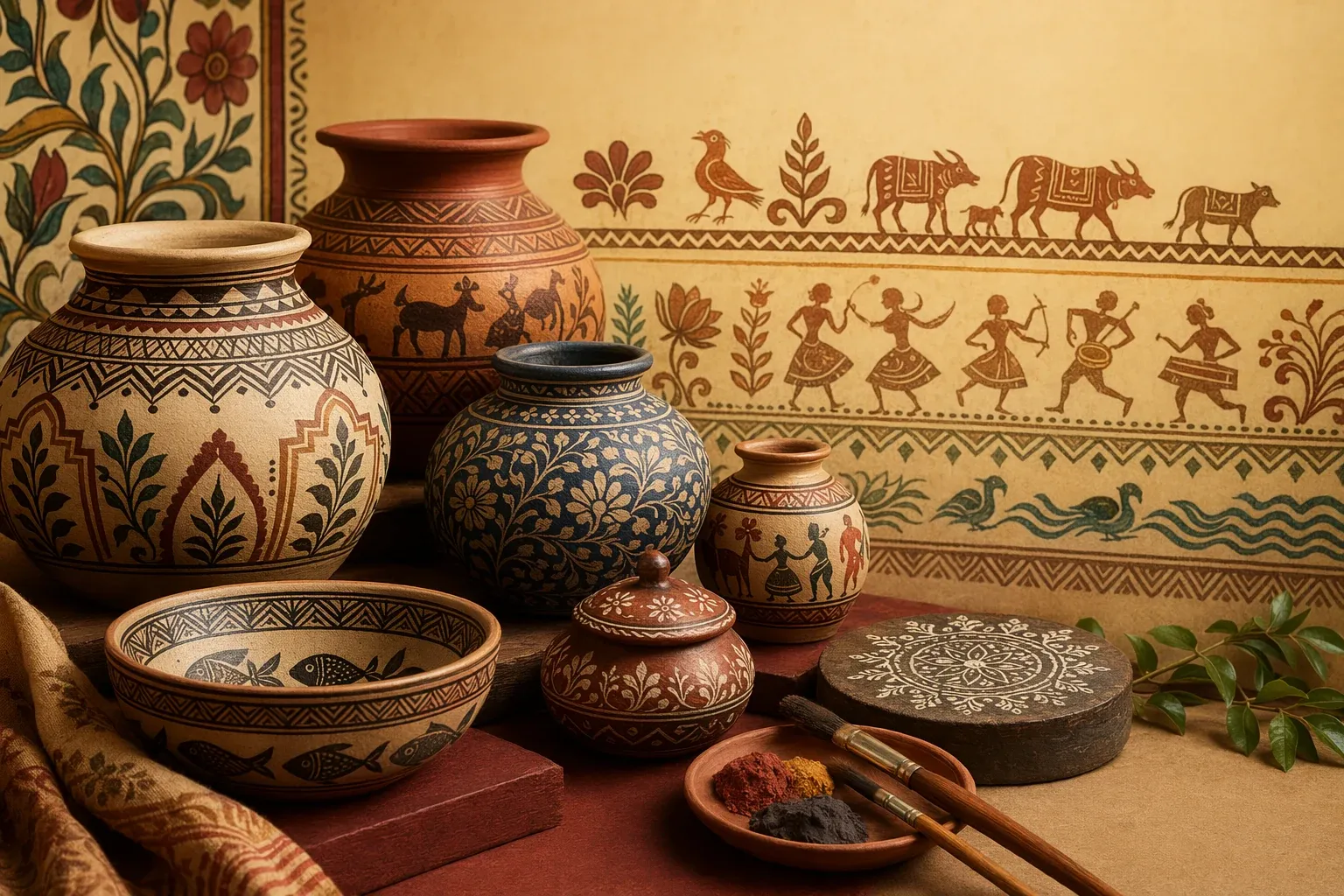
Many pottery designs begin with simple geometry. Lines can divide a pot into sections. Dots can fill empty space. Triangles, waves, circles, checks, and bands can create rhythm around a curved surface. A border near the rim can frame the mouth of a pot; a circular band around the belly can emphasise shape. These details guide the eye and make a vessel feel complete.
Geometry is also practical. Repeating forms are easier to paint across many objects, especially in a working craft environment. A potter or painter can use a brush, twig, needle, or slip trail to create quick but beautiful designs. The pattern does not have to be complicated to be meaningful. Even a neat black line on red clay can show discipline, balance, and care.
Flowers, leaves, fish, birds, and animals
Nature is one of the strongest sources of Indian decorative language. Leaves, vines, lotuses, flowers, peacocks, parrots, elephants, bulls, horses, fish, snakes, and deer appear in many craft traditions. Sometimes they are symbolic; sometimes they are simply familiar and beautiful. Fish may suggest fertility or abundance in some folk-art contexts. The lotus often carries ideas of purity and auspiciousness. Birds and vines bring movement to a still object.
On terracotta, animals can become sculptural forms rather than only painted motifs. Bankura horses, village elephants, clay bulls, and small toy animals show how design can grow into shape itself. On a painted plate or pot, the same animal may be flattened into a line drawing. Indian pottery design moves easily between object, image, and symbol.
Warli-style figures on clay
Warli art is associated with the Warli community of Maharashtra and nearby regions. A source check from Exotic India Art describes Warli visual language through earth-coloured surfaces, white rice-paste painting, and scenes of daily life such as farming, hunting, drawing water, fishing, dancing, and community activity. The style is famous for simple human figures built from triangles, circles, and lines.
When Warli-style figures appear on pots, vases, or plates, they often bring a storytelling feeling. A tarpa dance circle, a line of people, trees, animals, or huts can wrap around the curved surface. But we should speak carefully. Not every white stick-figure design is automatically a traditional Warli work made by Warli artists. Many urban products borrow the look. Respect means naming the source tradition and not reducing it to a trend.
Madhubani-inspired pottery motifs
Madhubani or Mithila art from Bihar is known for dense patterning, strong borders, mythic and natural imagery, and bright colour. On pottery and terracotta plates, Madhubani-inspired motifs may include fish, lotus, peacock, sun, moon, leaves, and filled backgrounds. The surface rarely feels empty; even small spaces may be decorated with lines or dots.
Here too, context matters. A student painting a Madhubani-inspired clay pot is not the same as a traditional Mithila artist working within a community lineage. Both may be beautiful, but they should not be described as identical. A respectful beginner learns the names of regions and communities instead of saying “Indian design” for everything.
Jaipur blue pottery patterns
Jaipur blue pottery has a very different surface language. Gaatha’s craft archive notes that blue pottery is widely recognised as a traditional craft of Jaipur and is known for blue dye, glazing, low firing, and a body that does not use ordinary clay in the usual way. Its designs often include birds, animals, flowers, and geometric or Persian-influenced patterns.
The blue colour itself becomes part of the design identity. Cobalt blue, turquoise, green, white, and occasional yellow or brown tones create a cool, glazed look very different from porous red terracotta. This is a good reminder that pottery design is not only drawing. Material, glaze, firing, shine, and colour palette all shape what a design communicates.
Ritual objects and symbolic caution
Some pottery designs are connected with ritual life: lamps for light, kalash-like forms for auspiciousness, deity figures, serpent forms, horses, elephants, or local guardian symbols. But it is risky to assign one fixed meaning to every motif. A horse may be a ritual offering in one context, a craft souvenir in another, and a decorative studio form somewhere else.
The honest method is to say what is known and keep room for local variation. Tradition preserves meaning through use. Interpretation helps us understand possible symbolism. Historical evidence asks where the object came from and how it was used. These three layers should support each other, not be mixed into overconfident claims.
How to read a pottery design
When you see an Indian pottery design, start with observation. Look at the base colour, material, glaze, shape, motif, border, and whether the design is painted, incised, stamped, moulded, carved, or applied. Then ask about place: Jaipur, Khurja, Nizamabad, Bankura, Molela, Kutch, Assam, Manipur, or another region. Place helps you avoid vague descriptions.
Next, ask about use. A cooking pot, water vessel, diya, ritual plaque, wall plate, planter, school project, and export souvenir are designed for different audiences. Finally, ask about maker and source. Handmade does not mean “primitive”; it often means the maker carried material knowledge that machines cannot easily replace.
Design ideas without copying blindly
If you are decorating a clay pot for a school or home project, begin with respect. Use simple borders, local flowers, leaves, birds, or geometric bands. If you borrow from Warli, Madhubani, blue pottery, or another tradition, name the inspiration and learn a little about the community or place. Do not claim your copied design is an ancient original.
A good design can be simple: a red pot with black bands, a diya with small white dots, a planter with leaf borders, or a plate with fish and lotus motifs. The aim is not to fill every inch. The aim is to let clay, shape, and pattern work together. In Indian pottery, beauty often comes from harmony between hand, material, and meaning.
Questions people ask
What are common Indian pottery designs?
Common designs include geometric borders, dots, waves, flowers, vines, lotuses, fish, peacocks, parrots, elephants, horses, human figures, deity forms, and region-specific painted or incised patterns.
What do Indian pottery symbols mean?
Meanings depend on region and use. A lotus may suggest auspiciousness, a fish may suggest abundance in some traditions, and a horse may be decorative or ritual. Context matters more than one universal answer.
Can I use Warli or Madhubani designs on pottery?
You can use them as learning inspiration, especially for school or personal art, but name the source tradition respectfully and avoid presenting copied motifs as your own traditional lineage.