
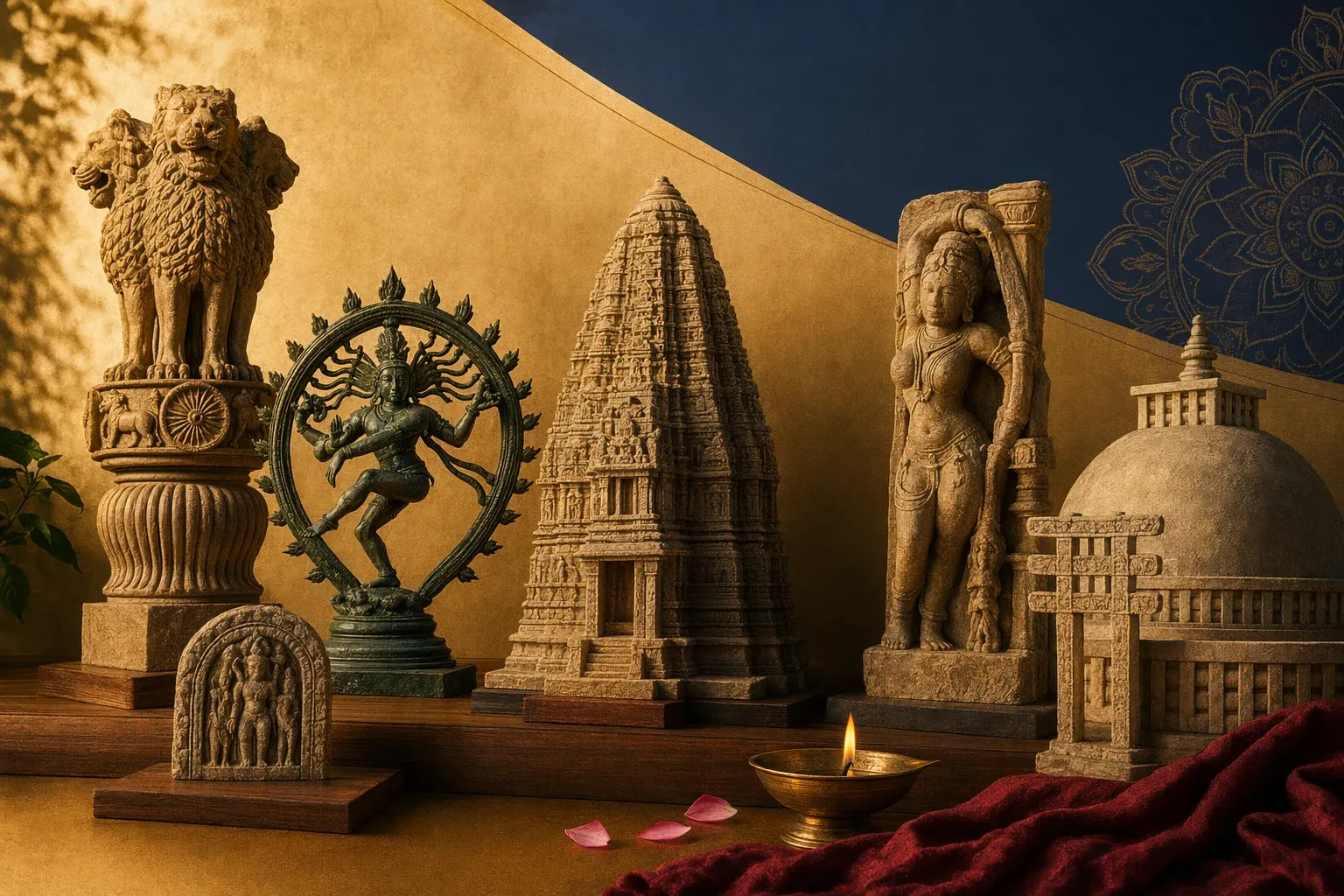
Indian sculpture is one of the easiest ways to enter Indian history because it lets us see ideas in stone, metal, terracotta, and relief carving. A sculpture can show a ruler’s power, a devotee’s faith, a dancer’s movement, a storyteller’s imagination, or a community’s idea of beauty. When beginners ask for famous Indian sculptures, the answer should not be only a list of names. Each example becomes more memorable when we ask three simple questions: where was it made, what does it show, and why do people still talk about it?
The Lion Capital of Ashoka
The Lion Capital from Sarnath is one of the most recognised sculptures connected with ancient India. It was created in the Mauryan period, usually dated to the 3rd century BCE, and was originally placed on top of an Ashokan pillar. Four lions stand back to back, suggesting dignity, alertness, and royal authority. Below them are animals and the dharma chakra, the wheel that later became central to India’s national emblem.
What makes this sculpture special is not only its beauty, but its public meaning. Ashoka used pillars to communicate moral ideas, royal presence, and Buddhist inspiration across a large empire. The polished surface and confident animal forms show how skilled Mauryan artists were. For a beginner, the Lion Capital is a good reminder that Indian sculpture was never only temple decoration; it could also speak the language of statecraft, ethics, and memory.
The Great Sanchi Torana Reliefs
At Sanchi, the famous gateways around the stupa are covered with carved scenes. These reliefs do not always show the Buddha in human form. Instead, they use symbols such as the Bodhi tree, footprints, the wheel, and the empty throne. This makes Sanchi especially interesting for young readers who expect every religious image to be direct and literal.
The carvings show stories, processions, animals, worshippers, and decorative patterns. They invite the viewer to move slowly, almost like reading a visual book. Sanchi teaches us that sculpture can work as storytelling. It also shows how early Buddhist art used symbols to create devotion and memory without depending only on portrait-like images.
The Didarganj Yakshi
The Didarganj Yakshi, found near Patna, is often discussed for its graceful standing posture and polished surface. The figure is usually connected with the wider tradition of yaksha and yakshi images, which are associated with fertility, abundance, and nature spirits in ancient Indian art.
Beginners sometimes look at this sculpture only as a beautiful female figure, but it is more than that. It shows how early Indian artists gave human form to prosperity, presence, and auspiciousness. The jewellery, body posture, and calm confidence tell us about ideals of beauty and sacred power in early art. The exact dating has been debated by scholars, which is also useful to remember: history is not always a fixed one-line answer.
The Dancing Shiva Nataraja
The bronze image of Shiva as Nataraja is one of the most powerful icons of Indian art, especially associated with the Chola period in Tamil Nadu. Shiva dances within a ring of flame, one hand holding the drum of creation, another holding fire, one hand giving assurance, and one foot pressing down the dwarf of ignorance.
This sculpture is famous because it turns philosophy into movement. The image is not frozen in a stiff pose; it feels rhythmic and alive. It brings together destruction and renewal, fearlessness and energy, cosmic scale and temple devotion. For a beginner, Nataraja is a perfect example of how Indian sculpture often joins symbol, story, and spiritual idea in one image.
The Kailasa Temple at Ellora
Kailasa at Ellora is not a single small statue, but it belongs in any beginner list because the whole temple is a sculptural achievement. Carved from rock, it is often described as one of the most astonishing examples of rock-cut architecture in India. The temple includes panels, pillars, elephants, deities, and narrative scenes connected with Shiva and wider Hindu sacred imagination.
The most important point is that Kailasa was made by removing rock, not by building upward block by block in the usual way. That makes the planning and labour difficult to imagine even today. Its fame comes from scale, technique, and devotion working together. It shows how Indian sculpture can become architecture, and architecture can become a sacred mountain-like experience.
The Mahishasuramardini Panel at Mamallapuram
At Mamallapuram, the Mahishasuramardini relief shows Durga in battle against the buffalo demon Mahishasura. The scene is energetic, dramatic, and full of movement. Durga appears powerful and focused, while the surrounding figures add tension to the story.
This sculpture matters because it captures a narrative moment rather than only a calm devotional pose. It helps beginners understand why Indian temple art often feels like a story paused at its most intense second. The panel also connects with the Pallava period and the coastal art heritage of Tamil Nadu. It is a good example of how sculpture can carry both religious meaning and visual drama.
Khajuraho Temple Sculptures
The sculptures of Khajuraho are famous across the world, but they are often misunderstood when people focus only on the erotic panels. The temple walls include deities, dancers, musicians, couples, guardians, everyday figures, and decorative forms. The full sculptural programme is much wider than one category of imagery.
For beginners, Khajuraho should be read as a complex temple art world. The human body, music, celebration, divinity, and cosmic order appear together. The sculptures show technical skill, but also a worldview in which sacred architecture contains many layers of life. A respectful reading avoids both embarrassment and sensationalism. It asks what the temple as a whole is trying to show.
The Buddha Images of Sarnath
The seated Buddha images from Sarnath, especially from the Gupta period, are admired for their calm expression, balanced posture, and refined spiritual mood. The Buddha is often shown teaching, with the hands in dharmachakra mudra, the gesture of turning the wheel of dharma.
These images are famous because they communicate stillness without looking empty. The face, robe, posture, and halo create a quiet dignity. If Nataraja shows cosmic movement, Sarnath Buddha images show inward peace and teaching. Together, they reveal the range of Indian sculpture: intense motion in one tradition, deep calm in another.
How to Remember These Examples
A simple way to remember famous Indian sculptures is to group them by what they teach. Ashoka’s Lion Capital shows public ethics and royal communication. Sanchi shows symbolic storytelling. Didarganj Yakshi shows auspicious presence and early artistic polish. Nataraja shows movement and philosophy. Ellora shows sculpture at architectural scale. Mamallapuram shows dramatic narrative. Khajuraho shows the fullness of temple life. Sarnath Buddha images show serenity and teaching.
This also helps avoid a common mistake. Indian sculpture is not one style from one period. It changes across region, religion, material, patronage, and purpose. Stone reliefs, bronze icons, pillar capitals, cave temples, and free-standing images all belong to the story. If you want the broader visual vocabulary before studying individual works, read our guide to key features of Indian sculpture, which explains posture, symbols, materials, and storytelling clues in a simple way.
FAQ
Which is the most famous Indian sculpture?
There is no single answer, but the Lion Capital of Ashoka, Shiva Nataraja, and major temple sculptures at Ellora, Sanchi, Khajuraho, and Mamallapuram are among the most widely recognised examples.
Why are Indian sculptures important?
They preserve stories, symbols, artistic skill, religious ideas, social memory, and historical clues. Many sculptures help us understand how people imagined dharma, devotion, power, beauty, and the sacred.
Are all famous Indian sculptures religious?
Many are connected with Hindu, Buddhist, or Jain traditions, but not all sculpture should be reduced to worship alone. Some works also express royal authority, storytelling, social ideals, architecture, and cultural identity.
What should beginners notice first?
Start with posture, hand gestures, facial expression, objects held in the hands, surrounding figures, and the place where the sculpture was made. These clues usually reveal the story and meaning more clearly than memorising dates alone.