
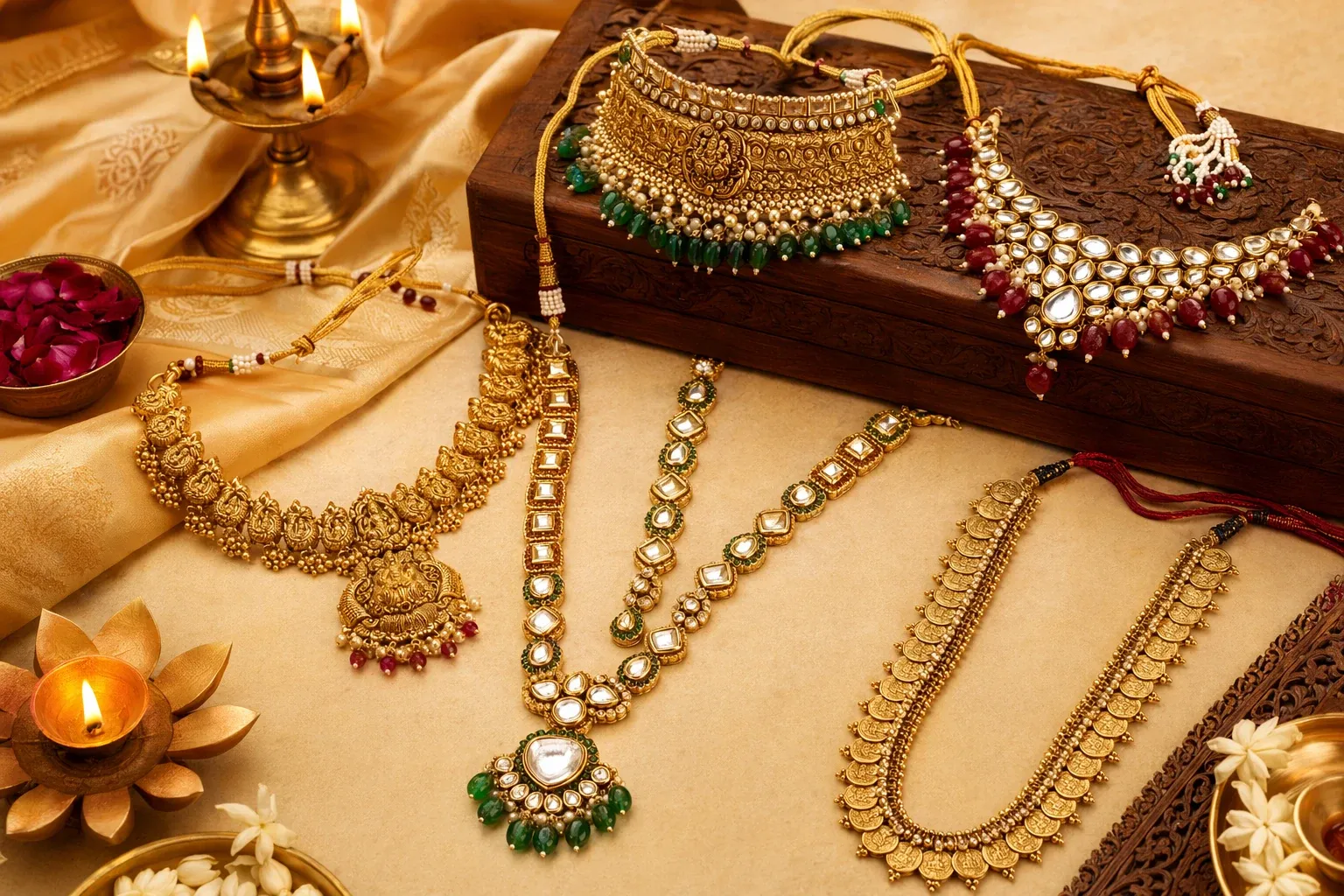
Traditional Indian necklaces can look overwhelming in photographs: one bride may wear three layers, a dancer may wear a temple choker and long chain, and a royal portrait may show pearls, emeralds, turban jewels, and gem-heavy collars. But necklace types become easier when we group them by shape, length, craft style, and occasion.
A necklace can be named because of how it sits on the body, like a choker or long haar. It can be named by technique, like kundan or meenakari. It can be named by social use, like mangalsutra. It can be named by motif, like coin, mango, lotus, or deity forms. Most real necklaces combine more than one category, so a “kundan choker” is both a craft style and a shape.
Necklace styles also appear in performance costume and older visual art, so it helps to compare them with The 8 Classical Dance Forms of India Explained Simply and examples in Famous Indian Sculptures: Examples Every Beginner Should Know.
Short necklaces and chokers
A choker sits close to the neck. In Indian styling, chokers are popular because they frame the face and leave space for longer necklaces below. Bridal looks often pair a choker with a rani haar or other long haar, creating a layered effect that feels grand without depending on only one piece.
Chokers can be simple gold bands, pearl collars, kundan settings, temple-style pieces, oxidised silver, beadwork, or fabric-backed designs. A gulbandh is a close necklace form, and a thushi is a Maharashtrian choker style made with small, closely packed gold beads. In Rajasthan, an aad necklace has a broad choker-like front, sometimes with a curtain or panel effect. These pieces are useful for beginners because their shape is easy to identify: they sit high and close.
Haar and rani haar
Haar is a broad word for necklace, often used for longer pieces. A rani haar means “queen’s necklace” in the popular sense: a long, regal necklace that falls below the collarbone and sometimes reaches the chest. It may have multiple strands, a large pendant, kundan work, polki stones, pearls, or gemstone units.
Rani haars became visually powerful in royal and bridal contexts because length creates drama. In wedding styling, a long haar can balance a heavy lehenga, silk saree, or embroidered dupatta. In portraits and courtly jewellery, long necklaces also signalled rank and wealth. Christie’s discussion of Indian jewellery notes how Mughal and regional elites used necklaces, bangles, rings, gems, pearls, and jewelled objects to show authority and taste. Today, the same silhouette survives in wedding fashion, even when the material is imitation.
Kundan necklaces
Kundan is not a necklace shape; it is a setting style. Stones are placed in a prepared framework and secured with refined gold foil. The look is usually rich, smooth, and highly decorative, with stones appearing closely held rather than raised by modern prongs. Kundan is strongly associated with North Indian bridal jewellery and Rajasthani craft traditions, though modern kundan-inspired pieces are now sold everywhere.
A kundan necklace may be a choker, a long haar, a collar, or a pendant set. It may include glass stones, gemstones, pearls, enamel, or imitation materials depending on price and maker. Beginners should not assume every “kundan” listing means pure gold and precious stones. The word may describe an authentic craft method, a design inspiration, or a fashion finish. When buying, ask about base metal, stone type, plating, return policy, and care instructions.
Polki necklaces
Polki usually refers to uncut diamonds used in traditional settings. Polki pieces have a softer, raw sparkle compared with modern cut diamonds. They are common in bridal and luxury jewellery, especially in North Indian and Rajasthani-inspired designs. A polki necklace may be combined with enamel work on the back, pearls around the edges, and gemstone drops.
The important beginner point is that polki and kundan are related in visual culture but not identical. Kundan describes the setting approach, while polki points to the uncut diamond material. Many commercial pieces use the words loosely, so careful buyers should check certificates, invoices, and jeweller reputation. Cultural learning is one thing; shopping accuracy is another.
Meenakari necklaces
Meenakari is enamel decoration on metal. In Indian jewellery, it is often associated with Rajasthan and courtly traditions. A necklace may show stones on the front and bright enamel on the reverse, making the back almost as beautiful as the front. Christie’s notes enamel among the techniques that shaped Indian jewellery, and craft sources often connect Jaipur with refined meenakari work.
Meenakari necklaces are easy to recognise when you see colourful floral, bird, or geometric enamel patterns in red, green, blue, white, or other tones. Sometimes the enamel is visible only when the piece is turned over. This hidden beauty is part of the charm: the craft honours the whole object, not only the camera-facing surface.
Temple necklaces
Temple necklaces are inspired by South Indian temple art, deity ornaments, and classical dance. They may show Lakshmi, Ganesha, Vishnu forms, peacocks, mango motifs, lotus patterns, coin chains, parrots, or yali-like mythical creatures. Enroute Indian History links temple jewellery with South Indian temples, offerings, royal support, specialised artisans, and later use in Bharatanatyam. Because dancers need visible ornaments, temple necklaces often have bold motifs and strong outlines.
Common temple necklace forms include a close choker, a longer haram, mango necklace, kasu or coin necklace, and layered sets used with earrings, waist belt, head ornaments, and bangles. Traditional pieces could be gold or silver-gold, with rubies, emeralds, uncut stones, pearls, or kemp-style red and green stones. Modern dance and bridal versions may be imitation, which is practical for performance and budget.
Coin necklaces and kasu mala
A coin necklace uses repeated coin-like units. In South India, kasu mala is a beloved form, often made with gold coins or coin-shaped pieces. Some versions show goddess Lakshmi on each coin, linking wealth, auspiciousness, and ornament. Coin necklaces may be short, medium, or long, and they work well with silk sarees because their repeated pattern catches light without needing large stones.
Coin jewellery also reminds us that ornaments can connect beauty and savings. Gold coins, pendants, and chains have long been part of family wealth in many households. A necklace could be worn during ceremonies and also preserved as an asset. That dual role explains why gold jewellery remains emotionally powerful.
Mangalsutra and marriage necklaces
A mangalsutra is a marriage necklace in many Hindu communities, but it does not look the same everywhere. Some have black beads and gold pendants. Some are short and minimal for daily wear. Some are grand wedding pieces. Maharashtrian, South Indian, North Indian, and modern urban designs can differ widely. In some communities another sacred necklace or pendant may carry the marriage symbolism instead.
It is best to avoid one-line claims such as “all Indian brides wear this.” India is too diverse for that. A respectful explanation says that many communities have marriage necklaces or sacred ornaments, and the form depends on family, region, sect, and personal choice.
Pearl and multi-strand necklaces
Pearls have a long association with Indian courtly and bridal jewellery. Multi-strand pearl necklaces may be called teenlada, panchlada, or similar names depending on the number of strands and regional usage. Pearls soften a heavy look, especially when paired with kundan pendants, emerald drops, or gold clasps. In royal images, pearls often sit beside emeralds, rubies, spinels, and diamonds, creating a layered language of elegance.
For modern readers, pearl necklaces are also versatile. They can be styled with sarees, lehengas, anarkalis, or even fusion outfits. The cultural point is not that every pearl piece is ancient; it is that pearls entered Indian jewellery through trade, courts, coastal wealth, and long-standing taste for luminous materials.
How to recognise a necklace type in photos
First, look at length. Is it close to the neck, collar-length, mid-chest, or long? Second, look at the repeated unit: coins, pearls, mango shapes, gemstones, beads, or deity motifs. Third, check the craft look: smooth kundan setting, raw polki sparkle, enamel colours, filigree wire, or temple-style relief work. Fourth, notice the occasion: daily wear, bridal, dance, ritual, or fashion styling.
A single necklace can have several identities. A bride might wear a temple-style mango choker with kemp stones, a long kasu mala, and a pearl haar. A North Indian bride might wear a kundan choker with a polki rani haar. A student at a college event might wear an oxidised silver choker inspired by tribal forms. The richness is in the layering.
Careful words for a rich tradition
Traditional Indian necklaces are not just accessories. They are craft objects, family memories, ritual markers, regional signs, and fashion choices. Some are sacred to the wearer; some are simply loved for their beauty. Some are precious gold; some are affordable imitation. A good beginner does not reduce them to “bling” or assume every piece has the same meaning.
Start with shape, then technique, then context. Choker, haar, rani haar, kundan, polki, meenakari, temple necklace, kasu mala, mangalsutra, and pearl strands will soon stop feeling like random names. They will begin to feel like doors into Indian art, history, and everyday life.