
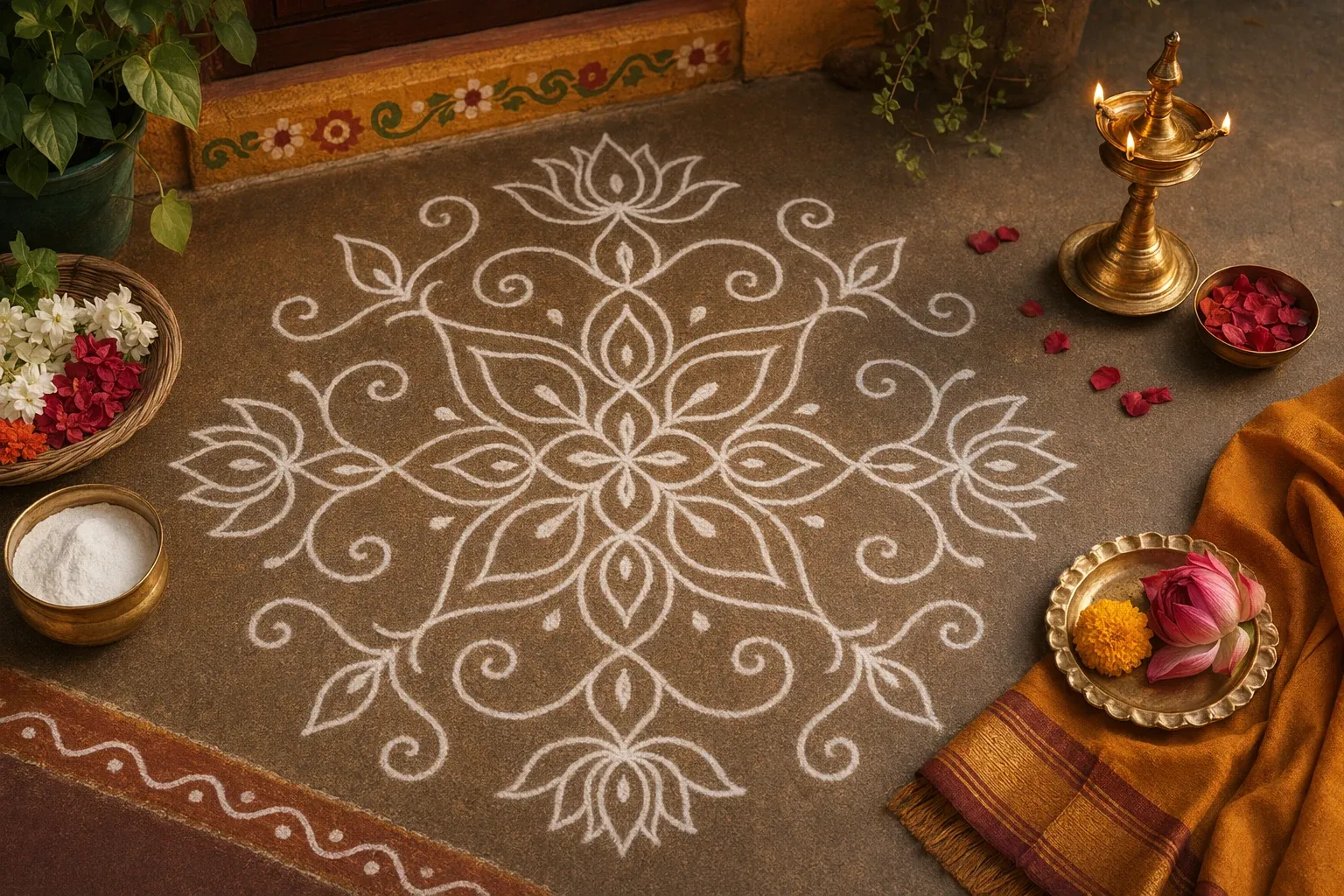
Simple kolam without dots is a friendly starting point for anyone who wants to try kolam but feels nervous about dot grids. Instead of placing dots first, you draw freehand lines, curves, flowers, leaves, lamps, borders, and small symmetrical shapes directly on the ground or paper. It may look informal, but a good freehand kolam still needs attention, balance, and patience.
For beginners, the best way to understand it is this: kolam without dots gives you more freedom, while pulli kolam, or dot kolam, gives you more structure. Neither is better in every situation. Freehand kolam is useful for quick daily designs, doorway borders, festival decorations, and creative practice when you want the hand to move naturally.
What does “without dots” mean?
In many classic kolam patterns, the artist first places a dot grid. The dots guide the line, help maintain spacing, and make symmetry easier. A kolam without dots skips that grid. You may still imagine a centre point or rough boundary in your mind, but you do not mark every dot before drawing.
This makes the design feel more flowing. You can begin with a small circle, a curved line, a lotus petal, a diya shape, a star, or a simple border. From there, you repeat the same shape on both sides so the kolam looks balanced. The secret is not complicated: keep the design small, repeat one idea clearly, and leave enough empty space.
Freehand shapes that work well
The easiest freehand kolam elements are curves, loops, petals, leaves, lamps, stars, and borders. A small flower in the centre with four or six petals can become a complete doorway design. Add two curved leaves on each side, a thin outer circle, or tiny dots as decoration, and it already feels graceful.
Line kolams are also useful. You can draw two parallel curved lines, turn them into a simple arch, and repeat the arch around a centre. Beginners often find borders easier than full circular designs because a border moves left to right and does not demand perfect symmetry from every angle.
Daily designs and festival designs
A daily kolam without dots should be quick, clean, and easy to repeat. Think of a small flower, a four-petal pattern, a simple lamp, or a neat border near the entrance. The purpose is to bring care and beauty to the doorway without needing a lot of time.
Festival kolams can be larger and more decorative. For Deepavali, lamps and radiating lines look beautiful. For Pongal, pots, sugarcane, and sun-like forms can be added. For Friday or Lakshmi-associated customs, lotus shapes and graceful curves are common. Even then, keep cultural symbols respectful and avoid turning sacred imagery into careless decoration.
How to practise steady lines
If you are using kolam powder, first practise line control separately. Take a small pinch between your fingers and let the powder fall slowly while your hand moves. Try one straight line, then a curve, then a small circle. Do this on newspaper, a tile, or any washable surface. The aim is to make the flow even, not thick in one place and empty in another.
If powder feels difficult, begin with pencil, chalk, or a finger on a tray of rice flour. Draw the same small flower ten times. You will notice your hand becoming calmer. Repetition is not a punishment in kolam; it is how the hand learns rhythm.
When dots are still useful
Even if you love freehand designs, dots are helpful for learning symmetry. A small dot grid can teach spacing, proportion, and direction. Many beginners improve faster when they practise both styles: freehand kolam for flow and pulli kolam for discipline.
A good habit is to start a design without dots, then lightly imagine an invisible centre line. Ask yourself whether the left and right sides feel balanced. If one side is heavier, add a small matching curve or leaf on the other side. Balance matters more than perfection.
A simple first design idea
Try this: draw a small circle in the centre. Add four petals around it like a flower. Between the petals, add four tiny leaves. Draw a loose outer circle or square border. Add small dots around the edge if you want texture. This design is simple, but it teaches centre, repetition, spacing, and finishing.
The real joy of kolam without dots is confidence. You do not need a huge design to begin. A tiny handmade kolam, drawn with attention, can make a doorway feel loved. Start small, repeat often, and let your hand slowly discover its own grace.
Common mistakes to avoid
The most common beginner mistake is trying a large design too early. A big freehand kolam looks tempting, but it also makes spacing harder. Start with one centre shape and one border. Once that feels comfortable, add more petals, lamps, or curves. Another mistake is pressing the powder too heavily. A light, even flow looks cleaner and is easier to correct.
Also avoid copying sacred symbols casually without knowing their meaning. If you use a lamp, lotus, or auspicious mark, place it neatly and respectfully. Freehand kolam gives freedom, but freedom works best with care. A simple design made sincerely will always feel better than a complicated design made without attention.
Over time, you can build a small personal collection: one design for ordinary mornings, one for Fridays, one for festivals, and one border for quick use. This keeps practice realistic and makes the tradition easier to continue.