
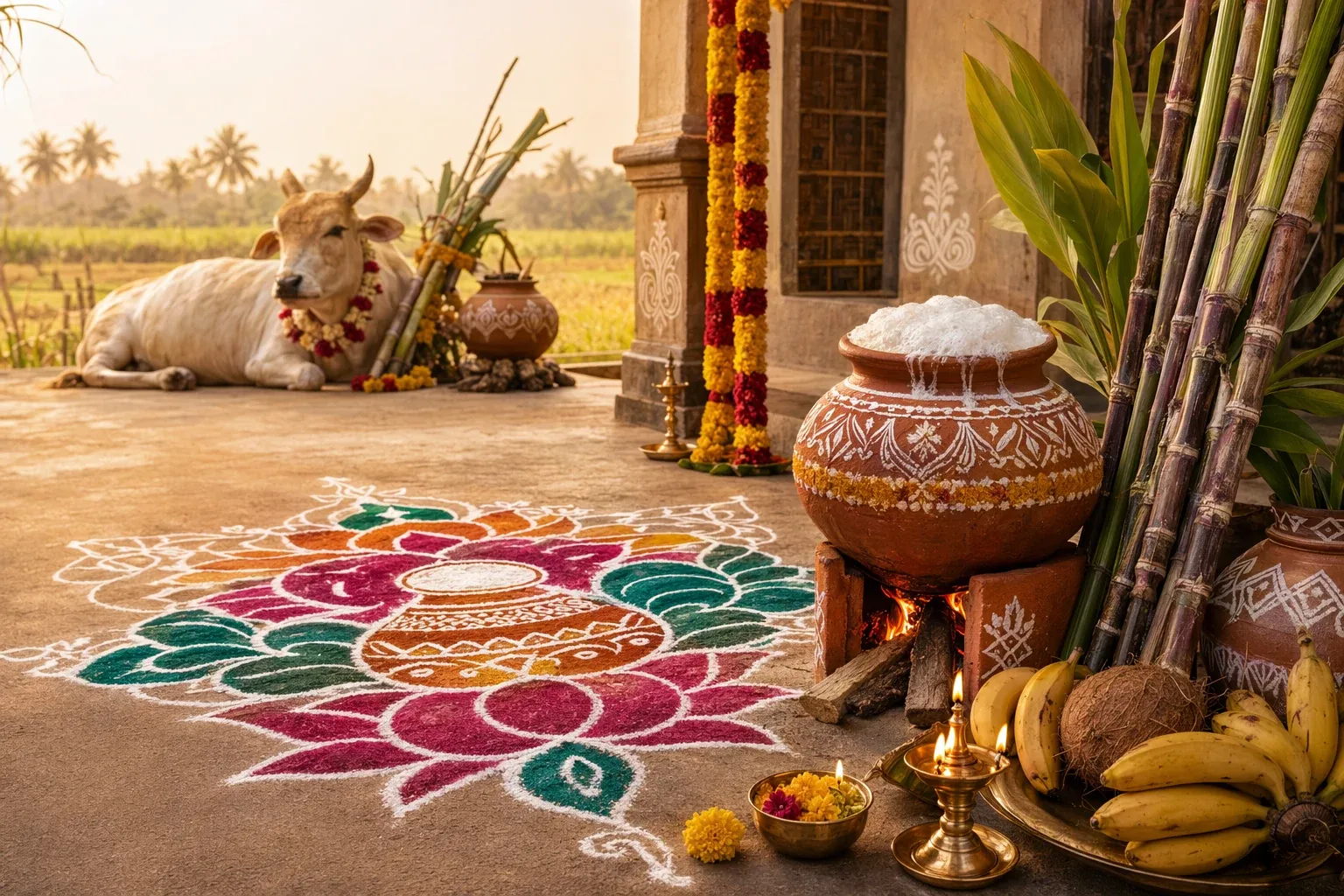
Pongal kolam is one of the most joyful forms of kolam because it brings harvest, home, gratitude, and celebration together. During Pongal, many doorways and courtyards become brighter than usual, with designs showing pots, sugarcane, the sun, cows, flowers, and festive colours. The kolam is not just there for beauty; it helps the home participate in the festival.
Pongal is a harvest festival widely celebrated in Tamil Nadu and by Tamil communities around the world. It thanks nature, cattle, land, family effort, and divine grace for food and prosperity. A Pongal kolam reflects that feeling. It says, in a visual way, that the home is grateful and ready to celebrate abundance with humility.
Why kolam becomes special during Pongal
Daily kolam is often simple and white. Pongal kolam may be larger, more colourful, and more symbolic. Families may clean the entrance carefully, draw a fresh design, add colours, place a sugarcane motif, or create a central pot with boiling rice. In some homes, the kolam frames the real Pongal pot used in worship and cooking.
The entrance matters because Pongal is not only an indoor celebration. It connects the household with the sun, fields, animals, neighbours, and community. A bright kolam outside the home makes that connection visible.
Common Pongal symbols
The Pongal pot is the most recognisable symbol. It represents cooking the new rice until it overflows, which is linked with abundance and blessing. Sugarcane suggests harvest sweetness and agricultural prosperity. The sun reminds us of Surya, whose warmth and light support crops and life. Cows and bulls are honoured especially around Mattu Pongal because cattle have traditionally been important to farming life.
Other common design elements include lamps, flowers, turmeric leaves, banana leaves, dots, borders, and colourful geometric shapes. A beginner does not need to include everything. One clear pot, two sugarcane stalks, and a neat border can be more beautiful than a crowded design.
Bhogi, Pongal, and Mattu Pongal
Bhogi, the first day in many Pongal celebrations, is associated with cleaning, renewal, and letting go of the old. Bhogi kolam may focus on freshness, colour, and a clean start. The main Pongal day centres on thanksgiving for the harvest, so pot, sun, and sugarcane designs are especially fitting.
Mattu Pongal honours cattle, especially cows and bulls. A Mattu Pongal kolam may include cow motifs, horns, bells, garlands, or village scenes. When drawing animal forms, keep them simple and respectful. The point is not cartoon decoration alone; it is gratitude for living beings that have supported agricultural life.
Tradition, interpretation, and historical context
In tradition, Pongal kolam belongs to a larger festival atmosphere of cleaning, cooking, worship, family gathering, and gratitude. It is often learned at home by watching elders, not by formal art lessons. The designs carry memory from one generation to another.
In interpretation, Pongal kolam can be seen as harvest gratitude drawn on the earth. The rice pot, sun, cattle, and sugarcane are not random festival icons. They show the relationship between food, labour, nature, and blessing. The design turns these ideas into something visible at the threshold.
Historically, Pongal is rooted in agrarian life, seasonal rhythm, and Tamil cultural identity. Modern city celebrations may look different from village celebrations, but the main feeling can remain: food does not come from nowhere, and gratitude should be practised, not only spoken.
Beginner-friendly design ideas
For a simple Pongal kolam, draw a pot in the centre with three curved lines above it to show boiling rice. Add two sugarcane stalks on the sides. Put a small sun above the pot and a border of dots, leaves, or petals around it. Use yellow, green, red, and white if colours are available.
For Mattu Pongal, try a small cow-face outline with a garland, or draw two decorated horns beside a pot. For Bhogi, choose a bright geometric design that feels fresh and clean. If you are new to kolam, sketch the outline lightly first, then fill it with powder or colour.
The meaning to remember
Pongal kolam is beautiful because it joins art with thankfulness. It reminds us that harvest is not only about crops; it is about relationships—with land, animals, sunlight, family, and community. A design made with care can carry that meaning even if it is small.
So do not worry about making the biggest kolam on the street. Make one that feels sincere. Clean the space, choose a few meaningful symbols, draw patiently, and let your doorway say what Pongal has always taught: prosperity is sweetest when it is remembered with gratitude.
How families make it personal
Pongal kolam often becomes personal because every family has its own favourite symbols. One home may always draw sugarcane on both sides of the pot. Another may add cows for Mattu Pongal. Another may keep the design mostly white because that is what the grandmother taught. These small differences are not mistakes; they are family memory.
If you are making a Pongal kolam for the first time, ask an elder what your family usually did. If that is not possible, choose symbols with clear meaning: pot for abundance, sun for gratitude, sugarcane for harvest sweetness, and a clean border for welcome. The design then becomes more than decoration. It becomes a small act of remembering where food, culture, and celebration come from.
Children can also join by filling colours, placing flowers, or drawing small suns and sugarcane leaves. When the family makes the kolam together, the festival becomes a shared memory instead of only a finished decoration.