
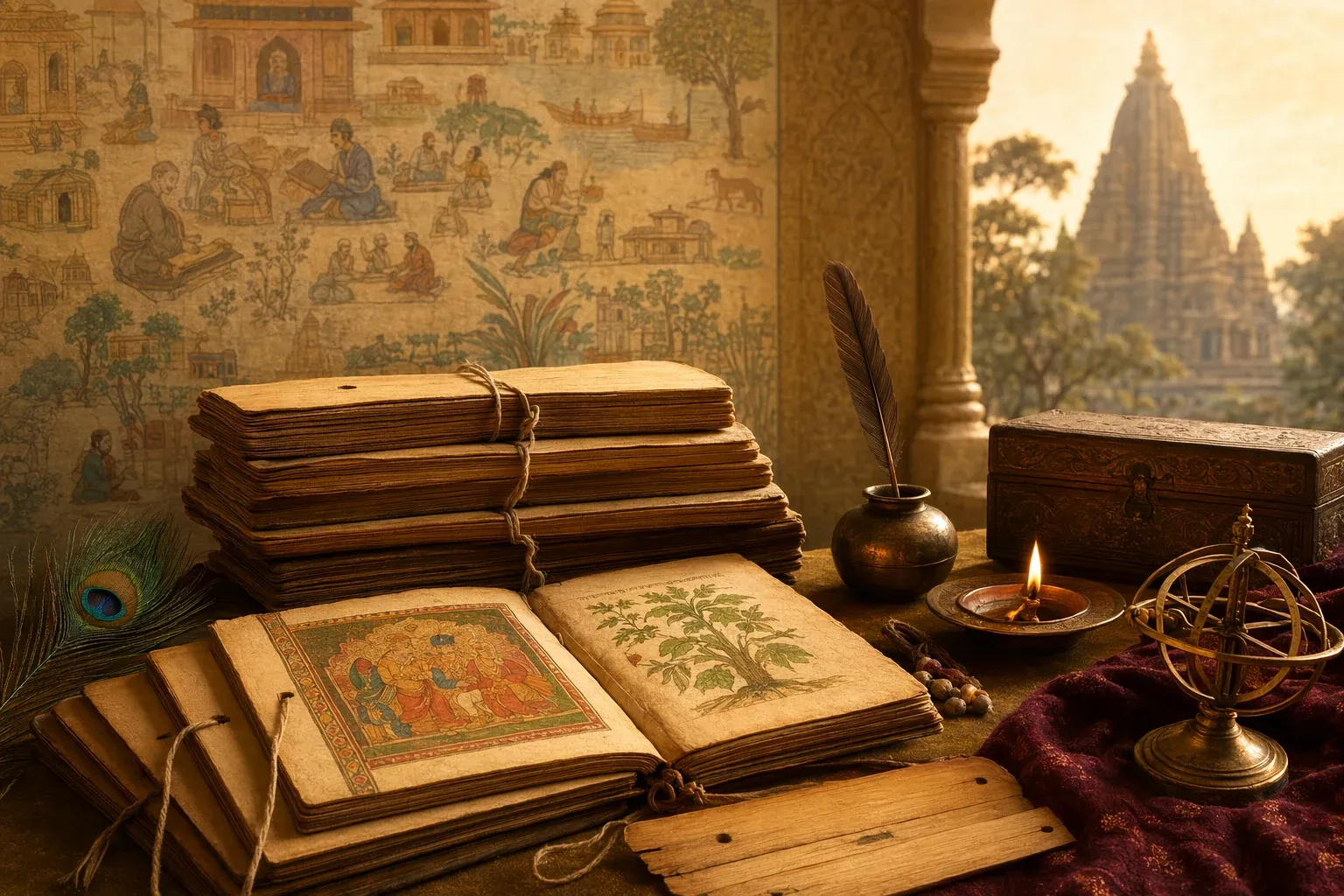
Medieval Indian manuscripts are not silent museum objects. They are evidence of people at work: scribes copying, monks teaching, poets composing, patrons donating, healers preserving recipes, accountants recording gifts, painters filling margins, and communities protecting texts for the next generation. If we read them carefully, they reveal culture, knowledge, and daily life in ways that stone monuments alone cannot.
The word medieval covers a long and regionally varied period, so we should use it carefully. India did not experience one single “medieval” story. Kashmir, Gujarat, Tamil Nadu, Bengal, Odisha, the Deccan, Kerala, Rajasthan, Nepal-linked networks, and Indo-Persian courts all had different manuscript worlds. The value of manuscripts is that they help us see this diversity in material form.
Manuscripts connected many places
A manuscript could belong to a temple, monastery, Jain bhandar, royal library, scholar’s house, family chest, court workshop, matha, madrasa, or private collection. It could travel as a gift, a teaching copy, a commissioned work, a pilgrim’s possession, or a copied text carried by students. This movement created networks of learning across regions.
The Bower Manuscript is earlier than much of what we casually call medieval, but it gives a useful clue about mobility. Found near Kucha in Central Asia, written in Sanskrit and early Gupta script on birch bark, it includes medical material, dice divination, and protective incantations. Such objects remind us that Indian knowledge moved beyond modern borders through Buddhist, scholarly, commercial, and cultural routes.
Materials tell a social story
Palm leaf, birch bark, paper, ink, wooden covers, string, cloth wrapping, and painted folios all reveal practical choices. Palm leaves were important in many parts of India and wider South and Southeast Asian manuscript culture. They were cut, cured, inscribed, and tied through holes. Because moisture, insects, mould, and use could damage them, texts often needed to be copied again.
Paper became increasingly important in many medieval and early modern settings. It allowed different formats, scripts, painted margins, and binding habits. The shift of material did not simply mean “better technology.” It changed how pages looked, how libraries stored them, how scribes wrote, and how art could appear beside text.
Courts, temples, monasteries, and communities
Royal courts supported poetry, histories, translations, administrative documents, astronomy, music, and illustrated works. Temples preserved ritual manuals, donations, festival instructions, devotional texts, and local memory. Jain communities became especially important for manuscript copying and preservation, with libraries that protected religious and literary works. Buddhist monasteries, where active, maintained teaching and textual traditions.
Indo-Persian culture also shaped manuscript life. Persian, Arabic, Sanskrit, and regional-language materials existed in overlapping worlds of administration, poetry, religion, science, and storytelling. A manuscript history of India must therefore be multilingual. If we speak only about Sanskrit, we miss a major part of the picture; if we ignore Sanskrit, Prakrit, Pali, Tamil, Telugu, Kannada, Malayalam, Odia, Bengali, Marathi, Kashmiri, Persian, and Arabic, we flatten a living civilisation into a single file.
Knowledge was practical as well as sacred
Many medieval manuscripts preserved devotional and philosophical material, but they also carried practical knowledge. Ayurveda, astronomy, astrology, mathematics, grammar, music, architecture, law, ritual procedure, poetics, drama, veterinary care, omens, craft knowledge, and local records could all appear in handwritten form. Manuscripts show that learning was not locked into one subject.
A medical manuscript may tell us about healing ideas. A grammar text shows how language was taught. A musicological work points to performance and theory. A donation record shows economy and patronage. A painted literary manuscript reveals taste, status, and storytelling. Each object is small, but together they form a cultural archive.
Margins, colophons, and ownership notes matter
Beginners often focus only on the main text, but the edges can be just as revealing. A colophon may name the scribe, patron, date, place, teacher, or reason for copying. A margin note may correct a reading or explain a difficult word. An ownership mark can show how a manuscript moved from one person or institution to another. Damage can reveal use; repairs can reveal care.
This is where manuscripts become human. We meet not only famous authors, but also copyists, donors, students, librarians, and readers. Their traces remind us that culture survives through repeated labour, not through one dramatic moment.
Tradition, interpretation, and evidence
Many manuscript texts belong to living traditions. A Purana, Tantra, Jain narrative, Buddhist sutra, Vedic text, or devotional poem may still be meaningful to communities today. Respecting that living meaning is important. At the same time, historical study asks different questions: what is the date of this copy, what script is used, what regional features appear, and how does this version compare with others?
The composition of a text may be older than the physical manuscript that survives. A copy from the seventeenth century may preserve a much older work. That does not make the copy useless; it makes it evidence of transmission. The careful reader avoids both extremes: dismissing tradition, or claiming every surviving copy is as old as the story it contains.
Where were manuscripts preserved?
They survived in many places: temples, monasteries, Jain bhandars, royal and court collections, family libraries, scholarly houses, regional archives, and later museums and universities. Survival was uneven. Climate, insects, flood, fire, war, neglect, heavy use, and changing politics destroyed many manuscripts. Dry or cold conditions, careful wrapping, copying traditions, and dedicated libraries helped others survive through preservation.
Questions beginners ask
What is the oldest surviving manuscript in India?
There is no single easy answer because survival depends on material, region, definition, and whether we mean a complete manuscript, a fragment, or a dated copy. It is safer to discuss well-known examples and their evidence than to make a viral “oldest” claim.
What is the rarest manuscript in the world?
Rarity depends on context: uniqueness, age, condition, text, provenance, script, and cultural value. For Indian manuscripts, responsible writing avoids ranking them like trophies.
Why do medieval manuscripts matter today?
They show how knowledge moved through real communities. They connect philosophy with paper, devotion with patronage, science with teaching, and art with everyday acts of preservation.
A grounded way to remember them
Think of medieval Indian manuscripts as bridges. They connect oral teaching with written memory, sacred tradition with practical knowledge, local communities with wider networks, and individual hands with civilisational continuity. Their pages may be old, but the questions they raise are still fresh: what do we preserve, how do we preserve it, and what kind of people become worthy of receiving it?