
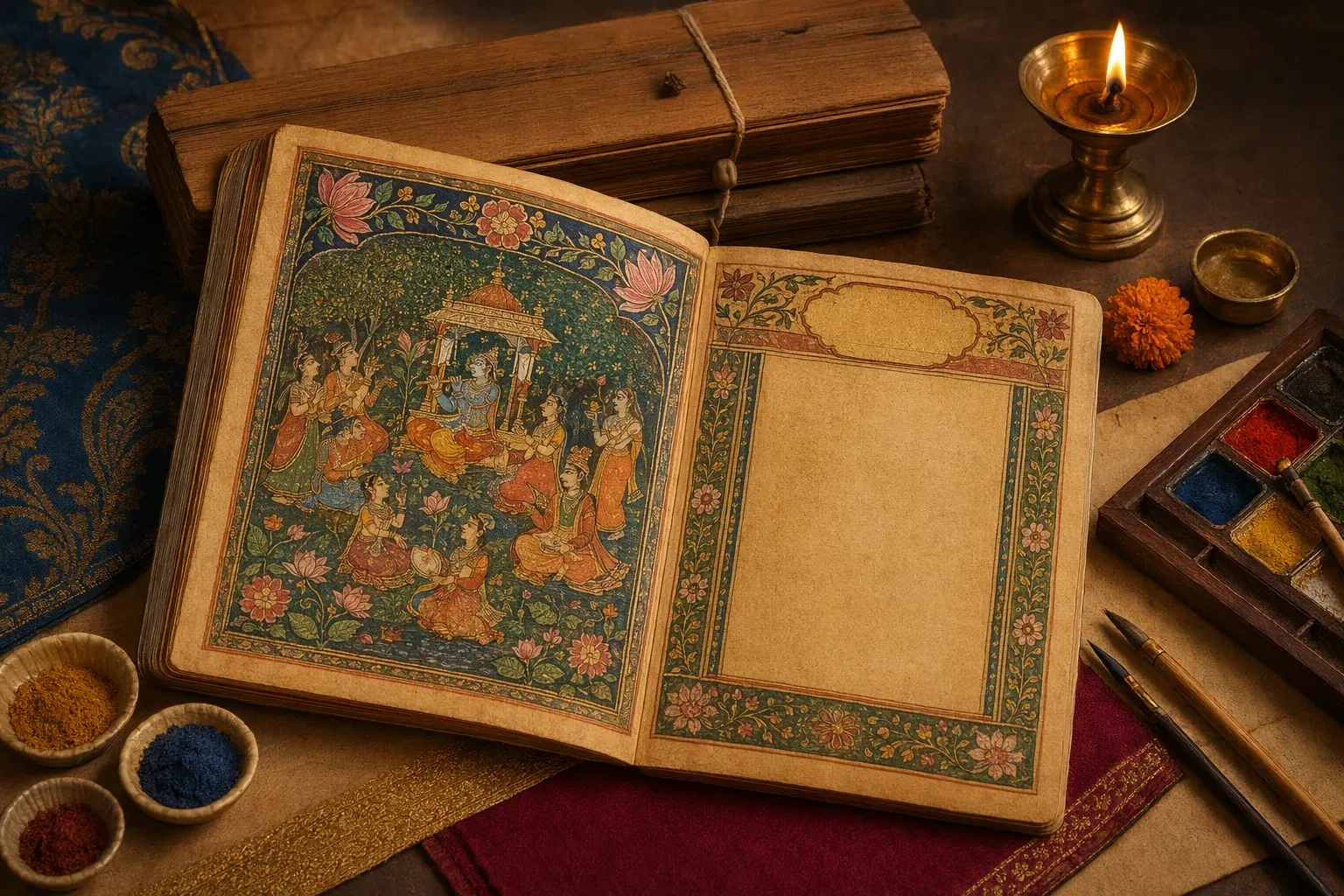
When we hear the word manuscript, we often imagine lines of old writing. But many Indian manuscripts were also visual worlds. A painted border, a red margin, a small figure, a lotus, a court scene, a deity, a monk, a king, a battle, a procession, or a storyteller’s gesture could guide the reader before a single word was read. This is the world of Indian illuminated and illustrated manuscripts.
In simple language, an illuminated manuscript is a handwritten work decorated with visual elements. In India, the exact style changed by region, material, faith community, patron, workshop, and period. Some manuscripts are richly painted. Some are restrained but beautifully ruled and coloured. Some use image to narrate a story; others use decoration to mark sacredness, hierarchy, or important sections.
Colour made the page speak
Images were not added only to make a manuscript pretty. They helped organise attention. A reader could recognise a new section from a decorated opening, follow a story through painted scenes, or understand the emotional mood of a text through colour and gesture. In devotional works, the image could also support darshan, remembrance, and reverence.
The idea is easy to understand today. A textbook uses diagrams, maps, bold headings, and illustrations to help a student learn. A manuscript page used its own older visual language: red borders, blank spaces, miniature scenes, decorative initials, stylised figures, symbols, and carefully placed images. The technology was different, but the learning problem was similar: how do we help the eye and mind travel through knowledge?
Jain manuscripts are a major example
Jain manuscript painting is one of the most famous Indian examples for beginners to notice. Jain communities preserved religious and narrative texts in manuscript libraries, often called bhandars. Many illustrated Jain manuscripts use strong lines, bright colours, compact figures, and carefully organised folios. The Kalpasutra, which includes accounts connected with the lives of the Tirthankaras, is especially known in illustrated manuscript traditions.
These paintings were not random decoration. They served a religious and educational world shaped by monks, lay patrons, scribes, painters, donors, and community memory. A painted folio could honour a text, teach a story, mark a festival context, or show devotion through the act of commissioning and preserving.
Palm leaf shaped the art
Material matters. Palm-leaf manuscripts are long and narrow, so artists and scribes had to work within a horizontal space. The writing surface was cut, treated, inscribed, and tied into bundles. Because the leaf shape was narrow, images often became compact and rhythmic. The central string-hole could also affect layout.
Paper changed possibilities. Wider paper folios allowed larger painted scenes, richer margins, and more flexible page design. Court workshops, temple-linked settings, Jain libraries, and regional painting traditions all used the page differently. A manuscript’s beauty is therefore not only about style; it is also about material, labour, and use.
Storytelling happened frame by frame
Indian illustrated manuscripts often tell stories in small visual moments. A single scene may show a king listening to a teacher, a hero entering a forest, a goddess seated on a lotus, a monk preaching, musicians in a court, or devotees gathered in worship. These scenes can work like memory hooks. A reader who already knows the story recognises the moment; a younger learner becomes curious and asks what is happening.
This is especially useful for epics, Puranic stories, Jain narratives, devotional poetry, romances, and courtly literature. The image does not replace the text. It converses with it. Sometimes it summarises a scene. Sometimes it highlights a feeling. Sometimes it reflects the patron’s world more than the ancient setting of the story. That is why art history asks not only “what story is shown?” but also “who painted it, for whom, where, and when?”
Tradition, interpretation, and history
Tradition may treat a manuscript as a sacred or respected object. Interpretation asks how readers understood the text and images. History asks when the manuscript was produced, what materials were used, which community preserved it, and how its style relates to other works. These three layers should stay connected, but they should not be mixed carelessly.
For example, a painting of Krishna, a Jain Tirthankara, a Buddhist scene, or a royal court can be devotionally meaningful and historically informative at the same time. The respectful reader can appreciate faith, artistic skill, and historical context together without reducing the page to only one meaning.
How to look at an illuminated manuscript
Begin with the whole page. Notice the shape of the folio, the writing area, the margins, the colours, the script, the material, and the placement of the image. Then ask what the image is doing. Is it narrating a moment? Marking a section? Honouring a deity or teacher? Showing a patron’s taste? Helping a reciter remember the order of events?
Next, check the catalogue record. A museum label may tell you the region, approximate date, material, language and script, text title, and collection history. Without that information, it is too easy to make confident but wrong claims based only on style.
Common mistakes to avoid
- Do not assume every painted Indian manuscript is “ancient.” Many surviving examples are medieval or early modern.
- Do not use manuscript images without checking credit and reuse rules.
- Do not treat sacred images as generic decoration.
- Do not assume one Jain, Hindu, Buddhist, Persian, or courtly manuscript represents all Indian art.
Questions beginners ask
What are Indian illuminated manuscripts?
They are handwritten works whose pages include decoration, painted scenes, borders, symbols, or other visual elements that support beauty, memory, devotion, status, or storytelling.
Are Indian manuscript images useful for learning history?
Yes, if read carefully. They can reveal dress, gesture, patronage, religious practice, artistic style, and storytelling habits, but they should be checked with catalogue and scholarly context.
Can I buy prints or replicas?
Buy only from legitimate museums, publishers, artists, or licensed sellers. A cheap print copied from an archive image without credit may be disrespectful and legally unsafe.
Why this art still feels alive
Indian illuminated manuscripts remind us that knowledge was once handmade, coloured, touched, recited, sponsored, protected, and seen together. The page was not a flat screen. It was a meeting place of text, image, craft, devotion, memory, and community. When we look carefully, we are not just admiring old art. We are learning how earlier Indians taught the eye to listen.