
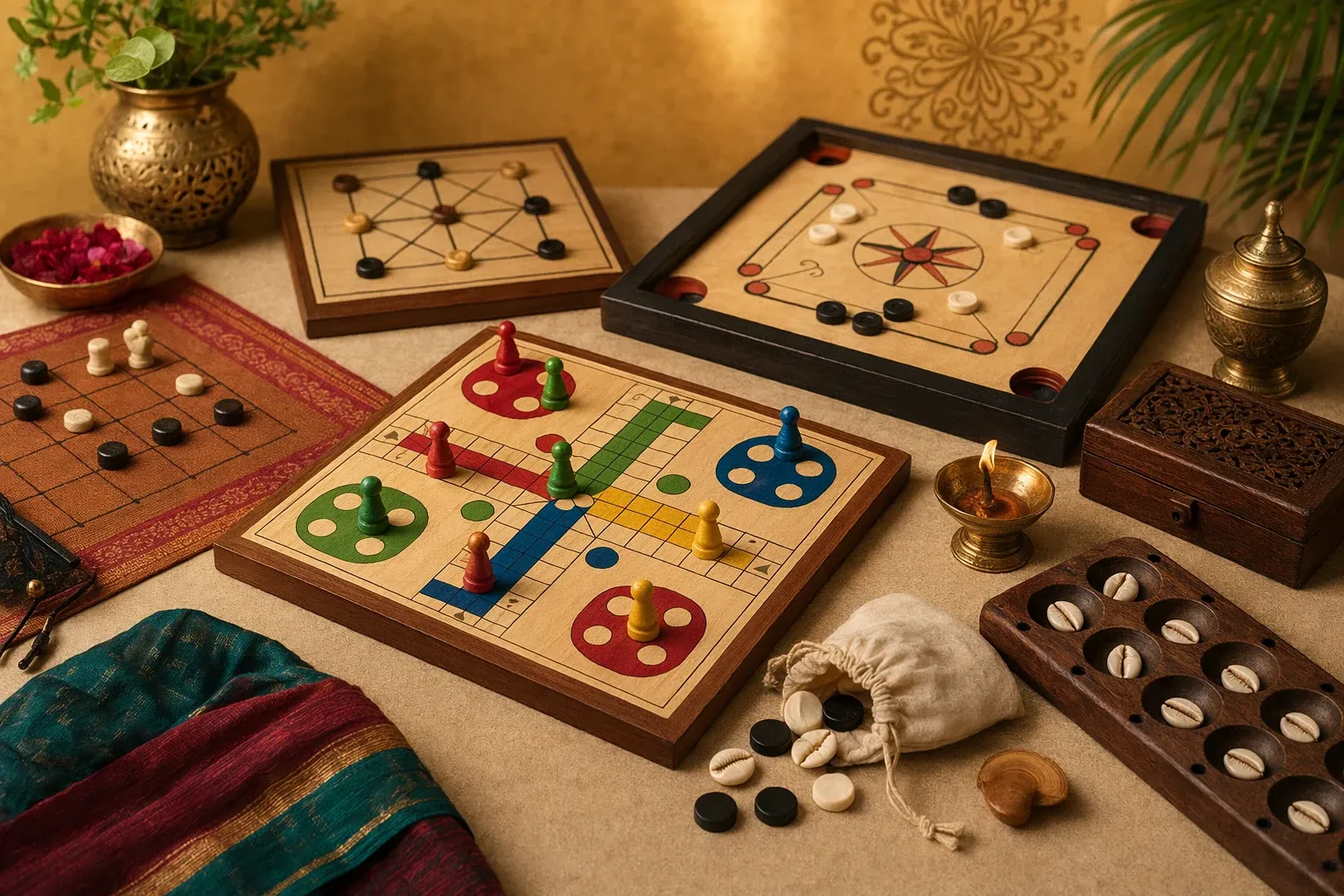
Indian board games are tabletop games that grew in Indian homes, courts, temples, libraries, streets, clubs, and family rooms. Some are ancient or medieval in memory. Some became popular in the modern period. Some use dice, cowrie shells, counters, seeds, wooden pieces, cloth boards, chalk marks, or polished boards. What joins them is not one single rule system, but a larger culture of sitting together, thinking, counting, taking turns, accepting chance, and learning how choices create consequences.
For a beginner, the simplest way to understand Indian board games is to see them as a mix of play and culture. Chaturanga points toward strategy and war-formation imagination. Pachisi and Chaupar show movement, counting, risk, and social play. Gyan Chauper connects a race-game format with moral and spiritual ideas such as virtue, fall, rise, and moksha. Carrom brings the same tabletop energy into a familiar modern Indian setting, where skill, focus, and friendly competition matter more than expensive equipment.
A living family of games, not one fixed category
When people say Indian board games, they may mean very different things. One person may think of chess-like strategy. Another may remember Ludo nights, Chaupar stories, or a cloth Pachisi board. Someone else may picture a carrom board in a hostel common room, a neighbourhood club, or a cousin’s house during summer holidays. All of these memories sit inside a wider Indian play culture.
This is why we should avoid a narrow definition. Indian board games include race games, strategy games, moral-learning games, tabletop flicking games, counting games, and regional variants with local names. Many changed across time. Some travelled outside India and returned in new forms. Some survive as museum objects, some as printed boards, and some as living habits in families.
Strategy, chance, and judgement
One reason these games feel so human is that they rarely depend on only one skill. Pachisi uses chance through cowrie-shell throws, but the player still chooses how to move pieces and how much risk to take. Chaturanga and chess-family games are more about planning and position. Carrom needs aim, touch, angle, patience, and calm. Gyan Chauper may be based on movement through chance, but its board teaches a different kind of judgement: good actions lift, harmful tendencies pull down.
That mixture is important. Life also has both effort and uncertainty. A player can plan carefully and still receive a difficult throw. A strong position can be wasted by ego. A lucky turn can be lost by poor judgement. In this quiet way, board games become small classrooms for patience, decision-making, and emotional control.
Examples beginners should know
Chaturanga is often discussed as an early Indian ancestor within the wider chess family. The Sanskrit word caturaṅga refers to four parts or limbs, and in epic usage it is linked with the fourfold army: elephants, chariots, cavalry, and infantry. Historians are careful because the exact early rules are not fully certain, but the game is a strong example of Indian strategic imagination.
Pachisi is a cross-shaped race game traditionally played with pieces moving according to cowrie-shell throws. Its name is connected with paccīs, meaning twenty-five, the highest throw in a common version. Chaupar is closely related in popular memory, and modern Ludo belongs to the same broad family of cross-and-circle movement games, though its rules and material form are simpler.
Gyan Chauper, often connected with the later global form Snakes and Ladders, shows how a board can carry moral ideas. Ladders can represent virtues or upward movement, while snakes can represent falls caused by negative qualities. Different Hindu, Jain, Buddhist, and other versions have existed, so it should not be explained as one single fixed board for all India.
Carrom is a tabletop game of Indian origin in which players flick a striker to pocket small discs. It is common in South Asian family and social spaces. Unlike a long historical board painted with symbols, a carrom board feels immediately familiar: smooth surface, powder, striker, queen, corners, and the satisfying sound of a clean pocket.
Why families kept playing them
Indian board games survived because they are social. They do not always need a stadium, large budget, or perfect weather. A cloth can be spread, a board can be placed on the floor, or a carrom board can be balanced on a stand. Children can watch elders. Grandparents can teach counting and patience. Cousins can argue, laugh, and learn how to lose without breaking the relationship.
This family setting matters. A game is not only rules; it is also the way people behave around rules. Do players cheat? Do they mock the loser? Do they explain the move to a child? Do they accept defeat gracefully? In a dharmic reading, even leisure becomes a chance to practise fairness, self-control, kindness, and alertness.
Tradition, history, and interpretation
It is tempting to make very loud claims about every old Indian game: that it is thousands of years old, that it directly created every modern game, or that one famous epic line proves the exact rulebook. A respectful article should be more careful. Tradition preserves memory and meaning. History asks what evidence survives. Interpretation asks what the game teaches us today.
For example, the Mahabharata’s dice episode shows how gambling, pride, and manipulation can destroy a family and kingdom. That does not mean every dice or race game is immoral. It means Indian stories understood the emotional danger of uncontrolled play. The mature lesson is balance: play can build joy and judgement, but greed can turn play into harm.
Questions people ask
What are some Indian board games?
Common examples include Chaturanga, Pachisi, Chaupar, Gyan Chauper, Carrom, and modern Indian-themed tabletop games. Regional names and rules vary, so the best answer depends on place, period, and family tradition.
What board games do Indians play?
Many Indians play chess, Ludo-like games, Carrom, Scrabble-style word games, cards, and newer tabletop games. In cultural history, Pachisi, Chaupar, Chaturanga, and Gyan Chauper are especially important names.
What is the traditional board game of India?
There is no single answer for all India. Pachisi/Chaupar and Chaturanga are among the most famous traditional examples, while Gyan Chauper is important for moral-learning history and Carrom is a beloved modern tabletop game.
A simple way to remember the idea
Indian board games are small boards with big lessons. They teach counting, strategy, patience, risk, restraint, memory, and social conduct. They also remind us that culture is not preserved only in temples, books, and monuments. Sometimes it is preserved in the way a family sits in a circle, moves a piece, laughs at a throw, and learns to play fairly.