
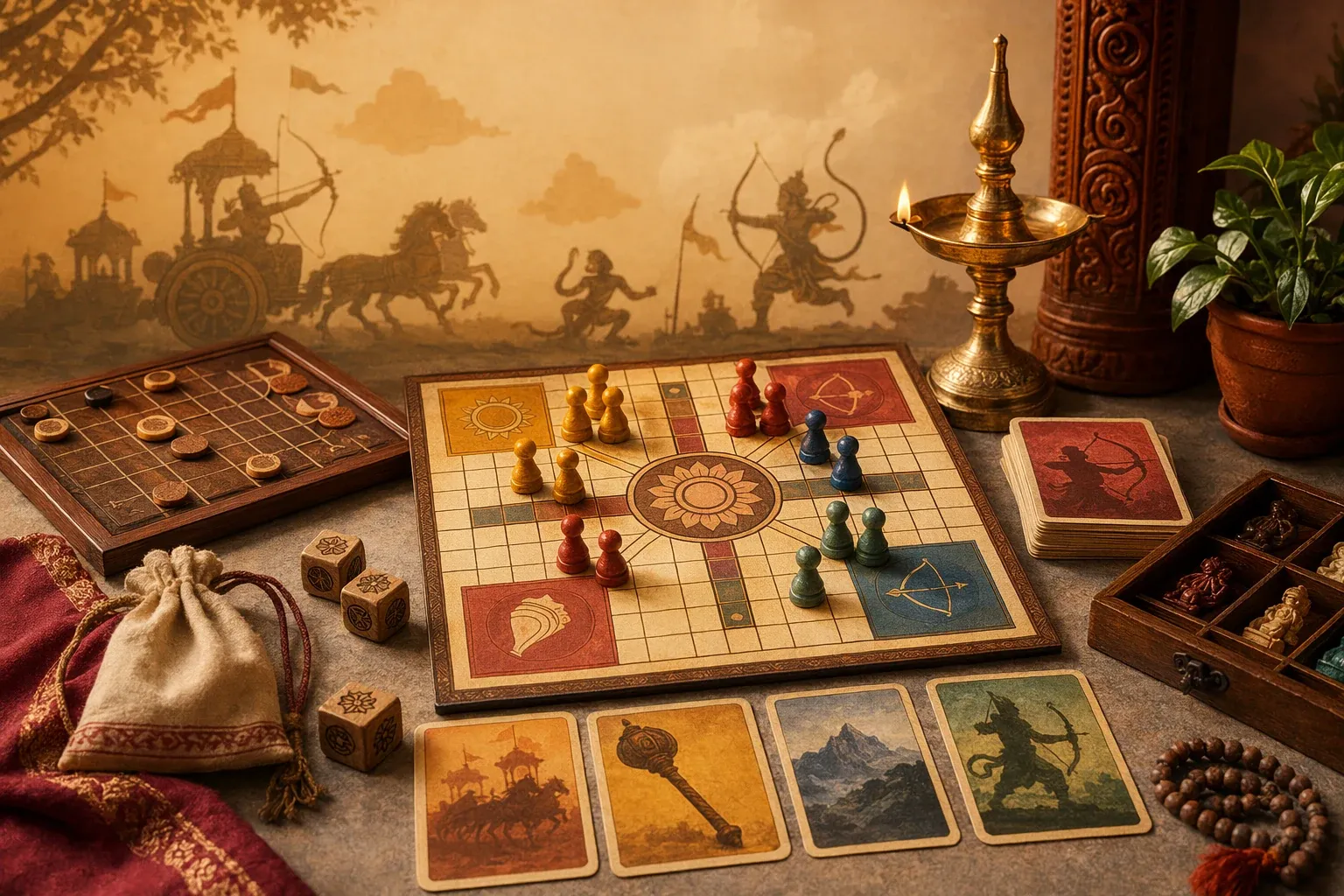
Board games based on Indian mythology can be exciting, but they also need care. Indian mythology is not just a pile of cool characters and weapons. It carries living devotion, family memory, temple art, performance traditions, regional tellings, philosophy, and ethical questions. A game can use these worlds beautifully, but only when it understands that sacred stories are not decoration.
A good mythology-based board game does more than put a deity on a card or name a power after an astra. It asks what kind of experience the player is entering. Is the game about a journey, a moral choice, a battle of dharma and adharma, a pilgrimage, a forest exile, a temple town, a festival, or a search for wisdom? When the design begins with respect, play can become a friendly doorway into culture.
Mythology as story, not just theme
The Ramayana, Mahabharata, Puranic stories, local goddess traditions, Krishna bhakti, Shaiva narratives, and many regional tellings are full of movement. People travel, choose, promise, fail, learn, fight, forgive, and return. That makes them naturally suitable for games. A board can represent a journey. Cards can represent choices. Tokens can represent companions. A track can represent exile, pilgrimage, or spiritual progress.
But mythology should not be treated as a costume. If the same game could replace Rama, Draupadi, Shiva, Durga, Hanuman, or Krishna with any fantasy name and lose nothing, the cultural work is shallow. The game should help the player notice something real about the story: duty, courage, friendship, humility, restraint, devotion, pride, or consequence.
Gyan Chauper and the moral board
One important Indian example is Gyan Chauper, a moral and spiritual board-game tradition connected in later global history with Snakes and Ladders. In many versions, ladders and snakes do not only move a player up or down for fun. They can represent virtues, vices, bondage, release, and the journey toward moksha. Jain versions, including 84-square cloth-board examples, show that religious communities could use a game to teach ideas in memorable form.
This is useful for modern designers and families. A mythology-based game does not need to become a sermon, but it should understand consequences. If a player gains by greed, what does the game say? If a player helps another, does the board recognise that? Indian stories often care deeply about the inner quality of action, not only the final score.
Epic journeys can become playable maps
The Ramayana can inspire a journey structure: Ayodhya, forest life, Kishkindha, the ocean crossing, Lanka, and return. A respectful game would not reduce the story to random combat. It could include alliance, promise, service, courage, and devotion. Hanuman’s leap, Jatayu’s sacrifice, Shabari’s devotion, and Vibhishana’s choice can become moments of meaning, not only point bonuses.
The Mahabharata can inspire a different kind of game because it is full of complicated choices. The dice episode warns against manipulation and uncontrolled desire. The exile years show endurance. The Kurukshetra war raises questions about duty, grief, and responsibility. A game drawing from the Mahabharata should be extra careful not to turn a tragic ethical world into simple team cheering.
Deities and sacred symbols need context
Images of deities are not ordinary clip art for many players. A board game that uses Ganesha, Lakshmi, Shiva, Vishnu, Durga, Saraswati, Kali, or Krishna should consider how the pieces will be touched, thrown, stepped over, or discarded. A sacred symbol placed on a card that gets tossed on the floor may feel disrespectful to some families. That does not mean games cannot use sacred imagery. It means the design must think about use, placement, and explanation.
Sometimes indirect symbolism works better. A lotus, conch, discus, bow, mountain, river, lamp, peacock feather, veena, trishula, or temple gateway can suggest a world without turning the deity into a disposable game object. A rulebook can also explain the symbol in simple language so players learn rather than only consume.
Regional versions deserve respect
Indian mythology is not one flat national script. Kamba Ramayanam, Ramcharitmanas, Adhyatma Ramayana, folk Ramayanas, Jain retellings, regional goddess stories, village guardian traditions, and performance forms such as Yakshagana, Kathakali, Therukoothu, and Ramlila all shape how people understand stories. A game does not need to cover everything, but it should not pretend one version is the only version for all Indians.
A simple note can help: “This game is inspired by one telling,” or “This version uses common pan-Indian story elements while acknowledging regional variation.” That honesty builds trust. It also teaches players that tradition is living, not frozen.
Conflict should not erase dharma
Many mythology games are tempted to become battle games because battles are dramatic. The problem is not battle itself. The epics include conflict. The problem is when conflict becomes only power, attack, and victory. In Indian storytelling, the moral frame matters. Why is someone fighting? What vow has been made? What line should not be crossed? What happens when pride controls action?
A thoughtful game can include cooperation, sacrifice, restraint, and protection. For example, a player may gain more by protecting a village, keeping a promise, or helping another player complete a journey than by simply defeating the most enemies. That kind of design feels closer to the spirit of dharma.
For families, classrooms, and game nights
Families can use mythology-themed games as conversation starters. After a turn, ask: which story is this from? What quality does this character show? Is this moment tradition, interpretation, or a modern game invention? Children learn better when the game makes curiosity feel natural.
Classrooms should be careful with belief diversity. Present mythology as cultural, literary, devotional, and historical tradition depending on context. Do not mock faith. Do not force devotion. Do not flatten sacred stories into “just fiction” or “only history.” Good cultural education leaves room for reverence and inquiry.
Reader questions on mythology games
What are board games based on Indian mythology?
They are games that draw from Indian epics, Puranic stories, deities, symbols, journeys, moral ideas, festivals, or regional traditions. The best ones explain their inspiration clearly and respectfully.
Can sacred stories be used in games?
Yes, but with care. Sacred imagery, deity names, mantras, and ritual symbols should be handled with context, clean design choices, and sensitivity to living communities.
What is a traditional Indian moral board game?
Gyan Chauper is an important example. It connects movement on a board with moral and spiritual ideas such as virtue, fall, bondage, and moksha, though versions differ across communities.
A respectful way to play
Mythology-based board games can be wonderful when they make players curious, humble, and attentive. They should not turn sacred worlds into gimmicks. A good game helps people enjoy the story while remembering that these stories still matter to living families, temples, artists, performers, and communities. Fun and reverence do not have to be enemies.