
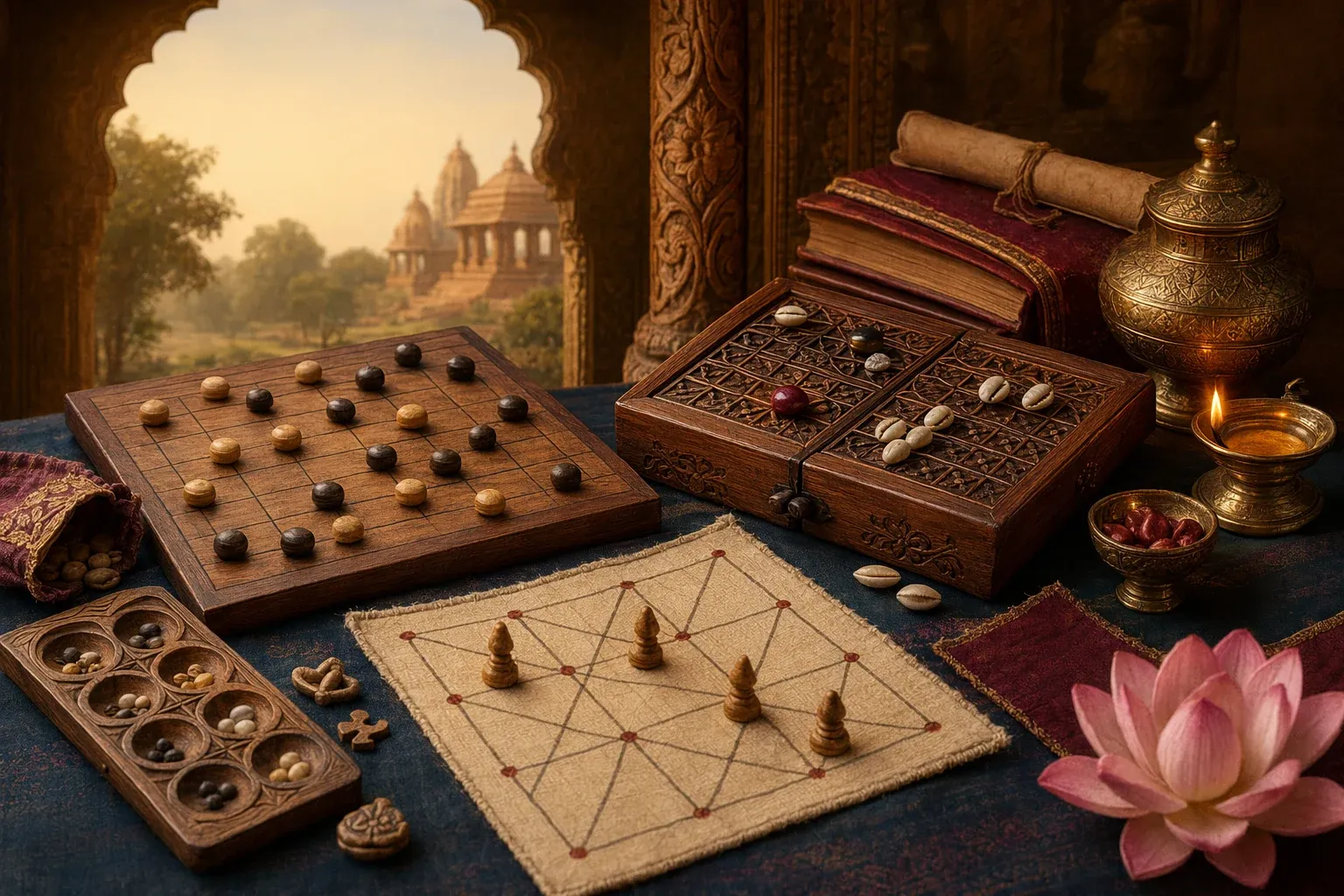
Ancient Indian board games are fascinating because they sit between evidence, memory, and imagination. We have old texts that mention dice, play, armies, risk, and leisure. We have later boards, museum objects, regional traditions, and living games. We also have gaps. The honest way to explore this subject is not to pretend that every rule is known from the beginning, but to ask what these games reveal about Indian life: strategy, counting, chance, morality, social spaces, and the pleasure of learning through play.
Some games associated with India became globally famous. Chaturanga is usually discussed as an early ancestor within the chess family. Pachisi and Chaupar belong to the family of cross-shaped race games that later connect, in simplified forms, with Ludo-like play. Gyan Chauper shows how a game board could become a moral map. Dice play appears powerfully in epic memory, especially in the Mahabharata, where play without restraint becomes a warning about greed and humiliation.
The evidence is rich, but not always simple
For younger readers, this moral side connects naturally with Bhaktilipi’s beginner explainers on Dharma and Karma: games can be fun, but they also reveal how choice, restraint and consequence shape character.
When we call a board game ancient, we should ask what kind of evidence we mean. A text may mention a game or a gambling scene without giving a full rulebook. A board design may survive without the original oral rules. A later version may preserve an older pattern but also include changes from its own time. A family game may carry a traditional name while using modern materials.
This careful approach does not reduce the beauty of the subject. It actually makes it stronger. Indian play culture did not remain frozen. It moved through languages, regions, classes, courts, homes, and religious communities. A game could be entertainment in one setting, training in judgement in another, and a moral teaching device in a third.
Chaturanga and the imagination of strategy
Chaturanga is one of the most important names in the history of Indian board games. The Sanskrit word caturaṅga means four-limbed or four-part, and in epic and military language it is connected with the fourfold army: elephants, chariots, cavalry, and infantry. This is why the game is so powerful as an idea. It turns the battlefield into a board, and the board into a place where mind matters more than force.
Historians usually place clear references to Chaturanga in early medieval India, with the wider chess family developing through transmission into Persia as chatrang or shatranj and then into other regions. The exact early rules are debated, especially for some pieces. That uncertainty should be stated openly. What we can say safely is that Chaturanga represents a deep Indian interest in position, movement, hierarchy, planning, and consequence.
Pachisi, Chaupar, and the drama of movement
Pachisi and Chaupar belong to a different mood. Instead of two armies facing each other on a square battlefield, these games usually feel like races across a cross-shaped path. Throws of cowrie shells or dice-like objects determine movement, but the player still chooses how to use the result. This creates a lively balance of fate and decision.
The name Pachisi is connected with paccīs, twenty-five, a highest throw in a common form using cowrie shells. The board is often described as a symmetrical cross. Related games and variants travelled widely, and modern Ludo is a simpler descendant within this broad family. But we should not flatten Pachisi into Ludo. Traditional boards, materials, and social settings carry a different texture.
Dice play and moral caution
Dice and gambling appear in Indian cultural memory with both fascination and warning. The Mahabharata’s dice game is one of the most dramatic examples. It is not remembered as harmless fun. It becomes a moment where pride, manipulation, addiction, silence, and adharma create disaster. For a young learner, this is a useful reminder that Indian traditions did not blindly celebrate winning. They asked what kind of conduct sits behind a win.
This does not mean that all chance-based games are bad. Chance can teach humility. A throw can remind us that control is limited. The problem begins when play becomes greed, when rules are twisted, or when another person’s dignity is treated as a stake. Ancient play culture therefore gives us both joy and caution.
Gyan Chauper and the board as a moral map
Gyan Chauper, known in later global forms through Snakes and Ladders, shows another side of Indian game history. Here the board is not only about winning quickly. It can become a map of moral movement. Ladders raise the player; snakes pull the player down. The journey can be interpreted as a movement through virtues, errors, bondage, and liberation.
Different religious and regional versions existed, including Jain examples with structured symbolic layouts. That variety matters. A Hindu version, Jain version, Buddhist version, or later popular version should not all be explained as identical. The larger lesson is that Indian board culture could use play to teach karma-like consequences in a form that children and adults could remember.
Materials, places, and people
Ancient and traditional games did not need one standard factory-made kit. Boards could be cloth, wood, stone, floor markings, painted surfaces, or later printed paper. Pieces could be shells, seeds, counters, carved tokens, or discs. This flexibility helped games travel across rich and ordinary spaces. A palace could have an elegant version; a household could improvise a simpler one.
The social setting also shaped meaning. Courtly play could show refinement, leisure, and rivalry. Family play could teach counting and patience. Religious or moral boards could teach virtues and dangers. Public play could create community. The same basic act of moving a piece could carry different meanings in different places.
What ancient games reveal about culture
First, they show that Indian learning was not only formal. People learned through story, song, ritual, debate, memory, and play. Second, they show that mathematics and counting were not abstract for everyone; movement, probability, pattern, and calculation entered daily entertainment. Third, they show that Indian culture was comfortable joining serious ideas with enjoyable forms.
They also reveal an important value: self-mastery. Whether one plays a strategic game, a race game, a flicking game, or a moral board, the player must manage desire. Should I take the risky move? Should I protect one piece or advance another? Should I accept defeat gracefully? The board becomes a mirror for the mind.
Questions people ask
What are the ancient games played in India?
Important examples include Chaturanga, Pachisi, Chaupar, dice games, and moral board games such as Gyan Chauper. India also has many traditional outdoor and regional games, but this article focuses on tabletop and board-game examples.
What are the classic board games of India?
Chaturanga, Pachisi, Chaupar, Gyan Chauper, and Carrom are commonly discussed classic names, though Carrom’s modern organized form belongs to a later period than the ancient games.
What board game is the classic game of India?
There is no single classic for all contexts. Chaturanga is famous for strategy and chess history, while Pachisi/Chaupar is famous for race-game culture. Gyan Chauper is classic for moral-learning symbolism.
A grounded takeaway
Ancient Indian board games should be remembered with both pride and care. Pride, because they show creativity, strategy, symbolic thinking, and social warmth. Care, because exact origins and rules are sometimes complex. The best beginner attitude is simple: enjoy the games, respect the tradition, check the evidence, and notice the deeper lesson. A small board can hold a surprisingly large part of culture.