
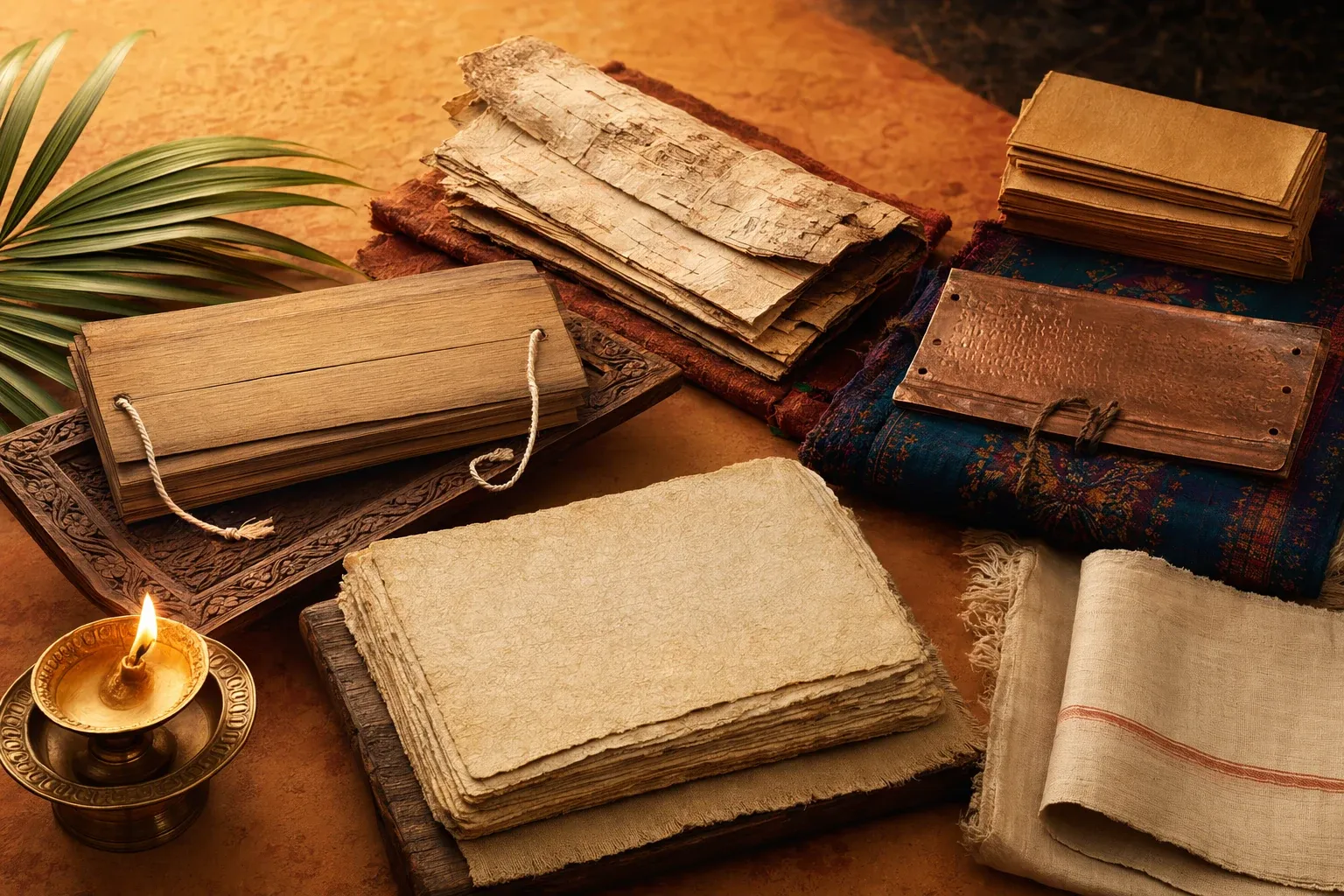
When we imagine an old Indian manuscript, we may picture a dusty book with yellow pages. But many ancient and medieval Indian manuscripts were not “books” in the modern printed sense. They could be long palm leaves tied with a cord, fragile birch-bark sheets from Himalayan regions, paper folios with painted margins, cloth records, or copper plates that preserved royal grants and public acts.
The material mattered. It affected how a text was written, how it was stored, how long it survived, and even how readers held it. India’s manuscript world was shaped by climate, local plants, trade, craft, religion, courts, and the practical question every scribe faced: what can we write on here, and how can we make it last?
Palm leaf: the long, narrow page
Palm leaf is one of the most recognisable materials in Indian manuscript history. It was used widely in the Indian subcontinent and across Sri Lanka and Southeast Asia. The leaves of palms such as palmyra or talipot were cut, dried, treated, trimmed, and prepared for writing. The final page was usually long and narrow. This is why many palm-leaf manuscripts have a horizontal shape that looks very different from a modern notebook.
In many traditions, the scribe did not simply write with a pen as we do on paper. On palm leaf, letters were often incised with a stylus or knife-like tool. Pigment or soot-based colouring could then be rubbed over the surface and wiped away, leaving dark colour in the cut grooves. Holes in the leaves allowed a string to pass through, tying the pages into a bundle. Wooden covers protected the top and bottom.
This form shaped reading itself. You did not flip pages like a paperback. You handled a bundle, leaf by leaf. In a temple, monastery, scholar’s home, or royal collection, the physical discipline of tying, untying, reading, and storing was part of the text’s life. Many palm-leaf manuscripts also had to be copied again when they became brittle, split, or damaged by humidity and insects.
Birch bark: the Himalayan and north-western material
Birch bark was another important writing material, especially in and around the Himalayan and north-western regions. The bark of the Himalayan birch, often associated with Kashmir and nearby areas, could be prepared as a writing surface. It appears in Sanskrit, Buddhist, and other manuscript traditions connected with the wider Indian cultural world.
Birch bark reminds us that “ancient Indian manuscript” is not one single object. The Gandharan Buddhist scrolls, written in the Gāndhārī language and Kharoṣṭhī script, are among the oldest known Indic manuscript witnesses and were written on birch bark. The Bower Manuscript, a late fifth- or early sixth-century Sanskrit collection in early Gupta script, was also written on birch bark and found near Kucha in Central Asia. It included medical material, dice divination, and protective incantations.
These examples show both the strength and fragility of birch bark. It could carry important knowledge across long distances, but it could also split, curl, and break. Modern conservation work treats such objects with great care because the material can be far more delicate than it looks in photographs.
Paper changed manuscript culture
Paper became increasingly important in many parts of India over time, especially in the medieval and early modern periods. Compared with palm leaf, paper allowed different page proportions, denser writing, marginal comments, decorative borders, and new binding habits. It was well suited to courtly records, Persian and Sanskrit scholarship, illustrated stories, administrative writing, and devotional collections.
Paper did not instantly replace older materials everywhere. India is too regionally diverse for that simple story. Palm-leaf copying continued for a long time in many places. Birch bark remained meaningful in some northern contexts. Copper plates continued for durable public records. What changed was the range of choices available to scribes and patrons.
Paper also helped manuscript art flourish in some settings. Jain manuscript painting, illustrated Bhagavata Purana folios, Ragamala paintings, court albums, and literary manuscripts show how page space could become a visual field. Text, border, image, colour, and calligraphy worked together. A manuscript could be a reading object, a ritual object, a luxury object, and an artwork at the same time.
Copper plates and durable records
Not every written object was meant to be read like a literary manuscript. Copper-plate inscriptions were often used for records that needed durability and authority, such as land grants, royal orders, temple donations, and legal confirmations. They could be strung together, sealed, and preserved as proof.
Copper plates are not the same as palm-leaf copies of a poem or scripture, but they belong to the larger history of written culture. They show how rulers, institutions, and communities used writing to remember rights, gifts, boundaries, and obligations. When historians study copper plates, they often learn about dynasties, village names, religious institutions, taxation, social groups, and political geography.
Cloth, wood, and protective covers
Some texts and records were written or painted on cloth. Cloth could carry diagrams, ritual material, genealogies, maps, scroll-like narratives, or devotional images with text. In other cases, wood was not the writing surface but the protective companion of the manuscript. Palm-leaf bundles often used wooden boards as covers. These covers might be plain, carved, painted, or wrapped in cloth.
Storage also mattered. A manuscript bundle might be wrapped in red or yellow cloth, placed in a chest, stored in a temple library, kept in a Jain bhandar, or protected in a family collection. The wrapping, cord, covers, and shelf were part of preservation. Without them, the written leaves could easily be lost.
Ink, stylus, and the hand of the scribe
The writing tool depended on the surface. Palm leaf often used incising. Paper usually used ink and pen. Birch bark could be written with ink. The colour, pressure, spacing, and correction marks tell trained readers a lot. A neat manuscript may show professional copying. Uneven writing may show learning, repair, speed, or regional habit. A correction above the line may reveal that a later reader compared the text with another copy.
Even small details matter. Are the letters rounded or angular? Are there red section marks? Is the folio numbered? Is there a colophon naming the scribe? Does the manuscript open with an invocation to Ganesha, Saraswati, Buddha, Jina, Shiva, Vishnu, Devi, a guru, or a patron? These clues turn a writing surface into a historical object.
Why climate shaped what survived
India’s climate is not kind to organic writing materials. Heat, monsoon moisture, insects, mould, smoke, dust, and repeated handling damaged manuscripts. Palm leaf can become brittle or rot. Birch bark can split. Paper can be eaten by insects or weakened by humidity. A manuscript in a dry cave, a cold region, or a carefully maintained library had a better chance than one left in a damp corner.
This is why the oldest surviving physical copies are not always from the places where the texts first became important. A text may have been composed in one region, copied in another, carried by monks or traders, and preserved in a third. The survival map is not the same as the creation map.
A simple way to remember the materials
If you want a beginner-friendly answer, ancient Indian manuscripts were written on whatever a region could prepare, use, and protect: palm leaf in many southern, eastern, and coastal traditions; birch bark in Himalayan and north-western contexts; paper in many later scholarly, courtly, and devotional settings; cloth for some special written or painted uses; and copper plates for durable public records.
So the next time you see a manuscript image, do not look only at the words. Look at the page itself. Its length, holes, fibres, colour, binding, covers, and damage are all part of the story. Indian manuscripts were not just texts placed on surfaces. They were knowledge shaped by leaf, bark, paper, metal, climate, craft, and care.