
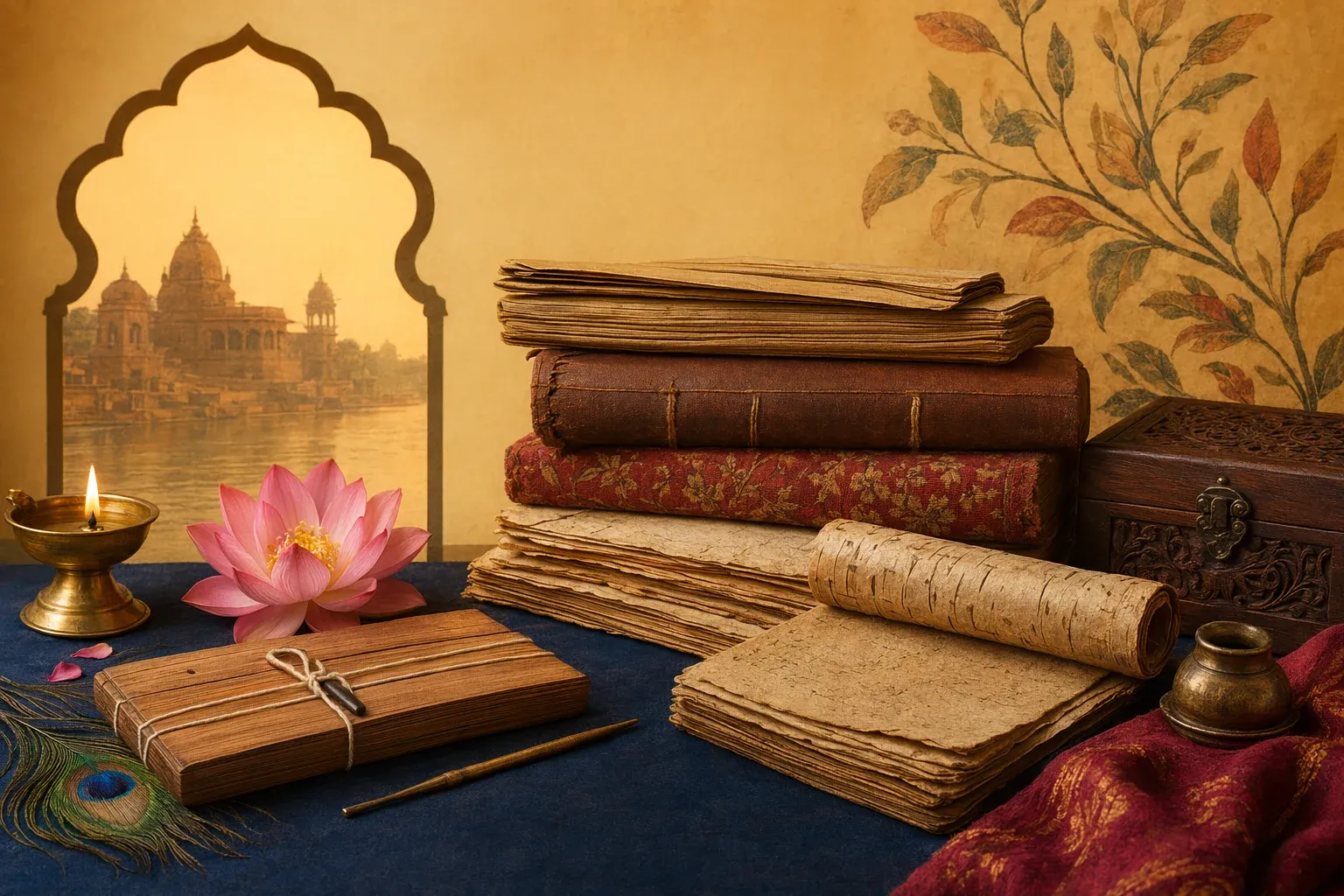
Before printed books became common, knowledge in India travelled through the human hand. A teacher recited, a student memorised, a scribe copied, a family protected a bundle, a temple or monastery stored it, and another generation read or copied it again. That handwritten world is what we usually mean when we talk about Indian manuscripts.
A manuscript is not just “an old book.” It is any handwritten document made before modern printing became the normal way to multiply texts. In the Indian context, manuscripts may contain sacred hymns, philosophical discussions, poetry, grammar, astronomy, medicine, mathematics, music, drama, law, ritual instructions, stories, local histories, account records, and art. Some were made for daily study. Some were made for worship. Some were copied by professional scribes for courts, temples, monasteries, scholars, merchants, or families.
Handwritten knowledge before print
The word manuscript comes from the idea of something written by hand. In India, that hand could belong to a trained scribe, a monk, a pandit, a court scholar, an artisan, a student, or a family member copying a text for use at home. The result could be a palm-leaf bundle tied with string, a birch-bark scroll, a paper codex, a set of loose folios, a painted Jain manuscript, or a copper-plate record issued by a ruler.
This matters because manuscripts show us a slower and more personal technology of knowledge. Printing creates many identical copies quickly. Manuscript culture creates copies through labour, skill, and care. A scribe may add a date, place, teacher’s name, owner’s note, correction, blessing, or colophon at the end. A later reader may add a margin note. A worn text may be copied again. That is why manuscripts are evidence not only of words, but also of people, places, habits, and communities.
What kinds of subjects did they preserve?
Many people first think of Vedas, Puranas, epics, or temple texts, and those are important. But Indian manuscript culture is much wider than religious literature. A single collection may include Sanskrit grammar, Prakrit stories, Tamil devotional poetry, Persian court records, Ayurveda, Jyotisha, musicology, architecture, ritual manuals, Buddhist sutras, Jain narratives, folk stories, mathematical rules, and illustrated romances.
Take the Bower Manuscript as one concrete example. It is a late fifth- or early sixth-century collection of Sanskrit texts written in early Gupta script on birch bark and found near Kucha in Central Asia. It includes medical material, divination by dice, and protective incantations. One object like this already shows how Indian knowledge moved across regions, languages, religious settings, and practical needs.
Another example is the palm-leaf tradition. Palm-leaf manuscripts preserved Hindu, Buddhist, Jain, medical, literary, and regional works across South Asia and Southeast Asia. A Bhagavata Purana manuscript on palm leaf is different in subject from a Sinhala medical manuscript or a Jain illustrated text, yet all belong to a shared handwritten culture shaped by materials, climate, patronage, and learning.
Materials shaped the look of Indian manuscripts
Indian manuscripts were not all made on paper. Palm leaves were especially important in many parts of southern and eastern India, Sri Lanka, Nepal, and Southeast Asia. Birch bark was used in Himalayan and north-western regions, including Kashmir and Gandhara. Paper became more common in many regions over time, especially in the medieval and early modern periods. Cloth, wooden covers, and copper plates also appear in different contexts.
Material changed design. Palm leaves are long and narrow, so the writing space is horizontal. Many leaves have holes for a cord, and wooden boards may protect the bundle. Birch bark can be fragile and may appear as sheets or scroll-like forms. Paper allowed different page sizes, painted margins, and binding styles. A manuscript’s physical shape is therefore a clue to region, period, purpose, and available resources.
Language and script are not the same thing
A beginner often asks: “What language were Indian manuscripts written in?” The honest answer is: many. Sanskrit appears widely, but it was never the only language. Manuscripts also preserve Prakrit, Pali, Tamil, Telugu, Kannada, Malayalam, Odia, Bengali, Marathi, Persian, Arabic, Kashmiri, Apabhramsha, and many other languages.
Script is a separate question. The same language can be written in different scripts, and one script can be used for more than one language. Sanskrit, for example, may appear in Devanagari, Grantha, Śāradā, Bengali-Assamese, Telugu-Kannada, Newar, Nandinagari, or other scripts depending on region and time. Śāradā is strongly associated with Kashmir and nearby north-western areas, and was used for Sanskrit and Kashmiri. So when we look at a manuscript, we should ask both questions: what language is this, and what script writes it?
Why surviving manuscripts are uneven
The manuscripts we have today are not a perfect mirror of everything India once wrote. Climate, insects, mould, fire, war, neglect, and ordinary use destroyed huge amounts of material. Palm leaves can rot in humidity. Birch bark can split. Ink can fade. Paper can become brittle. A manuscript used daily for study may wear out faster than one stored carefully in a dry library.
This is why survival often favours particular places and conditions. Colder or drier climates, careful temple libraries, Jain bhandars, Buddhist monasteries, royal collections, family trunks, and modern archives all affected what came down to us. Sometimes a text is ancient as a composition, but the physical copy in front of us is much later because it was recopied again and again. For sacred traditions, this is especially important: oral transmission, living practice, and written copies may have different histories.
How to read them with respect
For a modern reader, manuscripts can feel mysterious. But a respectful approach begins with simple questions. What is the material? Is it palm leaf, birch bark, paper, or metal? What script is used? Is the language Sanskrit, Tamil, Persian, Odia, or something else? Does the manuscript have illustrations? Does it mention a scribe, patron, date, place, teacher, monastery, temple, or owner?
Then ask what kind of knowledge it carries. A ritual manual is not a historical chronicle. A Purana is not a laboratory record. A medical text is not the same as a local family remedy. A painted manuscript may teach through image as well as word. Tradition, interpretation, and historical evidence should be kept close, but not mixed carelessly.
Why Indian manuscripts still matter
Indian manuscripts matter because they show India as a civilisation of memory, debate, craft, and learning. They prove that knowledge was not stored only in royal capitals. It lived in monasteries, temples, Jain libraries, village homes, courtly workshops, scholarly networks, and artisan hands. They also remind us that preservation is a responsibility, not just nostalgia.
Digitisation is helping more people see manuscripts without physically handling fragile originals. Government cultural portals, libraries, museums, and manuscript missions make parts of this heritage more visible. But access should be ethical: use legitimate archives, respect copyright and community rules, credit collections, and avoid treating sacred or fragile objects as free decoration.
So, what are Indian manuscripts? They are handwritten carriers of India’s knowledge before print: sometimes devotional, sometimes scientific, sometimes poetic, sometimes practical, often regional, and always human. Each one is a meeting point of text, material, hand, place, memory, and care.