
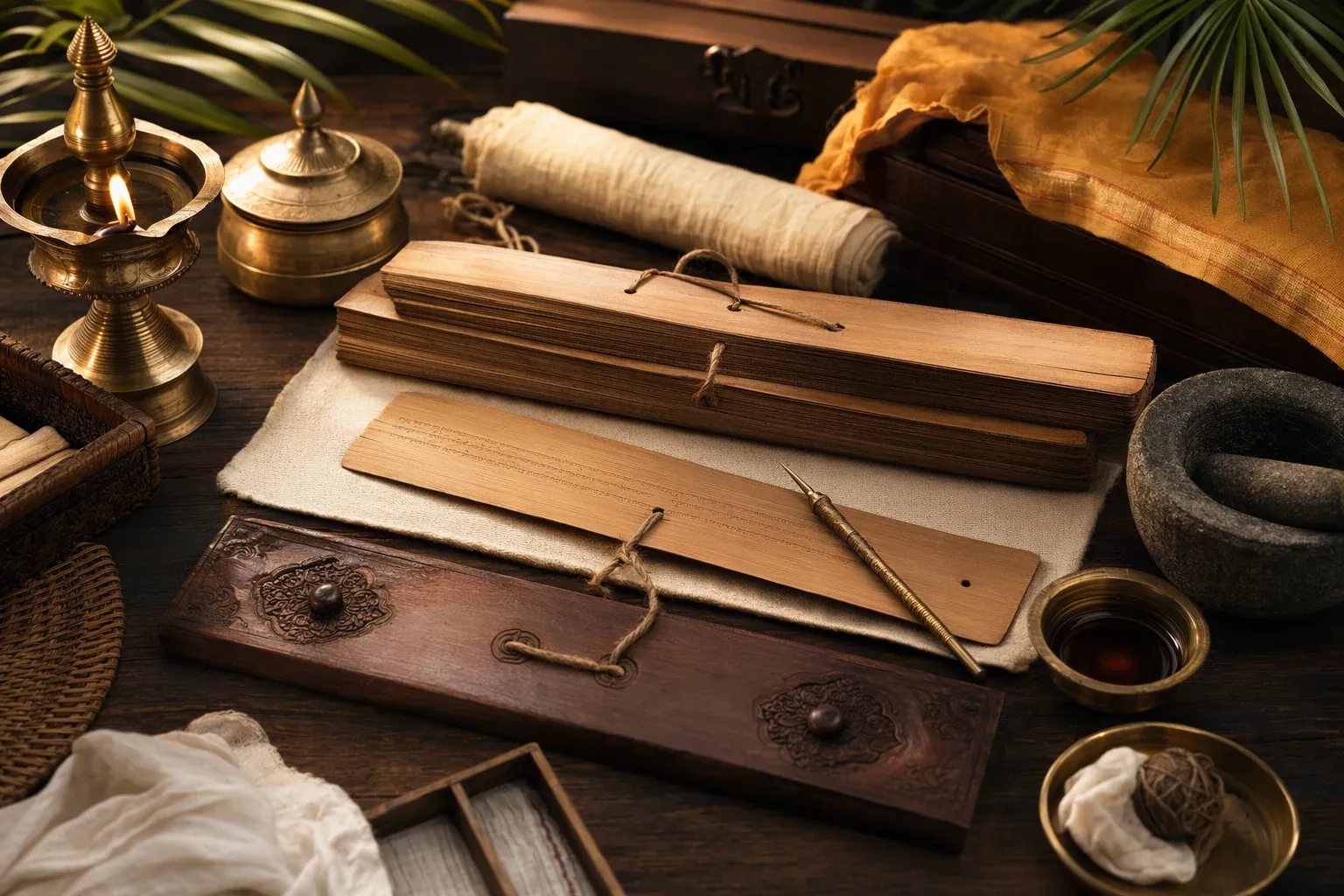
Long before printed books became ordinary, many Indian texts lived on leaves. Not fresh green leaves from a tree, but carefully prepared palm leaves: cut, dried, polished, written on, darkened, tied, protected, read, repaired by care, and often copied again before the old set became too weak. A palm leaf manuscript is therefore both a text and an object of craft.
For a young reader, this is the most important idea: palm-leaf manuscripts were part of India’s wider handwritten heritage, not random old pages. They were made through a disciplined process. Their shape, holes, string, covers, scratches, stains, and margins tell us how people stored knowledge in a climate where paper and leaf could easily be damaged by moisture, insects, mould, heat, and daily handling.
Why palm leaves became a writing surface
Palm leaves were useful because they were available in many parts of South and Southeast Asia, especially where suitable palm species grew. In India, palm-leaf writing became especially visible in southern, eastern, and coastal regions, while birch bark and paper belonged to other manuscript-material traditions. The choice of material was never only about scholarship. It was also about ecology, trade, craft, and climate.
The leaf shaped the book. Palm leaves are naturally long and narrow, so the manuscript page also became long and narrow. This is why many palm-leaf manuscripts look horizontal rather than like a modern notebook. A manuscript bundle might contain religious texts, poetry, grammar, medicine, astrology, ritual instructions, local records, or philosophical works. A Bhagavata Purana manuscript, an Odia palm-leaf work, a Sinhala medical manuscript, and a Shaiva text from Nepal may look different in language and script, but they share the same basic material logic.
From tree to writing leaf
The making of a palm-leaf manuscript began before writing. Leaves had to be selected, cut into useful strips, dried, and cured. They were trimmed to a regular size and polished so the surface could take letters. In some traditions, leaves were treated with heat, smoke, oil, turmeric, or other local methods to reduce insects and strengthen the writing surface. Practices varied by region, so we should not imagine one single Indian method used everywhere.
Once the leaves were ready, the scribe planned the writing area. The surface was not as forgiving as paper. A mistake could not simply be erased. The narrow form encouraged compact writing, careful spacing, and a steady hand. Some manuscripts also had decorative covers, painted boards, or protective cloth, especially when the text was valuable, sacred, or used in a temple, monastery, court, or scholarly household.
The stylus, the darkened letters, and the thread
In many palm-leaf traditions, the letters were incised with a stylus rather than written first with flowing ink. The scribe scratched the script into the surface. A dark substance, often soot-based or ink-like, was then rubbed across and wiped away so that colour remained in the grooves. That is why palm-leaf writing can look as if the letters are held inside the leaf itself.
Many leaves had one or two holes. A cord passed through the holes and tied the leaves together into a bundle. Wooden boards could protect the first and last leaves. This binding is not just a design detail. It shows how readers handled the manuscript: loosen the bundle, turn leaf by leaf, keep the order, then tie it back safely. If one leaf was lost or reordered, the text could become difficult to follow. Numbering, catchwords, colophons, and scribal notes helped reduce that risk.
Why copying was part of preservation
Modern people often think preservation means keeping the same physical object forever. In palm-leaf culture, preservation also meant recopying. Leaves could rot in humidity, split with age, be eaten by insects, or wear down through use. A manuscript that was loved and studied might become fragile faster than one hidden away. So a temple, monastery, teacher, family, or scholar could copy the text onto a fresh set of leaves before the older one disappeared.
This creates an important difference between a text and a copy. A composition may be ancient, while the physical palm-leaf manuscript we see today may be much later. That does not make it fake. It means the text survived through a chain of human care. For traditions such as Vedic recitation, Shaiva Siddhanta, Vaishnava Purana study, Jain learning, Buddhist scholastic work, Ayurveda, and regional literature, oral memory, teaching lineages, and manuscript copying could all work together.
Where palm-leaf culture lived
Palm-leaf manuscripts were not limited to one religion or one language. Sanskrit, Tamil, Odia, Telugu, Kannada, Malayalam, Sinhala, Pali, Prakrit, and many other languages and scripts appear in palm-leaf worlds. Hindu temples and mathas, Buddhist monasteries, Jain bhandars, royal courts, village scholars, medical families, and local literary communities all helped preserve different parts of this heritage.
Concrete examples make the story clearer. The Pārameśvaratantra palm-leaf manuscript preserved at Cambridge University Library is connected with Shaiva Siddhanta and is often discussed as one of the old dated Sanskrit palm-leaf examples from Nepal. Odia palm-leaf manuscripts are famous not only for writing but also for fine etched illustration. In South India, palm-leaf bundles could carry ritual manuals, philosophical commentaries, temple accounts, and literary works. Each example shows a different kind of knowledge moving through the same fragile medium.
If your family finds an old palm-leaf bundle
The safest first response is not excitement with scissors, tape, oil, water, or social-media handling. Do not separate leaves forcefully. Do not apply household oil or glue. Do not laminate it. Do not clean it with a wet cloth. Do not keep it in direct sunlight for a better photograph. Fragile manuscripts can be damaged in minutes by well-meaning handling.
A better response is calm documentation. Keep the bundle dry, shaded, and stable. Wash and dry hands before touching anything, or avoid touching until an expert can advise. Take simple photographs without flash if safe. Note where it was found, who owned it, and any family memory attached to it. Then contact a trained conservator, archive, manuscript library, museum, university department, or recognised cultural institution. The aim is not to turn heritage into a private trophy, but to protect knowledge responsibly.
What palm leaves teach us
Palm-leaf manuscripts teach us that knowledge has a body. A verse, story, mantra, commentary, or medical recipe did not float in the air by itself. It needed a leaf, a hand, a tool, a cord, a reader, and a community that cared enough to copy it again. That is why these manuscripts feel so intimate: they carry both ideas and touch.
They also teach humility. Many works have survived only in fragments. Many others vanished. When we see a palm-leaf manuscript today, we are not seeing all of India’s past. We are seeing what climate allowed, what communities protected, what collectors saved, and what archives now preserve. The right response is respect: learn from them, credit collections, use legitimate digital archives, and remember that preservation is a form of cultural dharma.