
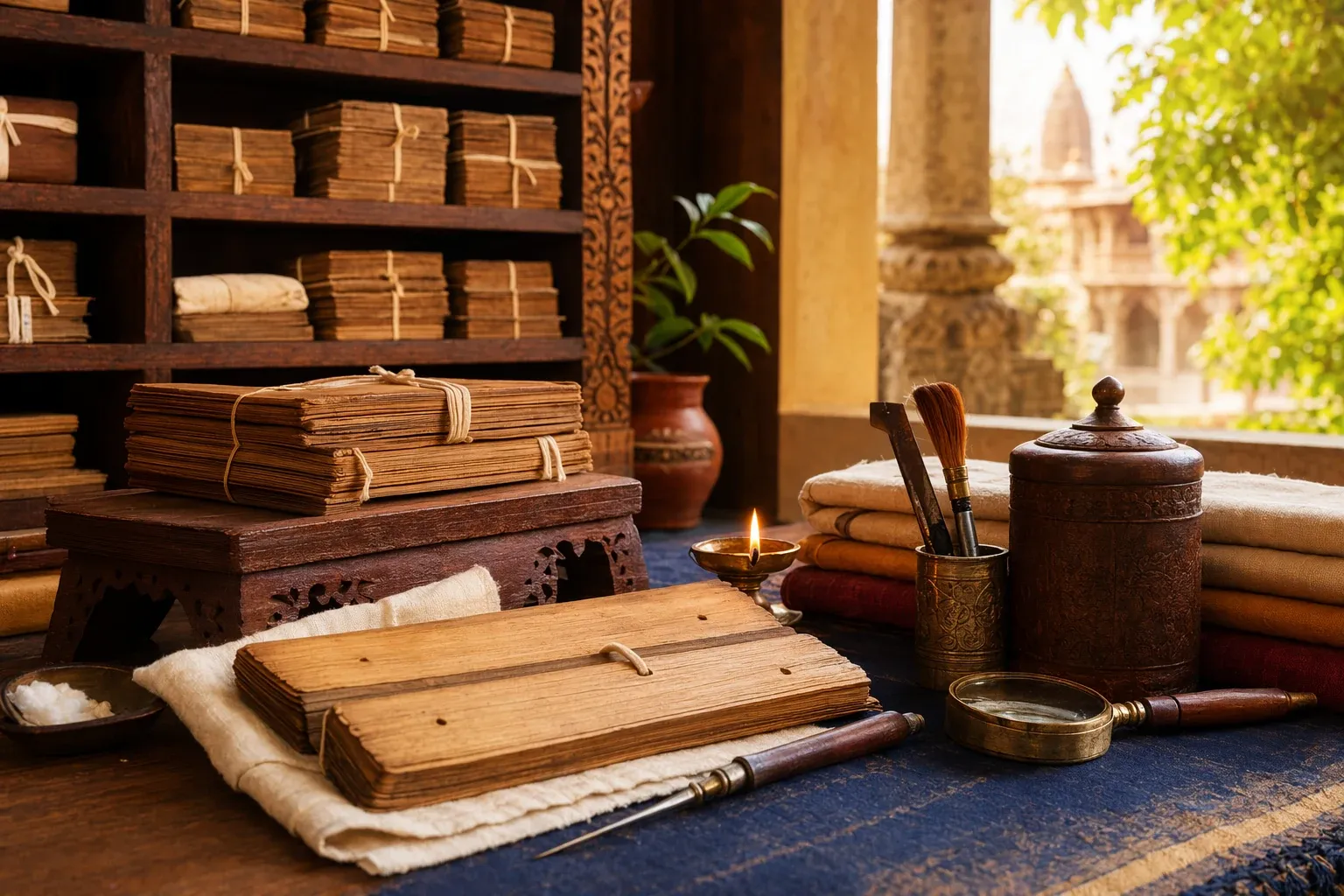
Indian manuscripts survived because many people cared for them before they became museum objects. A grandmother wrapped a bundle in cloth. A temple kept ritual texts near trained readers. A Jain bhandar stored folios in cupboards. A monastery copied worn leaves. A royal library collected works from scholars. A modern archive cleaned, catalogued, photographed, and stored fragile pages. Preservation was never one single trick. It was a chain of habits.
That chain matters because manuscripts are vulnerable. Palm leaf can become brittle, rot, or attract insects. Birch bark can split. Paper can become brittle or acidic. Ink can fade. Cloth wrappers can trap dampness. A manuscript handled daily may wear out, while one hidden in a trunk may suffer from mould or pests. Because different manuscript materials decay in different ways, the real answer to “how were manuscripts preserved in India?” is a mix of traditional care, copying, institutional storage, and modern conservation.
Preservation began with places
Manuscripts lived in many places: homes, temples, mathas, pathshalas, Jain bhandars, Buddhist monasteries, royal courts, scholarly households, libraries, and later museums and archives. Each place preserved a different kind of knowledge. A temple might protect ritual manuals and stotras. A scholar might keep grammar, philosophy, or commentary texts. A medical family might preserve Ayurveda or local healing manuscripts. A court might collect poetry, astronomy, law, history, and administrative records.
Place affected survival. A dry cupboard, stable room, and careful community could protect a bundle for generations. A damp corner could destroy it quickly. Regions with cooler or drier conditions sometimes preserved older material better than hot and humid areas. This is why the surviving manuscript record is uneven. It does not show everything India once knew. It shows what escaped climate, insects, fire, politics, neglect, and ordinary wear.
Traditional care was practical and local
Traditional care often began with simple physical protection. Palm-leaf bundles were tied in order and sometimes placed between wooden boards. Cloth wrapping kept dust away, though cloth also needed to stay dry. Some communities used boxes, cupboards, raised storage, smoke, herbal pest practices, oiling traditions, or periodic airing. The exact method varied by material and region, so we should avoid turning local practice into one universal rule.
For palm-leaf manuscripts, preparation itself helped preservation. Leaves were dried, cut, polished, and treated before writing. Letters were incised with a stylus and darkened so the grooves held the writing. Holes and cords kept leaves together. Covers protected edges. For paper manuscripts, careful folding, stacking, wrapping, and avoiding dampness mattered. For birch bark, gentle handling was essential because the material can flake and split.
Recopying kept texts alive
One of India’s most important preservation methods was recopying. If a palm-leaf manuscript began to decay, a trained person could copy the text onto fresh leaves. If a paper copy became weak, another copy could be made. This is why many sacred, philosophical, literary, and scientific works survived even when older physical copies vanished.
Recopying also explains why a text and a manuscript copy may have different ages. The Mahabharata tradition is not as young as a particular paper copy of one section. A Purana may be ancient in its textual development but preserved in a later palm-leaf or paper manuscript. A Vedic text may belong to an oral tradition older than the surviving written object. This is also why the language and script of a manuscript matter when conservators and cataloguers identify what they are preserving. Preservation was therefore not only about freezing an object. It was about keeping knowledge usable.
Modern conservation is careful, not flashy
Today, manuscript conservation is slow and specialised. Conservators examine material, ink, damage, insects, mould, stains, tears, previous repairs, and storage conditions. They may dry, clean, flatten, house, stabilise, or repair objects using tested methods. The goal is usually minimal intervention: do what helps the manuscript survive, and avoid dramatic treatments that create new damage.
This is why do-it-yourself repair is risky. Tape can stain and tear paper. Glue can harden or attract dirt. Lamination can trap damage permanently. Household oils can darken, weaken, or chemically alter leaves. Water can spread ink or mould. Even enthusiastic handling for photography can break edges. Preservation begins with restraint: do less, document more, and ask someone trained before touching fragile material.
Storage conditions matter every day
Good storage is not glamorous, but it saves collections. General conservation guidance for paper materials recommends clean hands, clean work areas, no food or drink near objects, no tape, glue, rubber bands, paper clips, or folded corners, and stable storage away from direct light, dampness, heat, vents, and pests. Manuscripts need support so their own weight does not damage them.
For Indian materials, storage must also respect local object type. A palm-leaf bundle should not be forced into the shape of a modern book. A loose folio manuscript should not be shuffled like office paper. A painted page needs light control. A sacred family manuscript may need both cultural sensitivity and professional care. The best preservation protects the material without insulting the community memory attached to it.
Digitisation protects access, not the original
Digitisation is one of the biggest modern changes in manuscript preservation. A good digital image lets students, scholars, and ordinary readers see a manuscript without repeated handling of the fragile original. Catalogues help people discover title, subject, language, script, material, date, region, and collection. Digital access can also reconnect communities with works that are physically far away.
But digitisation is not magic. A scan does not preserve the original leaf or paper by itself. The physical manuscript still needs stable storage, pest control, conservation, and responsible ownership. Digital files also need metadata, backups, rights clarity, and ethical use. Sacred or community-sensitive materials should not be treated as free decoration simply because an image is online.
If an old manuscript is at home
If a family finds an old manuscript, the safest first step is calm protection. Do not clean it with water. Do not oil it. Do not apply tape. Do not press it under heavy books. Do not untie a brittle bundle roughly. Do not separate stuck leaves. Do not keep it in direct sun. Keep it dry, shaded, and away from food, insects, and curious handling.
Next, document what you can without stress to the object. Note where it was found, family names linked to it, any tradition about its use, visible script, material, size, number of leaves or pages, and condition. Take simple photographs only if the manuscript can be safely opened. Then approach a trained conservator, university department, manuscript mission, archive, museum, or library. If the manuscript is sacred, involve the family or community respectfully while seeking expert advice.
Preservation as cultural responsibility
Manuscript preservation is not only a technical subject. It is a form of gratitude. These objects carry the labour of scribes, teachers, artists, patrons, monks, priests, scholars, families, and librarians. They hold poetry, philosophy, ritual, medicine, music, law, astronomy, stories, and local memory. Some are beautiful. Some are plain. Some are complete. Some are wounded fragments. All deserve careful handling.
The dharmic way to think about preservation is simple: we received more than we created, so we should pass it forward with honesty. That means no fake age claims, no careless handling, no unauthorised reuse of collection images, no miracle stories without evidence, and no repair experiments on fragile heritage. Preserve the object, respect the tradition, credit the source, and let future generations learn from what survived.