
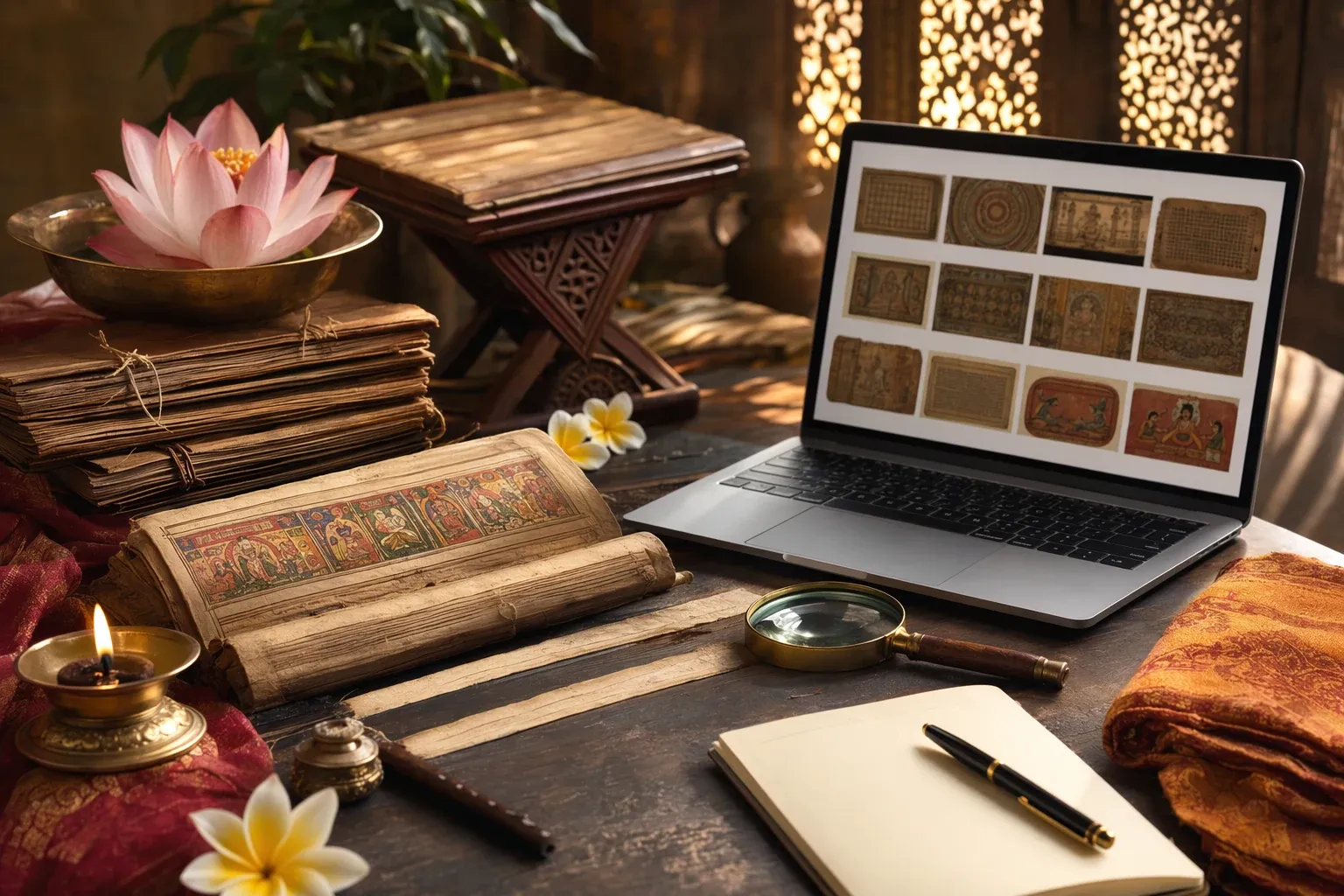
Indian manuscripts are no longer hidden only inside museum cupboards, temple libraries, Jain bhandars, family collections, or university archives. Many can now be seen online through digitised images, catalogue entries, searchable text libraries, and cultural portals. That is a beautiful change, especially for young readers who may never get permission to handle a fragile palm-leaf bundle or a centuries-old paper folio in person.
But online access also needs care. A manuscript is not just an aesthetic background image or a context-free file to copy. It may be sacred to a community, protected by copyright, connected to a private collection, or too fragile to be treated casually. The right approach is simple: use legitimate archives, read the catalogue details, credit the collection, respect access terms, and avoid context-free copies that strip away catalogue details.
Trusted digital collections for manuscript research
A good search begins with institutions that clearly explain what they hold. Government cultural portals, university libraries, museum collections, manuscript missions, and specialist research institutes are better starting points than anonymous file-sharing pages. The Indian Culture Portal has a manuscripts section for public discovery. The Muktabodha Digital Library describes a large online collection of Sanskrit and related texts, including searchable e-texts, paper transcripts from the French Institute of Pondicherry, and Vedic manuscript collections from Gokarna.
International libraries also matter because Indian manuscripts travelled through trade, scholarship, colonial collecting, pilgrimage, and private donations. Some are now in Cambridge, London, Paris, Berlin, Oxford, and other collections. This does not make every collection history simple or painless, but it does mean serious learners should know how to read museum and library records carefully.
Catalogue records are your map
When you open a digital manuscript page, do not rush straight to the image. First read the catalogue record. It may tell you the title, language, script, material, approximate date, place, number of folios, subject, collection name, shelfmark, and sometimes the scribe or donor. These details protect you from a common online mistake: seeing one beautiful page and making a huge claim about all of India.
For example, a palm-leaf manuscript behaves differently from a paper codex. Palm leaves are usually long and narrow, often pierced and tied through a hole. A paper manuscript may allow wider margins, painted borders, or more flexible page design. A Sanskrit text written in Devanagari is not the same thing as a Persian court record, an Odia palm-leaf manuscript, a Jain illustrated folio, or a Śāradā manuscript from Kashmir. The catalogue helps you notice these differences, especially when you compare materials and languages separately.
Images are not the whole text
Digitisation gives us access to images, but an image is not the same as understanding. Many manuscripts are hard to read without training in script, language, scribal habits, abbreviations, damaged letters, and older spellings. Even when a page looks clear, a beginner may not know where a line begins, which marks are punctuation, or whether a red mark is decoration, correction, or ritual emphasis.
This is why serious archives often combine images with metadata, scholarly notes, transcriptions, or references to printed editions. A digitised page can inspire curiosity; a catalogue and reliable scholarship turn that curiosity into learning. If you are using a manuscript for school, content creation, or research, mention what you actually saw: an image, a catalogue description, a translation, an edition, or a secondary explanation.
Respect copyright and access rules
Many people search for quick offline copies because they feel easy. Sometimes a library offers a clearly licensed image set or reading file. Sometimes it only allows online viewing. Sometimes it asks users to request permission for reuse. These rules should be followed even when the material itself is old. The physical scan, photograph, catalogue text, and platform may have separate rights.
Ethical access is not anti-learning. It protects the people and institutions who preserve, photograph, describe, and host these materials. If you share an image, give the collection name and link. If you are unsure whether reuse is allowed, use a citation instead of copying the image. If a site looks like it has copied manuscripts without context or permission, use a better source, and remember that preservation work is part of the story too.
How to search without getting lost
Use specific search terms. Instead of typing only “ancient Indian manuscripts,” try combinations such as “Sanskrit palm-leaf manuscript digital collection,” “Jain manuscript folio museum,” “Odia palm-leaf manuscript archive,” “Vedic manuscript Gokarna digital library,” or the name of a text, script, region, or collection. Add words like catalogue, digital library, collection, folio, manuscript, or archive.
Then slow down. Open fewer pages and read them better. Note the shelfmark. Save the archive URL. Write down the language and script separately. Record whether the item is a manuscript image, a printed edition, an e-text, or a modern article. This habit prevents confusion later, especially when different sites use similar titles for different objects.
Digital access still needs cultural sensitivity
Some manuscripts are devotional, ritual, or community-linked. A page from a Purana, Tantra, Buddhist text, Jain narrative, Qur’anic manuscript, Vedic collection, or local temple record may carry meaning beyond academic curiosity. Respect does not mean we cannot study them. It means we should not use sacred material as a meme, decoration, or proof for wild claims.
India’s manuscript heritage is also multilingual and multi-religious. Sanskrit matters, but so do Tamil, Pali, Prakrit, Persian, Arabic, Telugu, Kannada, Malayalam, Odia, Bengali, Marathi, Kashmiri, and many other languages. A respectful online learner does not flatten this diversity into one label.
Questions beginners ask
Where can I find digital collections of Indian manuscripts online?
Start with recognised cultural portals, university libraries, museum collections, manuscript missions, and specialist research institutes. The Indian Culture Portal and Muktabodha Digital Library are useful starting points, and major international libraries also hold Indian manuscript material.
Are Indian manuscripts available as online copies?
Some are, but availability depends on the archive and rights policy. A clearly licensed copy from a library is different from an anonymous file that removes source, shelfmark, and access terms.
Can I use manuscript images in my project?
Check the collection’s reuse policy first. If reuse is not clearly allowed, cite and link the archive instead of copying the image.
A good rule to remember
Treat every online manuscript page as a doorway, not a trophy. Ask where it comes from, who preserved it, what the catalogue says, what rights apply, and what you can honestly understand from it. That way digital access becomes not only convenient, but also dharmic: careful, truthful, and respectful.