
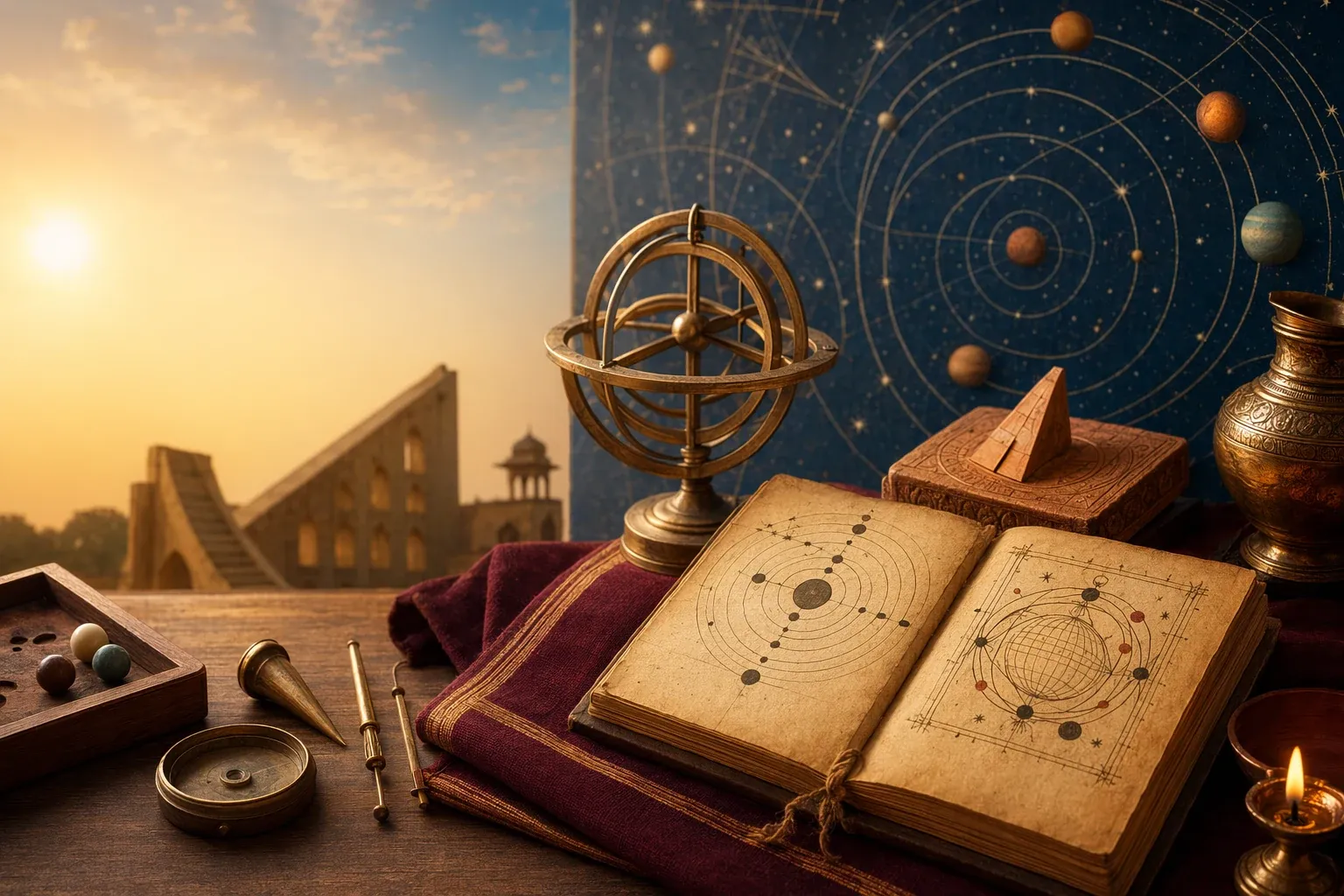
A siddhanta is a systematic astronomical treatise, and the Surya Siddhanta is one of the best-known doorways into classical Indian astronomy. This beginner guide explains the topic in simple language while keeping the cultural and historical context respectful.
Indian astronomy is best understood as a meeting point of observation, calculation, calendar-making, sacred time, and curiosity about the universe. It belongs to India’s knowledge traditions, but it also connects with wider human questions: How do we measure time? How do we predict repeating patterns? How do stories, rituals, farming seasons, and science all look up at the same sky?
The simple meaning
This article is a beginner guide to siddhanta literature with Surya Siddhanta as the familiar entry point. In everyday language, the subject is about learning how Indian thinkers, families, ritual specialists, mathematicians, and later scientists understood the movements of the Sun, Moon, stars, and planets.
A beginner should remember these key ideas: astronomical treatise, planetary motion, time cycles, eclipses, instruments, evolving versions. They are connected. A calendar needs observation. Observation needs counting. Counting becomes mathematics. Mathematics helps people plan festivals, journeys, study, agriculture, and teaching.
Tradition, interpretation, and history
Many readers search for free downloads, but sacred and scholarly texts deserve legal, reliable editions and patient study instead of random files without context.
When we discuss scripture, classical texts, or traditional knowledge, it is useful to separate three layers. Tradition preserves memory and meaning. Interpretation explains how communities understand that meaning. Historical context asks when ideas developed, how they changed, and what evidence we have. Keeping these layers separate makes the article more respectful, not less.
Define siddhanta in the astronomy context
Define siddhanta in the astronomy context means starting with the basic purpose of the subject. In Surya Siddhanta and Siddhanta Astronomy: A Beginner Guide, the central idea is not only to name facts, but to understand why people watched the sky so carefully. The sky helped communities organize astronomical treatise, planetary motion, time cycles, eclipses, and it also gave language to wonder, discipline, and sacred time.
For Surya Siddhanta and Siddhanta Astronomy: A Beginner Guide, this matters because readers often meet the topic through one small search phrase, but the real subject is wider. A good explanation should give enough context to be useful without pretending that one article can settle every scholarly debate.
Explain what Surya Siddhanta is and why people search for it
This part needs historical patience. Indian astronomy did not appear in one finished form. It moved through early calendar needs, classical mathematical texts, temple and courtly learning, regional schools, translations, and modern scientific institutions. That layered growth is what makes the topic rich.
For Surya Siddhanta and Siddhanta Astronomy: A Beginner Guide, this matters because readers often meet the topic through one small search phrase, but the real subject is wider. A good explanation should give enough context to be useful without pretending that one article can settle every scholarly debate.
Summarize the kinds of topics these texts discuss
A useful example is to think about a festival date, an eclipse, or the changing place of the Moon. None of these can be understood by guesswork alone. They require repeated observation, shared rules, and calculation that can be taught to the next generation.
For Surya Siddhanta and Siddhanta Astronomy: A Beginner Guide, this matters because readers often meet the topic through one small search phrase, but the real subject is wider. A good explanation should give enough context to be useful without pretending that one article can settle every scholarly debate.
Clarify that traditions and versions evolved over time
The careful distinction is between tradition, interpretation, and historical context. Tradition tells us how communities valued the sky. Interpretation explains what people believed those patterns meant. Historical context asks what texts, tools, and social needs shaped those ideas.
For Surya Siddhanta and Siddhanta Astronomy: A Beginner Guide, this matters because readers often meet the topic through one small search phrase, but the real subject is wider. A good explanation should give enough context to be useful without pretending that one article can settle every scholarly debate.
Point readers toward legal, beginner-friendly learning resources, not downloads
For students, the practical takeaway is to keep the subject grounded. Learn the words, notice the sky directly, compare reliable explanations, and avoid turning a complex knowledge tradition into either blind pride or careless dismissal.
For Surya Siddhanta and Siddhanta Astronomy: A Beginner Guide, this matters because readers often meet the topic through one small search phrase, but the real subject is wider. A good explanation should give enough context to be useful without pretending that one article can settle every scholarly debate.
For helpful background, you can also read our related Bhaktilipi guides: Hindu Calendar for Beginners and What Are the Vedas?.
Common misunderstandings
- Indian astronomy is not only prediction or horoscope language; it also includes calendars, observation, mathematics, and texts.
- Ancient knowledge should be respected without forcing exaggerated claims that serious students cannot defend.
- Modern astronomy uses today’s scientific methods, instruments, and peer review, even when it studies questions humans have asked for thousands of years.
- Different regions and periods used different terms, so one neat English translation may not capture the full meaning.
Questions people ask
What is Siddhanta in Indian astronomy?
In simple words, this topic belongs to the Indian study of the sky, time, calendars, and meaning. The exact answer depends on whether we are speaking about history, tradition, or modern science.
What did ancient Indian astronomy theories include?
In simple words, this topic belongs to the Indian study of the sky, time, calendars, and meaning. The exact answer depends on whether we are speaking about history, tradition, or modern science.
How were planetary positions and eclipses studied in ancient India?
The simple method was careful observation joined with calculation. People watched repeating patterns, measured time, compared positions, and improved rules through texts and teaching.
A grounded way to remember it
Treat the Surya Siddhanta not as a magic shortcut, but as a window into how classical India organized sky knowledge into a disciplined text. If you are new to the subject, do not begin with arguments on the internet. Begin with the Moon, a calendar, a reliable book, and the humility to learn slowly.
That approach fits Bhaktilipi’s spirit: make culture understandable for young readers, keep language simple, honour the tradition, and still be honest about history. When knowledge is handled with dharma, curiosity becomes service instead of noise.