
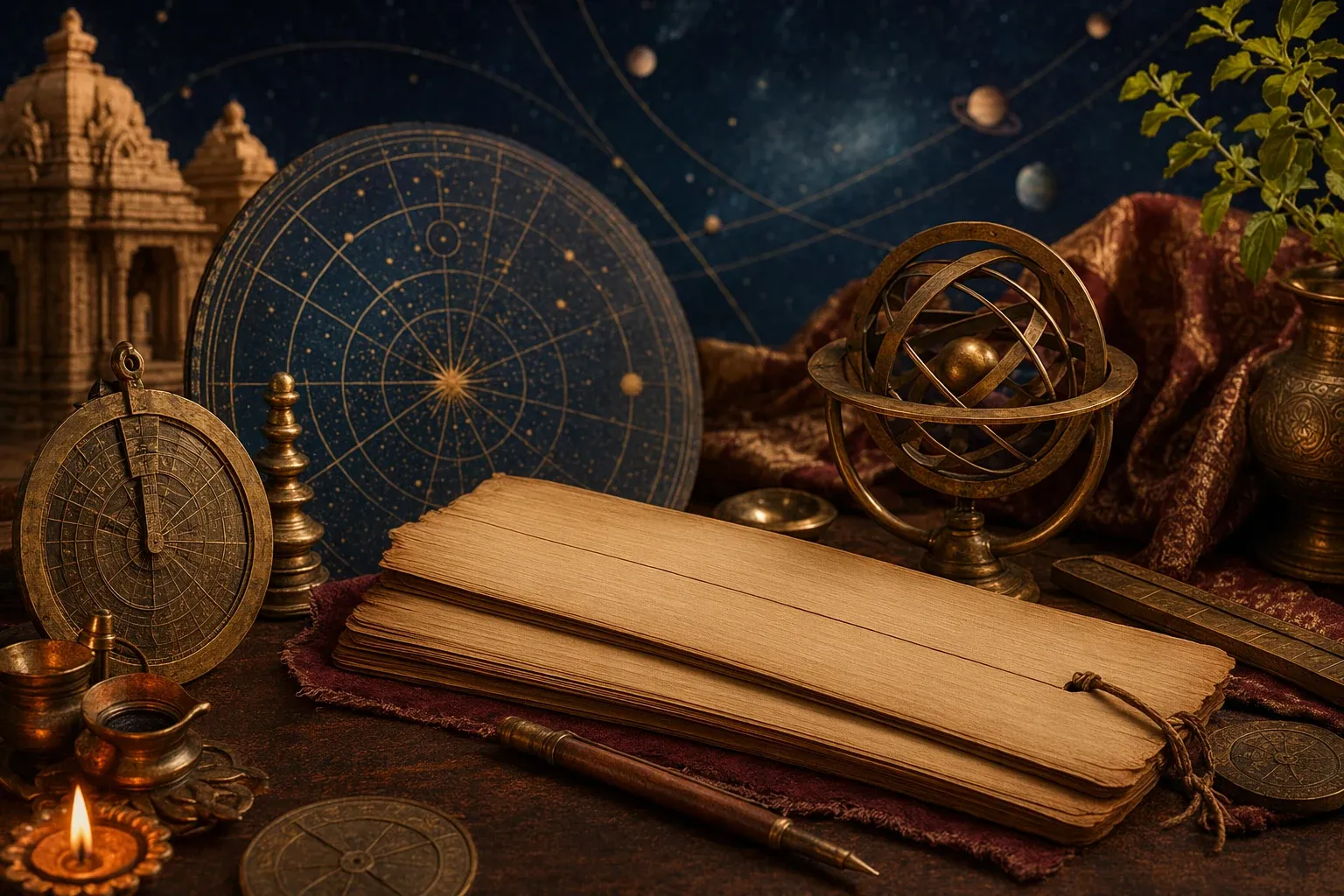
When people ask who is called the father of Indian astronomy, the short and common answer is Aryabhata. He is remembered as one of India’s most brilliant early astronomer-mathematicians, and his name appears in many school lessons, quiz answers, and introductions to Indian science history.
But that answer needs a little care. Astronomy in India did not begin with one person, and it did not end with one famous book. It grew through observation, calculation, calendar-making, teaching traditions, and many regional centres of learning. Aryabhata stands near the centre of that story because his work was unusually influential, not because he was the only contributor.
For a broader starting point, Bhaktilipi’s guide to what Indian astronomy means explains the larger subject, while the article on Indian astronomy and mathematics shows why calculation became so important.
Why Aryabhata Is Often Given This Title
Aryabhata lived in the late fifth and early sixth century CE. His famous work, the Aryabhatiya, is a compact Sanskrit text that covers mathematics and astronomy. It discusses topics such as planetary motion, the measurement of time, eclipses, trigonometric ideas, and methods useful for calculation. For a young reader, the important point is this: Aryabhata helped turn sky-watching into a disciplined mathematical subject.
In many cultures, astronomy began with practical needs. People watched the Sun, Moon, stars, seasons, and shadows because these helped with agriculture, ritual calendars, navigation, and timekeeping. Aryabhata inherited a long background of such knowledge. What made him special was the clarity and mathematical power of his explanations. He gave later scholars a model for how astronomy could be studied with numbers, rules, and carefully arranged verses.
One famous idea linked with Aryabhata is his explanation that the apparent daily movement of the heavens can be understood by the rotation of the Earth. In simple terms, he suggested that the sky seems to move because we are moving. This was a bold and memorable way to think about what people saw every night. He also gave explanations for eclipses that did not depend only on mythic storytelling: eclipses could be understood through the positions of the Sun, Moon, and Earth.
That is why Aryabhata is often named first. He represents a turning point where Indian astronomy appears as a strong mathematical science, not merely a set of observations.
Did Indian Astronomy Start Before Aryabhata?
Yes. The roots are older. Vedic and post-Vedic traditions show a deep interest in time, seasons, lunar days, and ritual calendars. Texts connected with Jyotisha, one of the traditional Vedangas, preserved methods for tracking time and arranging sacred activities. These earlier materials were not modern astronomy textbooks, but they show that systematic sky knowledge was already important in Indian life.
Readers who want that background can continue with Bhaktilipi’s simple guide to Vedanga Jyotisha and the beginner explanation of tithi in the Hindu calendar. Those topics show how sky observation, timekeeping, and calendar practice met in everyday religious and cultural life.
There were also older siddhanta traditions: rule-based astronomical schools and texts that explained how to calculate celestial positions. Some works survive fully, while others are known through later references. This means Aryabhata should be seen as part of a continuing chain. He gave a powerful expression to a subject that had already been developing for centuries.
This is why the phrase father of Indian astronomy is useful only as a simple introduction. It points students toward Aryabhata, but it should not erase the unnamed observers, teachers, calendar-makers, and earlier authors who prepared the ground.
Varahamihira and the Wider World of Knowledge
A little after Aryabhata, Varahamihira became another major name in Indian astronomy and related sciences. He lived in the sixth century CE and is associated with Ujjain, an important centre for learning and sky observation. His works brought together astronomy, astrology as understood in that era, calendrical knowledge, omens, weather signs, and cultural learning.
Varahamihira is important because he shows how knowledge travelled and was compared. Indian scholars were not working inside a closed room. They discussed different traditions, inherited older ideas, and sometimes referred to knowledge connected with the Greeks and other regions. His writing reminds us that Indian astronomy was part of a larger conversation across Asia and the wider ancient world.
For beginners, Varahamihira is a good example of a scholar who collected, organized, and transmitted knowledge. Aryabhata shines as a mathematical innovator; Varahamihira shines as a learned compiler and interpreter of a broad sky-science tradition.
Brahmagupta and Stronger Calculations
In the seventh century CE, Brahmagupta became one of the great figures of Indian mathematics and astronomy. His works, especially the Brahmasphutasiddhanta, are remembered for important mathematical ideas and astronomical calculations. He wrote about planetary positions, eclipses, and methods that were useful to later astronomers.
Brahmagupta also shows how scholarly disagreement worked. Indian scientific writing was not just praise and repetition. Scholars debated earlier rules, corrected methods, and proposed their own approaches. Sometimes they strongly disagreed with previous thinkers. That may sound surprising, but it is a sign of a living intellectual tradition.
If Aryabhata helped define a powerful mathematical direction, Brahmagupta helped extend and challenge that direction. The subject became richer because later scholars did not simply copy earlier answers.
Bhaskara and the Long Continuity
The name Bhaskara can refer to more than one important scholar. Bhaskara I, in the seventh century, wrote commentaries that helped explain Aryabhata’s work. Commentaries mattered because they made difficult verses usable for students and later teachers. Without such explanation, a compact text could remain hard to understand.
Centuries later, Bhaskara II, also known as Bhaskaracharya, became one of India’s most celebrated mathematician-astronomers. His works such as the Siddhanta Shiromani show how advanced the tradition remained in the medieval period. He wrote on arithmetic, algebra, planetary calculation, and astronomical instruments and methods.
These later scholars remind us that Indian astronomy was not a single event. It was a long river. Aryabhata is one bright bend in that river, but the water kept moving through many hands.
A Simple Timeline for Students
Here is an easy way to remember the story. Early ritual and calendar traditions show that Indians were carefully watching the sky long before the famous named astronomers. Aryabhata, around 499 CE, gave a mathematically powerful account of astronomy in the Aryabhatiya. Varahamihira, in the sixth century, organized a wide range of sky-related and cultural knowledge. Brahmagupta, in the seventh century, deepened mathematical and astronomical calculation. Bhaskara I helped explain Aryabhata, and Bhaskara II carried the tradition forward many centuries later.
This timeline is not a complete list. It leaves out many scholars, regional schools, observatories, instrument makers, teachers, and manuscript copyists. Still, it helps beginners see the main pattern: Indian astronomy grew through continuity, correction, and teaching.
Students comparing this article with other astronomy guides may also enjoy the introductions to ancient Indian astronomy achievements and Surya Siddhanta, because those pieces place Aryabhata inside a wider tradition of texts, methods, and debates.
So, Who Deserves the Title?
If a school question asks for one name, Aryabhata is the safest answer. He is commonly called the father of Indian astronomy because of the influence, originality, and mathematical strength associated with his work. His name gives students a doorway into the subject.
If the question is historical, the better answer is broader. Aryabhata was a foundational figure, but he belonged to a much longer tradition. Varahamihira, Brahmagupta, Bhaskara I, Bhaskara II, and many others helped preserve, challenge, and expand Indian astronomy. Earlier calendar traditions and unnamed observers also matter.
So the most accurate beginner-friendly answer is this: Aryabhata is often called the father of Indian astronomy, but Indian astronomy itself was a many-century achievement. It was built by people who watched the sky, measured time, wrote difficult verses, taught students, debated calculations, and connected the movements of the heavens with everyday life on Earth.
That wider view does not reduce Aryabhata’s importance. It makes his achievement clearer. He was great not because he stood alone, but because his work became a lasting point of reference in one of India’s richest knowledge traditions.