
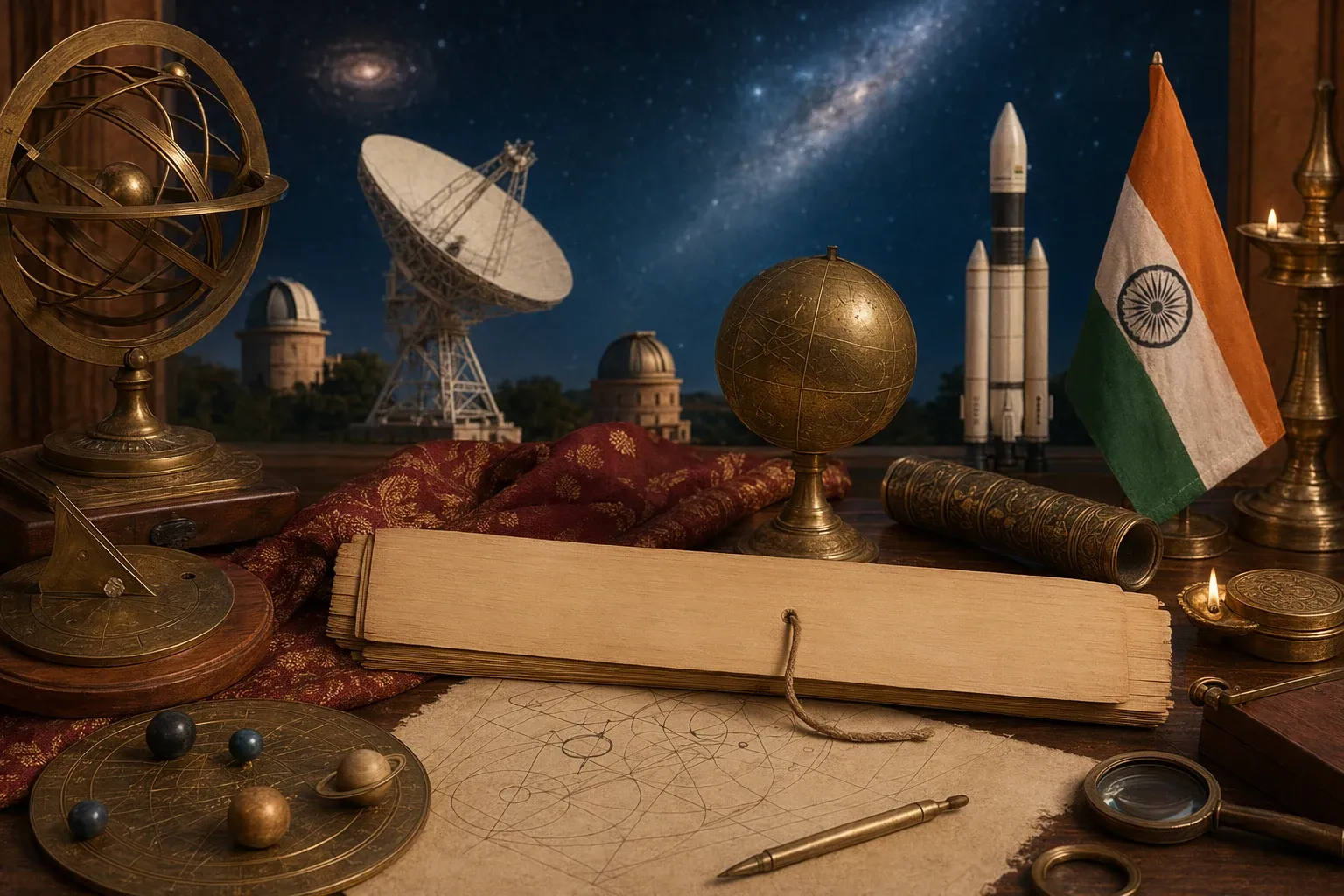
Modern Indian astronomy is not only a story of ancient texts or famous names from the past. It is also a living field of research, observation, engineering, data analysis, and public science. India studies the sky through optical observatories, radio telescopes, solar research centres, university departments, planetariums, and space missions. For a beginner, the most useful way to understand the subject is to connect three layers: the older curiosity about time and the heavens, the modern tools used to observe the universe, and the institutions that train people to ask better questions.
Ancient Indian astronomy gave attention to calendars, planetary motion, eclipses, nakshatras, and mathematical models. Modern astronomy uses very different instruments and methods, but the basic human wonder is familiar: how do we measure the sky, understand change, and place Earth within a larger universe? That continuity is inspiring, as long as we do not confuse historical astronomy with present-day astrophysics.
From sky watching to scientific observation
A village sky watcher, a calendar maker, and a modern astrophysicist all look upward, but they do not do the same work. Modern astronomy depends on careful instruments, repeatable measurements, peer review, mathematics, computing, and international collaboration. Telescopes collect light or radio signals. Detectors turn those signals into data. Scientists test models against evidence. This makes astronomy a science, not just a collection of beautiful sky stories.
India’s modern astronomy grew through universities, national laboratories, observatories, and dedicated scientists who built research cultures after independence while also drawing from earlier institutions. The result is a field that includes solar physics, radio astronomy, stellar studies, galaxies, cosmology, planetary science, and space-based observation. For the historical background, readers can also explore what Indian astronomy means.
Observatories and why location matters
An observatory is not just a building with a telescope. Its location matters because astronomers need clear skies, stable air, low light pollution, and suitable weather. That is why many optical observatories are placed in hill regions or quieter landscapes. India has used sites such as Kodaikanal, Nainital, Hanle, Mount Abu, and others for different kinds of sky observation. Each site has its own strengths.
Solar observatories study the Sun, its surface activity, magnetic behaviour, and influence on space weather. Optical telescopes examine stars, galaxies, nebulae, and transient events. Radio telescopes listen to long-wavelength signals that human eyes cannot see. A beginner should remember that no single instrument sees the whole universe. Different tools reveal different layers.
Radio astronomy and giant listening instruments
India has made a strong contribution to radio astronomy. Radio telescopes are sometimes described as giant ears, but they are more accurately instruments that collect radio waves from space. These signals can come from galaxies, pulsars, gas clouds, solar activity, and other cosmic sources. Radio astronomy is powerful because it can reveal parts of the universe that visible light alone cannot show.
The Giant Metrewave Radio Telescope near Pune is one of the best-known examples associated with Indian radio astronomy. It shows how astronomy is also engineering: large antennas, precise timing, electronics, computing, and long-term maintenance all matter. Behind every impressive image or discovery there is a team of scientists, engineers, technicians, students, and data specialists.
Institutes, universities, and training
Modern astronomy depends on institutions because research requires training. Students learn physics, mathematics, programming, statistics, instrumentation, and scientific writing. Institutes and universities create the environment where questions can be tested seriously. They also connect Indian researchers with global collaborations, conferences, telescope time, and shared data.
For young readers, this is important. Loving the stars is a good beginning, but astronomy as a career needs patient study. School-level curiosity can grow through physics, mathematics, coding, reading popular science carefully, visiting planetariums, joining astronomy clubs, and learning how evidence works. A related guide on Indian astronomy and mathematics can help connect these skills.
Space missions and astronomy from above Earth
Some astronomical observations are easier from space because Earth’s atmosphere blocks or distorts parts of the signal. Space missions can study the Sun, Moon, planets, high-energy sources, and cosmic events in ways ground instruments cannot always manage. India’s space programme is often discussed through launch vehicles and planetary missions, but it also supports scientific observation and data that researchers can study.
Missions connected with solar study, lunar exploration, Mars exploration, and space observatories show that modern astronomy is linked with space science. A spacecraft is not only a symbol of national pride. It is a platform for instruments, measurements, experiments, and long-term learning. The best public understanding celebrates achievement while still asking what the mission measured and what scientists learned.
Public astronomy: planetariums, clubs, and night-sky learning
Modern Indian astronomy also belongs to the public. Planetariums, science museums, local astronomy clubs, university outreach events, and eclipse-viewing programmes help people learn safely. This matters because the night sky is often hidden by city lights and misinformation. A guided sky session can teach a child the difference between a planet and a star, why eclipses are predictable, and how to enjoy the sky without superstition or fear.
Public learning should be careful during eclipses, meteor showers, and bright planetary events. Use safe solar filters for the Sun, follow expert guidance, and avoid viral claims that turn astronomy into panic. Good astronomy increases wonder; it does not need exaggeration.
Simple takeaway
Modern Indian astronomy is a living bridge between curiosity, instruments, institutions, and space science. Observatories gather light and radio signals. Institutes train researchers. Missions carry instruments beyond Earth. Clubs and planetariums bring the sky back to ordinary learners. If you remember one thing, remember this: India’s astronomy story is not finished in the past. It continues wherever careful observation, mathematics, engineering, and wonder work together.