
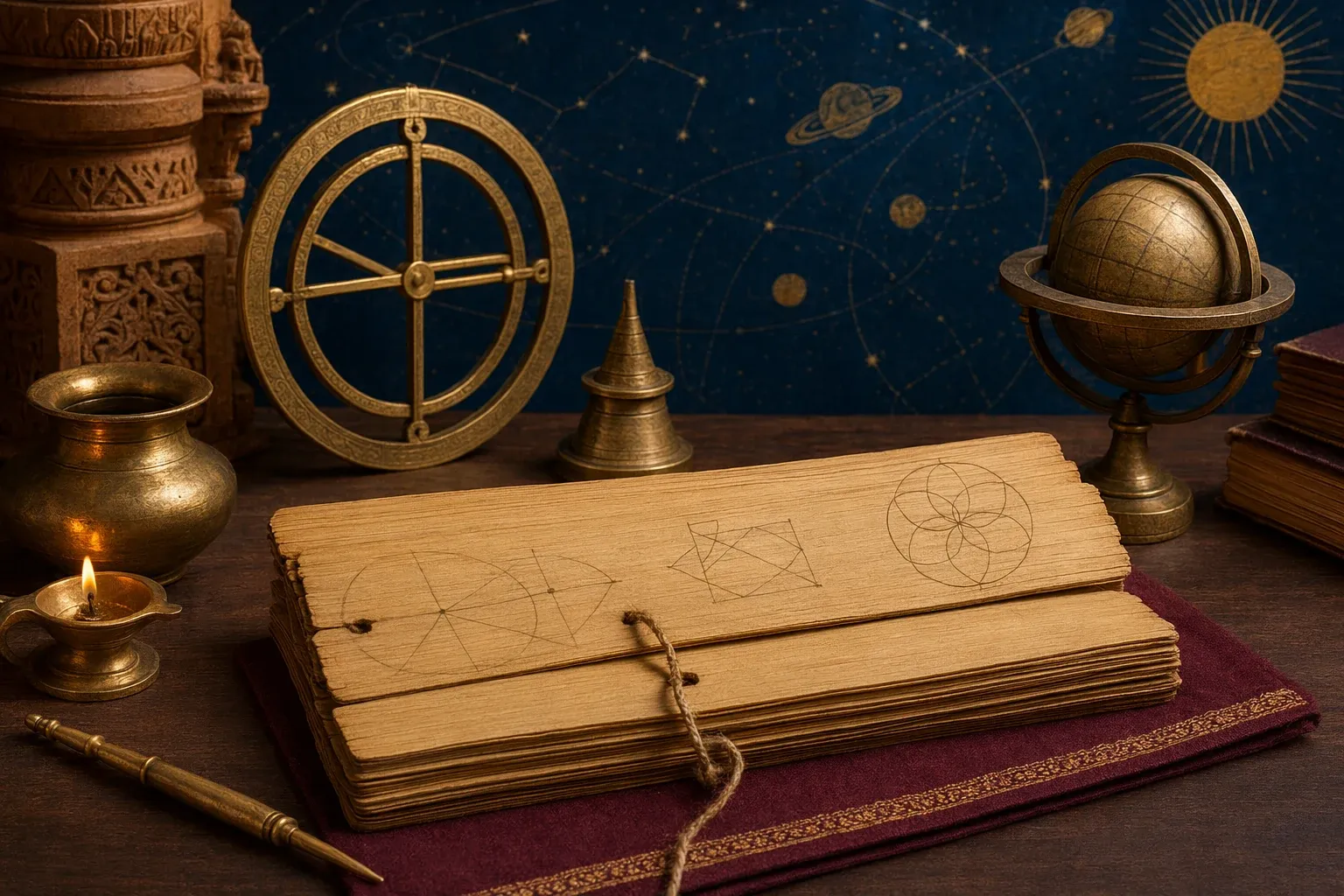
Ancient Indian mathematics is not only a story of clever sums. It is the story of how people measured land, tracked time, studied the sky, kept accounts, designed rituals, taught students, and slowly built a language for numbers that could travel across cultures. When we speak about its world contribution, the most important point is this: Indian scholars helped make calculation more flexible, more written, and easier to carry from one problem to another.
A living tradition, not one single invention
Mathematics in India grew through many settings. Vedic ritual specialists needed altar geometry and accurate counting. Astronomers needed methods for calendars, eclipses, planetary motion, and timekeeping. Merchants needed practical arithmetic for weights, prices, interest, and exchange. Teachers wrote rules in verse so that students could remember procedures before paper was common. Over many centuries these needs created a broad tradition called ganita, a word connected with counting and calculation.
This matters because it prevents a simple mistake. Ancient Indian mathematics was not made by one person on one date. It was a layered tradition. Some works were practical manuals. Some were astronomical treatises. Some were commentaries that explained older rules. Some ideas travelled outward and returned in new forms through contact with Persian, Arabic, Greek, and later European learning.
Place value made big numbers manageable
The place-value number system is one of the great strengths associated with Indian mathematics. In a place-value system, the position of a digit changes its value. The same symbol can mean three, thirty, three hundred, or three thousand depending on where it stands. That sounds ordinary today because we use it every day, but it changed the way people could write and calculate.
Place value made large numbers compact. It made addition, subtraction, multiplication, and division easier to teach as written procedures. It also allowed astronomers and accountants to work with long values without writing long strings of separate signs. For a beginner, this is the simplest way to understand the impact: Indian numerals helped calculation become portable. A person did not need a special counting board for every operation; the written number itself carried the structure.
For a related beginner explanation, see Bhaktilipi’s guide to zero and the Indian number system.
Zero became both a placeholder and a number
Zero is often the first idea people associate with Indian mathematics, and rightly so. As a placeholder, zero keeps positions clear. In 105, it shows that there are no tens while the one and five keep their places. Without that mark, many numbers become ambiguous. But Indian mathematics also helped develop zero as something that could be discussed in rules of arithmetic.
Brahmagupta, writing in the seventh century, gave rules involving zero and negative quantities. Not every rule matches modern classroom language, but the attempt itself was important. It shows that zero was not merely an empty spot in notation. It was becoming part of calculation. That shift influenced later mathematical writing through Sanskrit, Arabic, Persian, and Latin channels.
Zero should not be treated as a magic trick or as the work of one isolated genius. It became powerful because it sat inside a wider system of place value, written computation, and scholarly explanation.
Astronomy pushed calculation forward
Indian astronomy and mathematics were closely connected. To make calendars, predict lunar phases, estimate eclipses, and discuss planetary positions, scholars needed reliable computation. This is why many mathematical ideas appear inside astronomical works. Aryabhata, for example, is remembered for both astronomical reasoning and mathematical rules. Later authors such as Bhaskara II wrote on arithmetic, algebra, and astronomy with remarkable clarity.
The link with astronomy also encouraged trigonometric thinking. Sine tables and related methods helped scholars model arcs, angles, and celestial movement. These tools were not abstract luxuries. They supported calendar making, ritual timing, navigation of seasonal cycles, and intellectual debate. For more background on the science of the sky, read Indian astronomy and mathematics.
Algebra, series, and problem solving
Indian mathematical texts include rules for equations, progressions, combinations, fractions, roots, and practical problems. Some problems were framed through everyday life: merchants, flowers, animals, debts, inheritance, and travel. This teaching style made procedures memorable while still training careful reasoning.
In Kerala, scholars connected with the Kerala school worked on infinite series and refined calculation methods in astronomy and mathematics. These developments are often discussed in comparison with later calculus, though careful language is needed. It is better to say that Kerala scholars produced sophisticated series methods in their own intellectual setting, not that they simply wrote modern calculus before Europe.
How these ideas reached the wider world
Indian numerals and calculation methods moved through translation, trade, scholarship, and administration. Arabic-speaking scholars studied and transmitted Indian numerical ideas; later these methods entered Europe through Latin translations and commercial practice. This is why the numerals used globally today are often called Hindu-Arabic numerals. The name itself reminds us that knowledge travelled through more than one culture.
The world legacy of ancient Indian mathematics is therefore not a trophy claim. It is a story of usefulness. Compact numerals, place value, zero, arithmetic procedures, astronomical computation, and teaching traditions made calculation easier to share. Modern students encounter this legacy every time they write a number, solve an equation, check a calendar, or use a computer that depends on positional notation.
A balanced way to remember the contribution
The best summary is simple: ancient Indian mathematics helped turn numbers into a flexible written system for calculation. It did not develop in isolation, and it did not stop changing after one famous discovery. Its strength came from many scholars, many practical needs, and many centuries of refinement. That is why its contribution still feels present in ordinary life, not only in history books.