
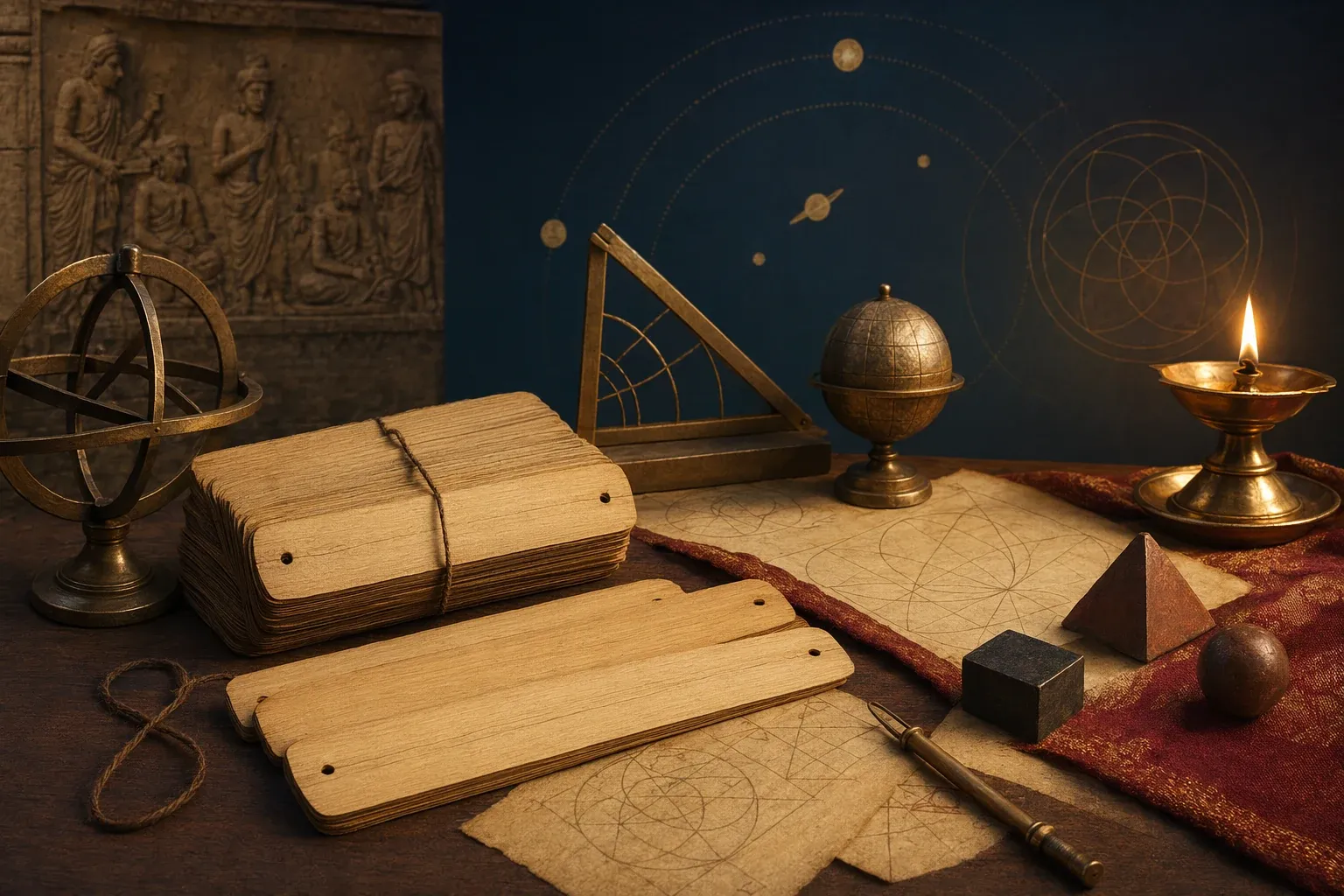
The name most often given as the “father of Indian mathematics” is Aryabhata. This is the answer many students see in general-knowledge books and school discussions. But it is only a short answer. A more accurate answer is that Aryabhata is a leading early figure in Indian mathematics and astronomy, while Indian mathematics itself was created by many scholars over a long period.
The short answer: Aryabhata is usually named
Aryabhata lived around the late fifth and early sixth century CE. His famous work, the Aryabhatiya, contains mathematical and astronomical material in concise verse. He is remembered for methods related to arithmetic, algebraic problems, trigonometric tables, and calculations used in astronomy. Because his work is early, influential, and widely taught, his name is often attached to the “father” title.
If you need a one-line answer for a quiz, Aryabhata is the safest common response. If you are writing an explanation, add that the title is informal and simplified.
Why the title is not perfectly exact
Mathematics rarely has a single father. Indian mathematics did not begin with one person, and it did not end with one person. Earlier ritual, counting, geometry, calendar, and measurement traditions existed before Aryabhata. Later scholars expanded the subject in major ways. Calling one person the father can be useful for memory, but it can hide the teamwork of centuries.
A better phrase might be: Aryabhata is one of the foundational figures of classical Indian mathematics. That wording gives him respect without erasing the wider tradition.
Why Aryabhata receives the label
Aryabhata receives the label for three main reasons. First, he is early and historically prominent. Second, his work joins mathematics with astronomy, showing how calculation was used to understand time and celestial motion. Third, his name is easier for students to connect with a surviving text and a recognizable intellectual legacy.
His trigonometric and astronomical calculations also influenced later scholars. He wrote in compact Sanskrit verses, which means his work needed explanation by commentators. That culture of commentary helped his ideas remain part of Indian learning.
For the astronomy side of his legacy, see Bhaktilipi’s guide to Aryabhata and other Indian astronomy contributors.
Other names students should know
Brahmagupta is essential in any discussion of Indian mathematics. He wrote in the seventh century and is famous for rules involving zero and negative numbers, along with important algebraic and astronomical work. If the question is about zero as a number in calculation, Brahmagupta’s name becomes especially important.
Bhaskara II, also called Bhaskaracharya, is another major figure. His works on arithmetic, algebra, and astronomy were influential, and his Lilavati is remembered for elegant mathematical problems. He shows that Indian mathematics was not only about discovery but also about clear teaching.
Mahavira, a Jain mathematician, contributed to arithmetic and practical problem solving. Madhava of Sangamagrama and the Kerala school are remembered for advanced series methods and refined astronomical calculation. In the modern period, Srinivasa Ramanujan became one of the world’s most admired number theorists.
What “Indian mathematics” includes
When people ask about the father of Indian mathematics, they often imagine a single subject like school algebra. Historically, the field was wider. It included counting, place value, fractions, geometry, astronomy, calendars, trigonometric tables, equations, series, and teaching methods.
This is why different names matter in different contexts. Aryabhata is a strong answer for early classical mathematics and astronomy. Brahmagupta is central for zero and negative numbers. Bhaskara II is crucial for arithmetic, algebra, and education. Ramanujan belongs to modern number theory. No single label can cover all of these roles.
A careful classroom answer
A good student answer can be written like this: “Aryabhata is often called the father of Indian mathematics because of his early and influential work in mathematics and astronomy. However, Indian mathematics was developed by many scholars, including Brahmagupta, Bhaskara II, Mahavira, Madhava, and later Ramanujan.”
This answer is short enough for school use but accurate enough for serious reading. It avoids the mistake of turning history into a one-person story.
Why the question still matters
The question matters because it opens a door. Once students learn Aryabhata’s name, they can explore the larger tradition: the place-value system, zero, astronomical calculation, algebraic rules, series, and modern mathematical creativity. Bhaktilipi’s introduction to what Indian mathematics means is a helpful next step.
So, who is called the father of Indian mathematics? Aryabhata is the common answer. The fuller answer is that he is a foundational figure in a much larger Indian mathematical heritage. Remember the name, but also remember the tradition around it.## Why students should avoid one-word history
One-word history is easy to remember, but it can become unfair. If Aryabhata alone is named, a reader may miss how Brahmagupta developed important rules, how Bhaskara II made mathematical learning elegant, how Jain and Kerala scholars added their own strengths, and how modern Indian mathematicians continued the story. The better habit is to connect a name with a contribution. That makes the answer richer and easier to revise later.
It also helps students avoid exaggerated claims. Indian mathematics deserves respect without needing inflated language. Its real achievements are strong enough: place value, zero in calculation, astronomical computation, algebraic methods, teaching traditions, and later work in series and number theory. Aryabhata belongs proudly inside that history.Another useful comparison is with the phrase “father of Indian astronomy.” Aryabhata is also frequently discussed there because his calculations helped connect mathematics with models of the sky. That overlap is exactly why he became such a memorable name. He was not only doing arithmetic exercises; he was using mathematical reasoning to explain time, motion, and observation.