
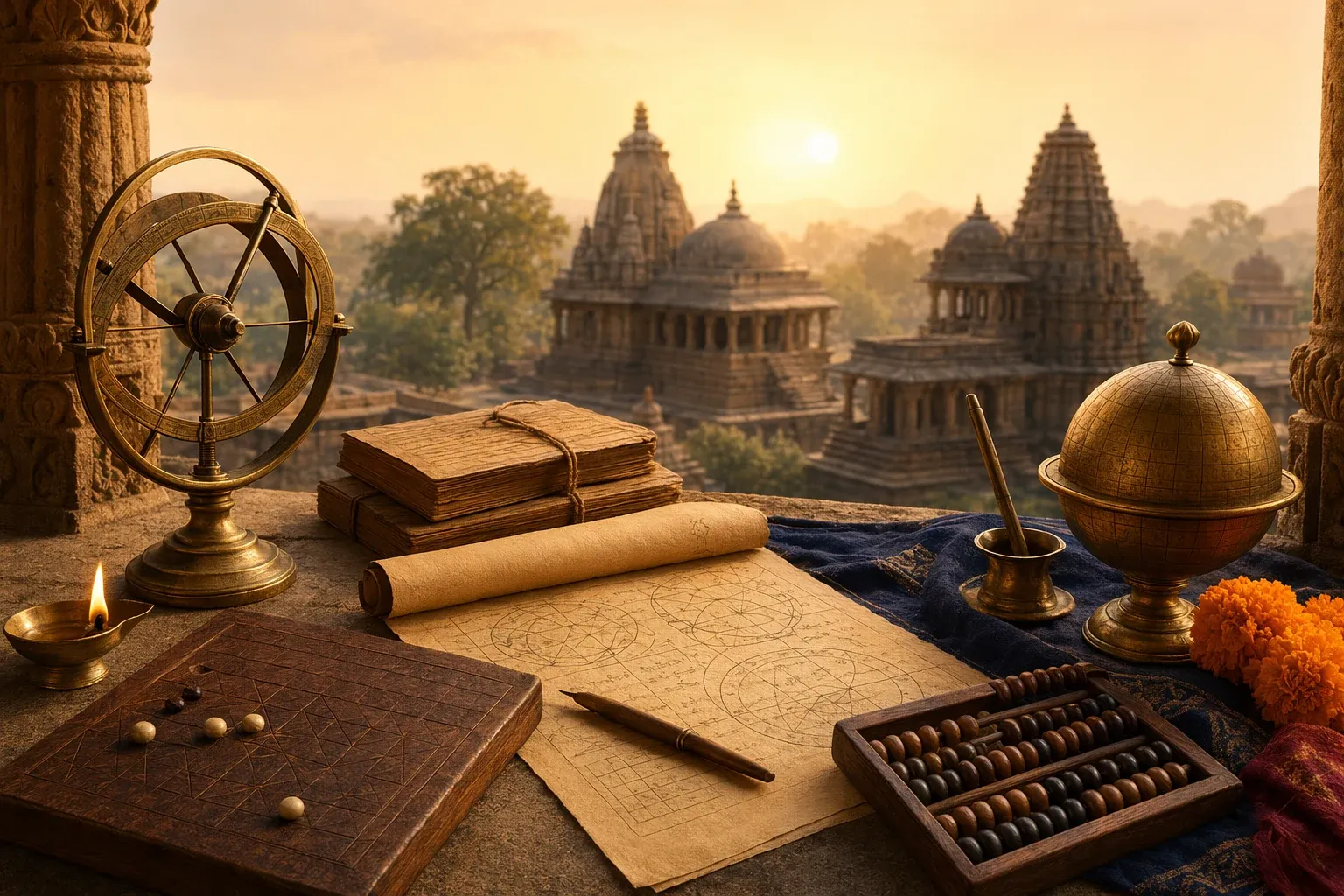
Indian mathematics means the long tradition of mathematical thinking that developed in the Indian subcontinent through counting, calculation, astronomy, trade, education, poetry-like rules, and problem solving. In Sanskrit and many Indian languages, the word ganita simply means calculation or mathematics. That is a good clue: this tradition was not only about abstract theory; it was also about doing useful calculations.
For a beginner, the best way to understand Indian mathematics is not to memorise a list of “firsts”. It is better to see the story as a chain: numbers became easier to write, calculations became easier to teach, astronomy created hard mathematical problems, scholars wrote rules in compact verses, and later mathematicians built new ideas from older methods.
The simple meaning
Indian mathematics is the study of numbers, shapes, measurements, equations, calendars, astronomy-linked calculations, and reasoning as they were developed, taught, and used in India. It includes famous ideas like zero and the decimal place-value system, but it also includes algebraic methods, geometry, trigonometry tables, combinatorics, infinite-series work in the Kerala school, and modern work by mathematicians such as Srinivasa Ramanujan.
It is not one single book, one single period, or one magical secret system. It is a living stream with many periods, languages, schools, teachers, commentaries, and practical needs.
A beginner timeline of Indian mathematics
- Early counting and geometry: people needed numbers for trade, land, ritual measurements, architecture, and daily life. Geometry appears in altar construction and measurement traditions, though beginners should avoid treating every old ritual rule as modern mathematics.
- Classical astronomy and calculation: texts such as Aryabhatiya show how astronomy pushed mathematical calculation. To predict positions, calendars, eclipses, and time, scholars needed arithmetic, geometry, and trigonometry-like methods.
- Zero and place value: the Indian numeral system made calculation more powerful because the value of a digit depended on its position. Zero worked as a placeholder and later as a number with rules.
- Algebra and rules: Brahmagupta and later scholars gave rules for arithmetic, equations, negative numbers, zero, and geometric problems. Some rules were written in verse so students could memorise them.
- Bhaskara and learning texts: Bhaskaracharya’s Lilavati became famous for mathematical problems presented in a poetic teaching style. It shows how mathematics could be both technical and literary.
- Kerala school: mathematicians such as Madhava and later Kerala scholars worked on infinite-series ideas connected with trigonometry and astronomy centuries before modern calculus became formalised in Europe.
- Modern period: Ramanujan showed how Indian mathematical creativity continued into the modern world, especially through number theory, partitions, infinite series, and deep intuition.
Important names to know
- Aryabhata: remembered for astronomy, calculation, place-value usage, approximation methods, and the Aryabhatiya tradition.
- Brahmagupta: important for rules involving zero, negative numbers, equations, and astronomy-linked mathematics.
- Bhaskara I: known for commentary and mathematical astronomy, including work connected with sine approximation.
- Mahavira: associated with Jain mathematical traditions and work on arithmetic and combinations.
- Bhaskaracharya / Bhaskara II: author of works such as Lilavati and Bijaganita, important for arithmetic, algebra, and problem solving.
- Madhava of Sangamagrama and the Kerala school: associated with advanced trigonometric series and astronomy-based mathematical work.
- Srinivasa Ramanujan: modern genius known for number theory, partitions, infinite series, modular forms, and extraordinary formulae.
Real contributions, explained simply
- Decimal place value: the same digit changes value depending on position. In 5, 50, and 500, the symbol is the same but its place changes its meaning.
- Zero: zero made empty place positions visible and later became a number that could be used in rules. This changed calculation forever.
- Arithmetic algorithms: Indian methods helped make addition, subtraction, multiplication, division, and extraction of roots more systematic.
- Algebraic thinking: rules for equations, unknowns, negatives, and problem solving appear in several Indian mathematical texts.
- Trigonometry and astronomy: sine tables, angle calculations, and planetary models needed strong mathematical tools.
- Combinatorics and patterns: Indian scholars explored counting arrangements, metres in poetry, combinations, and structured patterns.
- Infinite-series ideas: Kerala school work shows deep exploration of series linked with trigonometric functions.
What beginners should be careful about
Indian mathematics deserves respect, but respect does not require exaggeration. A good learner should avoid two extremes: claiming every modern discovery was already fully present in ancient India, or dismissing Indian achievements because they do not fit a Europe-only history. The honest middle path is stronger: read the sources, understand the context, and appreciate the real brilliance.
- Do not reduce Indian mathematics only to Vedic Maths shortcuts. Mental calculation is useful, but the historical tradition is much wider.
- Do not believe viral claims without sources, dates, and names of texts.
- Do not confuse mythological symbolism with mathematical proof.
- Do not study only biography. Learn at least one actual idea, example, or method.
How to start learning
- First, learn the big map: zero, decimal system, Aryabhata, Brahmagupta, Bhaskara, Kerala school, and Ramanujan.
- Second, choose one topic: zero, astronomy, Lilavati problems, Vedic Maths shortcuts, or Ramanujan.
- Third, write examples in a notebook. Mathematics becomes real only when you calculate something yourself.
- Fourth, use reliable books and courses instead of random PDFs or social-media claims.
- Fifth, compare Indian ideas with world mathematics. This shows connection, not isolation.
Final takeaway
Indian mathematics is a story of practical calculation, deep observation, teaching skill, and intellectual creativity. Its value is not only that India contributed important ideas to the world. Its deeper value is that it shows how culture, astronomy, language, memory, and reasoning can come together to create knowledge.