
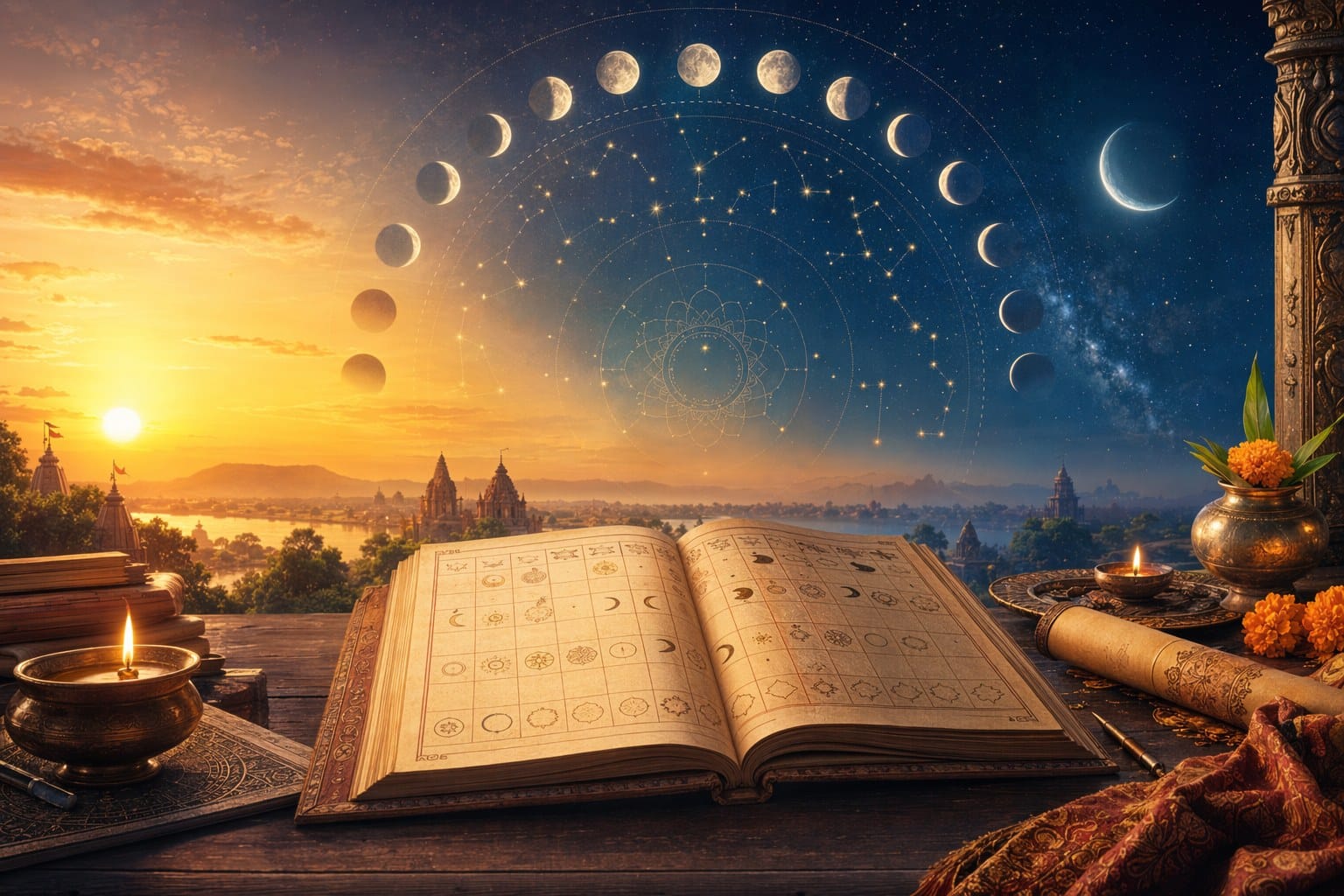
If you have ever opened a Hindu calendar and seen words like tithi, paksha, nakshatra, Chaitra, or Kartik, you are not alone if it felt confusing at first.
The Hindu calendar is not just a list of dates. It is a traditional way of understanding time through the movement of the Moon, the Sun, seasons, festivals, and daily spiritual rhythm.
This beginner guide explains the big words in simple language, so the next time someone says “today is Ekadashi tithi” or “this festival falls in Shukla Paksha,” you actually know what is going on.
What is the Hindu calendar?
In simple words, the Hindu calendar is a traditional Indian calendar system used for festivals, vrat, puja timings, cultural events, and panchang calculations.
Many Hindu calendar traditions are lunisolar. That means they pay attention to both the Moon and the Sun.
- The Moon helps define tithi, paksha, lunar months, and many festival dates.
- The Sun helps keep the calendar connected with seasons and solar movement.
- Regional traditions may follow slightly different rules, so one panchang can differ from another by location or tradition.
This is why the Hindu calendar feels different from the Gregorian calendar used in schools, offices, and government work. The Gregorian calendar mainly uses fixed solar dates like January 1 or August 15. Hindu festival dates often depend on lunar timing.
Hindu calendar vs Panchang: are they the same?
People often use “Hindu calendar” and “panchang” together, but there is a small difference.
A calendar gives you dates. A panchang gives a deeper daily almanac: tithi, weekday, nakshatra, yoga, karana, sunrise, moonrise, paksha, month, muhurat, and more.
The word panchang comes from “pancha” meaning five and “anga” meaning limbs. Traditionally, the five limbs are:
- Tithi — lunar date
- Vara — weekday
- Nakshatra — lunar mansion/star section
- Yoga — a calculated Sun-Moon combination
- Karana — half of a tithi
For most beginners, the first three words to understand are tithi, paksha, and nakshatra.
What is tithi?
A tithi is often called a lunar date. But it is not exactly the same as a normal midnight-to-midnight date.
A tithi is based on the angular distance between the Moon and the Sun. Because the Moon moves continuously, a tithi can begin or end at different times of the day. That is why a festival may sometimes feel like it “shifts” compared with the English calendar.
A lunar month has 30 tithis. Some famous tithis are:
- Pratipada — the first tithi
- Ashtami — the eighth tithi
- Ekadashi — the eleventh tithi
- Trayodashi — the thirteenth tithi
- Purnima — full moon
- Amavasya — new moon
So when someone asks, “Aaj kaunsi tithi hai?” they are asking for today’s lunar date according to the panchang.
What is paksha?
A paksha is a fortnight, or half of a lunar month. Each lunar month is divided into two pakshas of about 15 tithis each.
- Shukla Paksha — the bright/waxing half, when the Moon grows from Amavasya toward Purnima.
- Krishna Paksha — the dark/waning half, when the Moon reduces from Purnima toward Amavasya.
A simple way to remember it: Shukla Paksha is the “Moon getting brighter” phase, and Krishna Paksha is the “Moon getting darker” phase.
Many festivals and vrats are named using tithi plus paksha. For example, “Kartik Shukla Ekadashi” tells you the month, paksha, and tithi.
What is nakshatra?
A nakshatra is one of the 27 lunar mansions or star sections used in Indian astronomy and astrology traditions.
The Moon appears to move through these nakshatras as it travels across the sky. Panchangs list the nakshatra of the day because it is important for many rituals, muhurat decisions, naming traditions, and astrological calculations.
You do not need to memorize all 27 on day one. For beginners, just remember this: tithi tracks the Moon-Sun relationship, while nakshatra tracks the Moon’s position among star sections.
The 12 Hindu month names
Many Hindu calendars use these 12 lunar month names. Spellings can vary slightly in English:
| Order | Month name | Common note |
|---|---|---|
| 1 | Chaitra | Often connected with spring and some New Year traditions |
| 2 | Vaishakha | Associated with warm season observances |
| 3 | Jyeshtha | Summer period in many regions |
| 4 | Ashadha | Monsoon-linked season in many areas |
| 5 | Shravan / Shravana | Important for Shiva worship in many traditions |
| 6 | Bhadrapada | Includes festivals such as Ganesh Chaturthi in many calendars |
| 7 | Ashwin / Ashvina | Navratri and Durga Puja season in many regions |
| 8 | Kartik / Kartika | Diwali period in many calendars |
| 9 | Margashirsha / Agrahayana | Winter-linked month |
| 10 | Pausha | Winter month |
| 11 | Magha | Important for Magh observances |
| 12 | Phalguna | Holi period in many calendars |
Important: month rules are not identical everywhere. Some regions follow Amanta months, where the lunar month ends with Amavasya. Others follow Purnimanta months, where it ends with Purnima. Solar calendars are also important in regions like Tamil Nadu and Kerala.
Why do Hindu festival dates change every year?
This is one of the biggest beginner questions.
Many Hindu festivals are based on tithi, paksha, nakshatra, or lunar month — not on a fixed Gregorian date. Since lunar timing does not match perfectly with the Gregorian calendar, the festival date appears to move each year on the English calendar.
For example, Diwali is connected with Amavasya in the month of Kartik in many traditions. The Gregorian date changes, but the festival logic inside the Hindu calendar remains meaningful.
What is Adhik Maas?
A lunar year is shorter than a solar year. If nothing corrected this, lunar months and seasonal festivals would slowly drift away from their seasons.
To balance this, Hindu lunisolar calendars add an extra lunar month from time to time. This is called Adhik Maas. Think of it as a traditional calendar adjustment that keeps lunar months and solar seasons more aligned.
How to read a Hindu calendar without getting lost
- First check the location, because panchang timings can vary by city.
- Look for the tithi and whether it changes during the day.
- Check the paksha: Shukla or Krishna.
- Check the month name: Chaitra, Kartik, Shravan, etc.
- If planning a ritual, vrat, or muhurat, use a trusted local panchang or consult someone knowledgeable.
For normal learning, understanding the terms is enough. For actual ritual timing, do not depend on a random screenshot or social-media forward.
A simple Bhaktilipi takeaway
The Hindu calendar is a beautiful example of Indian timekeeping. It connects the Moon, Sun, seasons, festivals, and daily life.
You do not need to become a jyotisha expert to understand the basics. Start with four words: tithi is the lunar date, paksha is the bright or dark half of the lunar month, nakshatra is the Moon’s star section, and panchang is the daily almanac.
Once you know these, the Hindu calendar stops looking like secret code and starts feeling like a living cultural map.
FAQs
What is the Hindu calendar in simple words?
The Hindu calendar is a traditional Indian calendar system used for festivals, vrat, puja timings, panchang calculations, and cultural observances. Many Hindu calendar traditions are lunisolar, meaning they use both Moon and Sun cycles.
Is the Hindu calendar lunar or solar?
Many Hindu religious calendars are lunisolar. They use lunar months and tithis, while also using solar correction to stay connected with seasons. Some regional calendars place more emphasis on the solar cycle.
What is tithi in the Hindu calendar?
Tithi is a lunar date based on the angular relationship between the Sun and Moon. A lunar month has 30 tithis, and tithis can begin or end at different times of the day.
What is Shukla Paksha and Krishna Paksha?
Shukla Paksha is the bright/waxing half of the lunar month, from after Amavasya toward Purnima. Krishna Paksha is the dark/waning half, from after Purnima toward Amavasya.
What is nakshatra?
Nakshatra means one of the 27 lunar mansions or star sections used in panchang and Indian astrological traditions. A panchang lists the nakshatra of the day.
What are the 12 Hindu months?
The common lunar month names are Chaitra, Vaishakha, Jyeshtha, Ashadha, Shravan, Bhadrapada, Ashwin, Kartik, Margashirsha, Pausha, Magha, and Phalguna. Spellings and month systems can vary by region.
Why do Hindu festival dates change every year?
Many festivals follow tithi, paksha, nakshatra, or lunar month rules instead of fixed Gregorian dates. Because lunar timing and the Gregorian calendar do not align perfectly, festival dates appear to move each year.
What is the difference between a Hindu calendar and a panchang?
A Hindu calendar shows dates and festival information. A panchang is a detailed daily almanac that includes tithi, weekday, nakshatra, yoga, karana, paksha, lunar month, sunrise/sunset, and other timing details.