
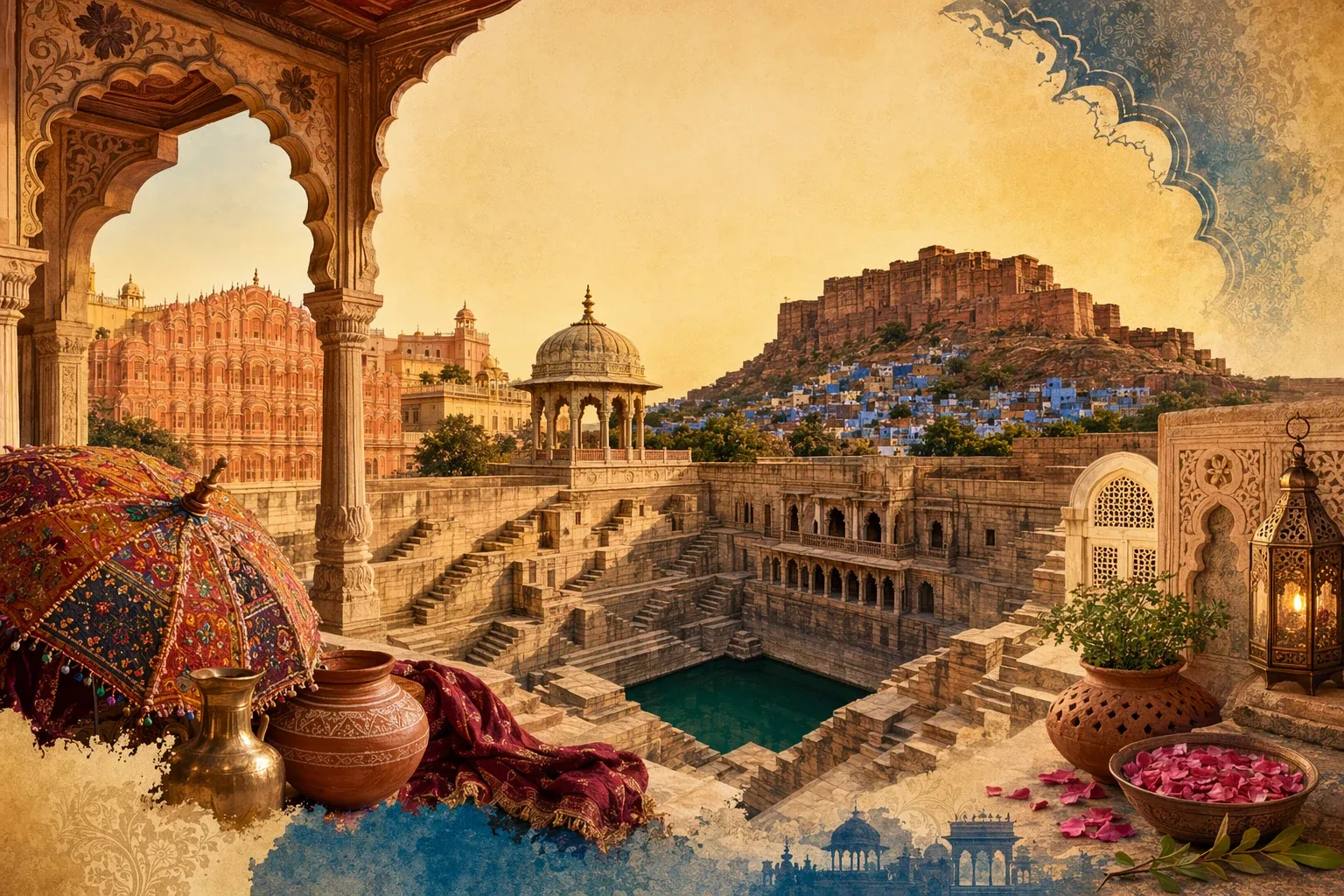
Rajasthan’s stepwells are best understood as desert water wisdom. In a region shaped by heat, dry months, forts, trade routes, villages, and uneven rainfall, water could never be taken casually. The local words baori, bawdi, or baudi often point to stepped wells that helped people reach water, rest in shade, and organise community life around a shared resource.
When readers search for stepwells in Jaipur or Jodhpur, they may be looking for travel spots. That is fine, but the deeper story is not tourism. Rajasthan’s baoris show how architecture responded to climate. They are practical structures first, and heritage monuments because that practical work was done with skill, patience, and sometimes great beauty.
Why Rajasthan needed baoris
Rajasthan includes arid and semi-arid landscapes where water management has always required planning. Rainfall can be seasonal. Summer heat can be intense. Settlements, roads, forts, and markets needed water points that could survive beyond a short rainy period. A baori helped by giving stepped access to water as the level rose or fell.
Unlike a simple open pond, a stepwell allows descent. Unlike a narrow well mouth, it can include stairs, landings, galleries, and shaded spaces. This made it useful not only for drawing water but also for rest, maintenance, and gathering. In a hot region, the ability to descend into a cooler stone space mattered.
Chand Baori and the Jaipur-area imagination
The most famous Rajasthan example for many readers is Chand Baori at Abhaneri in Dausa district, often discussed with Jaipur-area heritage because many travellers approach it from Jaipur. Rajasthan Tourism describes it as one of the state’s old and popular attractions, built to conserve water and provide relief from intense heat. It is known for about 3,500 symmetrical narrow steps and a dramatic three-sided descent toward the water.
Chand Baori also shows how water, architecture, and sacred setting could sit together. The Harshat Mata Temple stands nearby, adding a cultural layer beyond pure engineering. Some sources connect the baori with King Chanda of the Nikumbha dynasty and the 9th century, while also noting that direct evidence for every construction claim should be handled carefully. That balance matters: tradition deserves respect, and history deserves caution.
Jaipur, forts, and water thinking
Jaipur’s wider region is full of water intelligence, even when the famous examples are not always called stepwells. Forts such as Amer used lakes, tanks, channels, and storage systems. Cities and settlements needed wells, kunds, tanks, and baoris. Rajasthan’s built environment often teaches that power was not only about walls and palaces. It was also about managing water.
For a young reader, this changes how Jaipur heritage appears. Hawa Mahal, City Palace, Amer, and markets are the visible postcard. Behind that postcard is a long relationship with water: how to collect it, protect it, lift it, distribute it, and survive heat. Baoris belong to that less glamorous but more life-giving story.
Jodhpur and the memory of jhalras and baoris
Jodhpur is famous for Mehrangarh Fort, blue houses, sandstone, and desert-edge beauty. It also has an important water memory. Local stepped water structures, tanks, and jhalras formed part of the city’s older water landscape. One commonly discussed example in popular heritage conversations is Toorji ka Jhalra, a restored stepwell-like water structure in the old city. Because official source extracts can vary in detail, it is safer to describe it carefully rather than overload it with unsupported claims.
The broader point is clear: Jodhpur’s old urban life depended on water systems, not only royal monuments. Wells, stepwells, tanks, lakes, and channels helped make settlement possible. When people admire the blue city, they should also ask how water was stored and shared in such a climate.
What made Rajasthan baoris practical
A baori works because it follows the water down. As water levels change, steps allow users to descend further. Stone walls hold the earth. Landings create pauses. Pavilions or side spaces may provide shade. In some examples, the geometric pattern becomes visually stunning, but the visual form grows from a practical need.
Rajasthan Tourism’s description of Chand Baori captures this combination well: conservation, heat relief, community gathering, geometry, steps, and a pavilion side. Those details show that a baori was not merely a hole. It was a designed environment, with movement, cooling, social use, and water access working together.
Women, travellers, and everyday users
In many traditional communities, collecting water shaped daily routine, especially for women. A baori could become a place of labour, conversation, news, ritual, and rest. Travellers might stop there. Local rulers or wealthy patrons could support such structures as public service. Royals might use or sponsor them, but their daily meaning belonged to ordinary people.
This is why stepwells should not be described only as royal art. They were used by bodies carrying pots, walking in heat, meeting neighbours, and managing household needs. The beauty of a baori is tied to this everyday life.
How many stepwells are there in Rajasthan?
People often ask for an exact count, but it is difficult to give one careful number. Rajasthan has many old wells, baoris, kunds, tanks, and local water structures, and documentation differs by district, condition, and definition. Some are protected monuments. Some are restored. Some are neglected or absorbed into urban spaces. Some may be known locally but not widely listed in official tourist material.
Instead of chasing a viral number, it is better to learn district by district. Ask whether a structure is a baori, a kund, a tank, or another local form. Check whether it is protected, whether visitors are allowed, and whether the site still has a living community around it. Heritage is not only counting; it is understanding.
Questions people ask
What are stepwells in Rajasthan called?
In Rajasthan, stepwells are often called baori, bawdi, baudi, or related spellings. The exact spelling may change with local speech and English transliteration.
Which stepwell is near Jaipur?
Chand Baori at Abhaneri in Dausa district is commonly visited from Jaipur and is one of Rajasthan’s best-known stepwells. It is famous for its deep geometric steps and water-conservation purpose.
Are there stepwells in Jodhpur?
Yes, Jodhpur’s older water landscape includes stepped water structures, tanks, and jhalras. Toorji ka Jhalra is often discussed as a restored old-city example, but details should be checked carefully before making exact historical claims.
How many stepwells are there in Rajasthan?
There is no simple reliable public number for all Rajasthan stepwells because definitions and documentation vary. Rajasthan has many baoris and related water structures across districts.
The lesson from Rajasthan
Rajasthan’s stepwells teach that water management is culture. A baori is not separate from desert life; it belongs to it. It answers heat with shade, scarcity with storage, changing water levels with steps, and loneliness with a gathering place. It also reminds us that public infrastructure can be beautiful without losing its purpose.
For Bhaktilipi readers, the deeper lesson is simple: heritage is useful memory. Rajasthan’s baoris are not only old attractions. They are reminders that earlier communities observed their land closely and built with responsibility. In an age of water stress, that wisdom deserves more than a quick photo. It deserves attention, respect, and care.